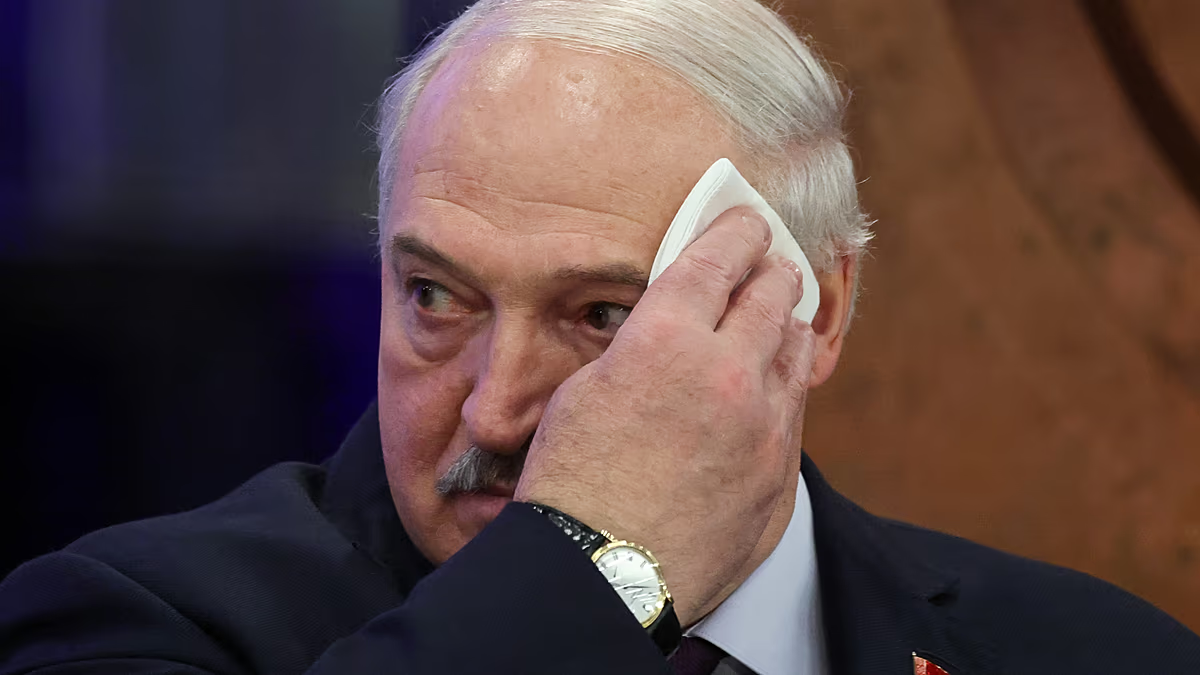


In the complex and often perilous diplomatic landscape surrounding the ongoing war in Ukraine, a notable and somewhat contradictory statement emerged from Belarusian leader Aliaksandr Lukashenka. Addressing recent tensions, Lukashenka asserted that his country poses no military threat to Ukraine, framing his earlier, more bellicose comments as merely a response to perceived provocations from Kyiv. He extended a specific, if conditional, apology to Ukrainian President Volodymyr Zelenskyy, stating, “If (Ukrainian President) Volodymyr Oleksandrovych (Zelenskyy) was offended, I apologise to him for these words.” However, this gesture was immediately diluted by qualification and condescension. Lukashenka suggested that perhaps he should not have spoken so bluntly given Zelenskyy’s wartime circumstances, but then invoked the adage “you reap what you sow,” shifting blame back onto the Ukrainian leadership. He argued that Zelenskyy, whom he dismissively labeled “young and inexperienced” and “not a military man,” should be more careful in his statements to avoid provoking Minsk. This convoluted message—simultaneously offering an apology, undermining it, and issuing a patronizing warning—highlights the delicate and fraught position Lukashenka occupies as a key Russian ally seeking to manage his own regime’s security without fully committing his limited forces to the front lines.
Lukashenka’s statements did not emerge in a vacuum but were direct reactions to escalating concerns from Ukrainian officials about the potential for a renewed northern front. For months, Kyiv has voiced growing alarm that Belarus could be drawn deeper into Russia’s war. President Zelenskyy articulated this concern pointedly in May, stating that Ukraine is prepared to take “preventive” measures against both Moscow and the Belarusian leadership. This warning came amidst heightened regional tensions, including joint Russia-Belarus nuclear exercises and a series of provocative drone incursions over NATO members in the Baltic region, which Western officials have linked to Russian operations from Belarusian territory. Furthermore, Zelenskyy revealed in April that, according to Ukrainian military intelligence, Belarus was actively enhancing military infrastructure near the border, including building roads and establishing artillery positions directed toward Ukraine. These developments painted a picture of a slow but steady militarization of the Belarusian-Ukrainian frontier, raising legitimate fears of a potential new axis of attack or increased logistical support for Russian forces from Belarusian soil.
The Ukrainian military has made it clear that it is not merely observing these developments but actively preparing contingency plans. In a stark and public warning, Commander of Ukraine’s Unmanned Systems Forces, Robert Brovdi (call sign “Magyar”), stated that his forces had already identified “500 potential targets” within Belarus. His social media message to Minsk was unambiguous: “The first 500 targets have already been identified. Free and very practical advice: do not stick in Ukraine’s craw.” This declaration signaled that Ukraine would not wait passively for a threat from the north to materialize; instead, it possesses both the reconnaissance capability to mark strategic sites and the demonstrated drone strike capacity to engage them preemptively if necessary. Brovdi’s warning served as a powerful deterrent, underscoring that any escalation by Belarus would carry immediate and severe consequences. It was this explicit threat of Ukrainian retaliation that prompted Lukashenka’s initial, aggressive response, in which he threatened to strike a “very serious” target in Ukraine, before his subsequent pivot to the more conciliatory, albeit begrudging, apology.
The dynamic between Lukashenka’s bluster and his backtracking reveals the immense pressure he faces from two opposing forces. On one side is his total political and military dependence on Russian President Vladimir Putin, whose war effort could benefit significantly from a more active Belarusian involvement. On the other side is the stark reality of a resolute and battle-hardened Ukrainian military that has proven capable of striking deep behind enemy lines. Lukashenka’s regime, while authoritarian, is also acutely aware of the potential domestic instability that could arise from committing Belarusian troops to a costly and unpopular foreign war. His rhetorical dance—threatening one day, apologizing the next—is a strategy of precarious balance. He must maintain his value to the Kremlin by appearing belligerent and supportive, while simultaneously trying to avoid actions that would trigger devastating Ukrainian counterstrikes or plunge his own country into direct conflict. The apology to Zelenskyy, however insincere, can be seen as an attempt to de-escalate a situation that was spiraling toward a direct confrontation he cannot afford.
The reaction from the Belarusian democratic opposition, led by Sviatlana Tsikhanouskaya, framed Lukashenka’s apology not as a diplomatic gesture but as a symptom of weakness exposed by Ukrainian resilience. Tsikhanouskaya interpreted the event as a significant moral and political victory, stating, “First, Lukashenka called on Ukraine to surrender. Now he is ‘apologising’ to President Zelenskyy. This is what Ukraine’s strength has done. It exposed the weakness of a dictatorship built on lies, fear and dependence on Putin.” Her analysis cuts to the core of the situation: Lukashenka’s power is derivative and fragile, reliant on Russian support and internal repression. Ukraine’s fierce resistance has forced the Kremlin’s clients, including Lukashenka, into uncomfortable positions. However, Tsikhanouskaya was also quick to add a crucial caveat, noting that “No staged apology can erase complicity in aggression.” This serves as a vital reminder that Belarus remains deeply culpable, having provided its territory as a launchpad for the initial invasion in February 2022 and continuing to offer logistical, military, and political support to Russia’s war machine, now well into its fifth year.
Ultimately, this episode is a microcosm of the wider conflict, where military posturing, diplomatic signaling, and information warfare are inextricably linked. Lukashenka’s contradictory statements reflect the calculations of a dictator trapped between his powerful patron’s demands and the formidable deterrent power of a defending nation. For Ukraine, the exchange validates its strategy of combining military preparedness with clear, public messaging to deter further aggression along its northern border. The identification of 500 targets in Belarus and the public warning issued by Commander Brovdi represent a modern form of deterrence—transparent, precise, and backed by proven capability. While Lukashenka’s “apology” does little to change the fundamental reality of Belarus’s alliance with Moscow, it demonstrates that Ukrainian strength can impose caution even on neighboring regimes aligned with the Kremlin. The ongoing vigilance in Kyiv underscores that, despite the rhetorical de-escalation, the threat from the north remains a persistent concern in a long war where fronts can reignite, and alliances can be tested at a moment’s notice.