


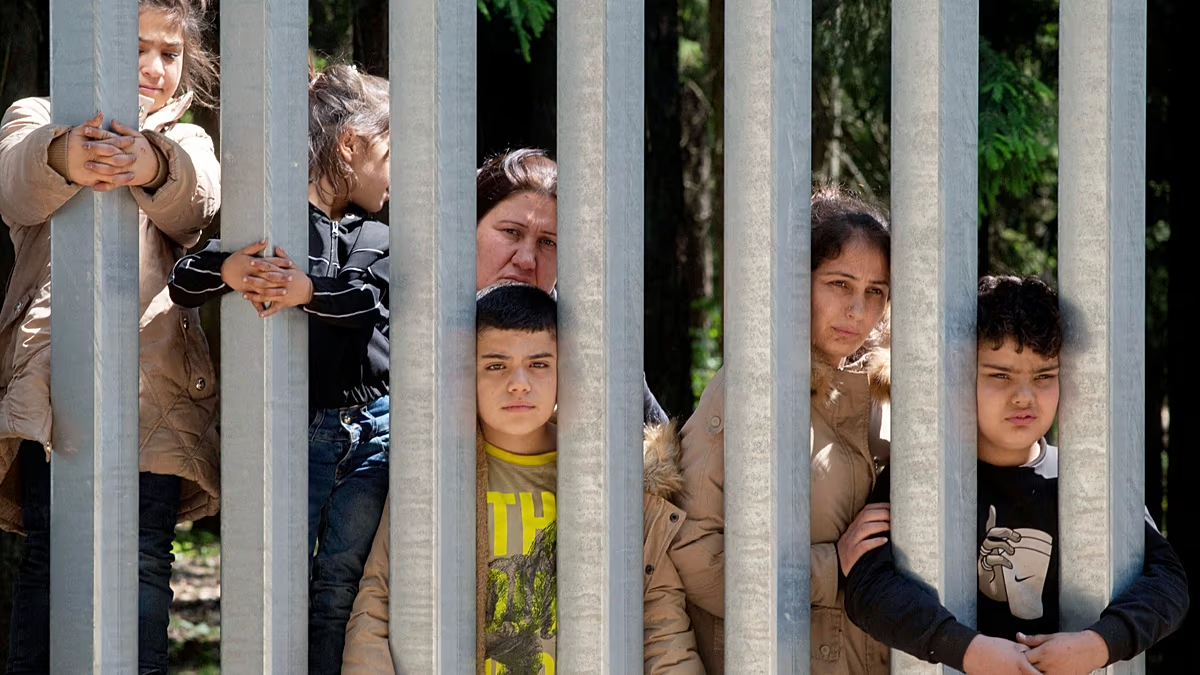
After years of arduous negotiation, the European Union’s new Pact on Migration and Asylum has become operational, marking a significant milestone in the bloc’s long-standing effort to overhaul its approach to migration. Adopted in May 2024 and entering into force on June 12, the comprehensive package aims to strengthen border procedures and reform an asylum system that has been under immense strain for nearly a decade. The pact emerges as a direct response to a recurring crisis, where frontline states like Italy, Greece, Spain, and Cyprus have borne a disproportionate burden, receiving the majority of migrants and asylum seekers arriving by land and sea. Its core ambition is to foster a more unified and predictable European response, moving away from the ad-hoc solutions and political friction that have characterized the past.
At the heart of the new system is a pioneering “solidarity mechanism,” designed to ensure a fairer sharing of responsibilities among all 27 member states. Under the previous rules, the country of first entry was primarily responsible for processing asylum claims, a policy that placed intense pressure on southern border nations. The new pact replaces this with a principle the European Commission calls “mandatory but flexible solidarity.” Crucially, while every member state is required to contribute, the form of that contribution is not one-size-fits-all. Solidarity can be demonstrated through several avenues, including the relocation of asylum seekers to other countries, financial support, or providing operational resources like border guards and equipment.
It is within this flexible framework that a specific figure—€20,000—has become a flashpoint for misinformation and political debate. Certain politicians, notably from France’ s far-right National Rally, have portrayed this amount as a punitive fine levied against countries that refuse to accept migrants. Party leader Marine Le Pen claimed the pact would force member states to welcome migrants “under the penalty of fines.” However, this characterization is misleading and strips the mechanism of its essential context. The €20,000 sum is not a fine but an alternative contribution option: a member state that chooses not to participate in the voluntary relocation of asylum seekers may instead make a financial contribution of €20,000 per person not relocated, with those funds directed to support nations under the greatest pressure.
This distinction is vital. The pact does not impose a top-down quota system with financial penalties for non-compliance. Instead, it offers a menu of solidarity choices, granting governments discretion to decide how best to contribute based on their domestic circumstances and political realities. A European Commission spokesperson confirmed that member states have “full discretion to choose from any of these solidarity measures.” The financial contribution is thus one pathway among equals, intended to ensure that all nations support the common system, whether through direct hosting, financial aid, or operational assistance. The funds generated are meant to be a constructive tool for burden-sharing, not a punitive measure.
The initial implementation of the pact has already revealed the enduring political sensitivities around migration. According to the regulation’s text, the solidarity mechanism aims to cover at least 30,000 relocations, backed by at least €600 million in financial contributions. Yet, as reported by Euronews, the early pledges from member states for the year 2026 fall short of this ambition, with commitments for fewer than 9,000 relocations. This gap indicates a clear preference among many governments for financial contributions or other forms of support over directly accepting asylum seekers. It underscores a continued reluctance toward large-scale relocation programs and highlights the challenges in building political consensus, even under a reformed system.
In conclusion, the EU Pact on Migration and Asylum represents a hard-won compromise, seeking to balance the urgent needs of frontline states with the political realities across the continent. Its solidarity mechanism is a novel attempt to inject flexibility and shared responsibility into a deeply divisive issue. While the debate over the €20,000 contribution reveals how easily complex policies can be misrepresented for political gain, the pact’s true test will lie in its practical application. Can this framework, with its blend of mandatory participation and flexible options, foster genuine cooperation and alleviate the pressures on Europe’s borders? The coming years will determine whether this new chapter leads to greater stability or simply lays bare the profound difficulties of achieving a unified European migration policy.