


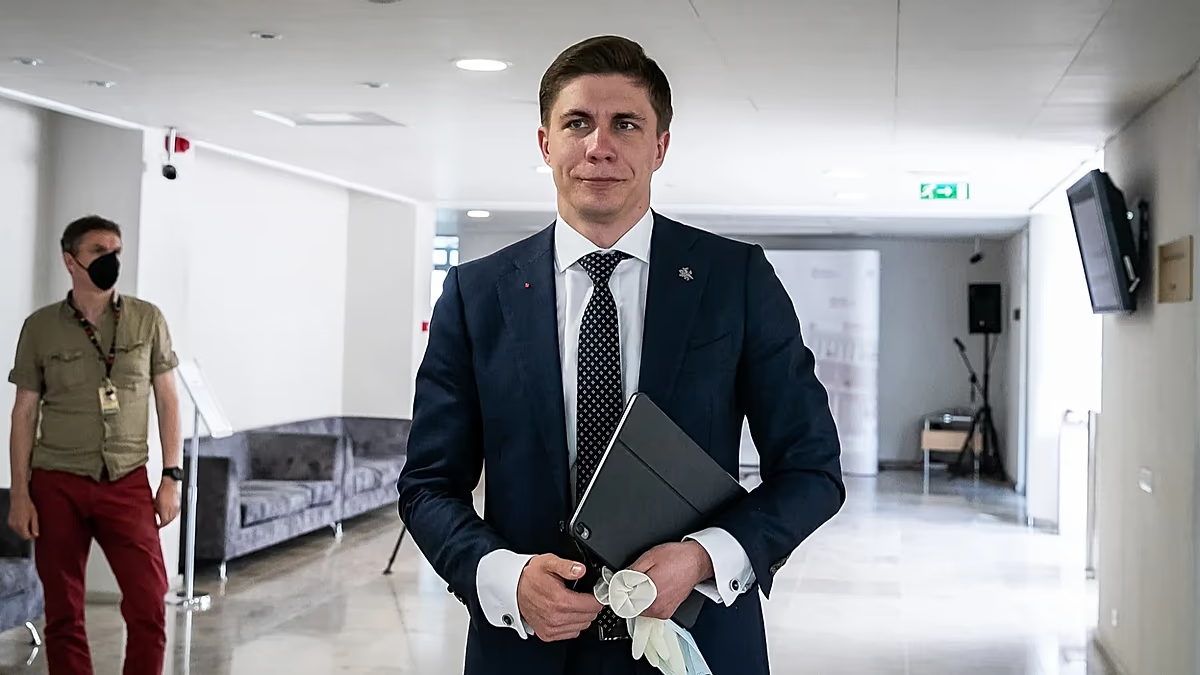
Lithuania stands at a pivotal moment of political recalibration, as Mindaugas Sinkevičius prepares to assume the role of Prime Minister. This transition marks the third change in government leadership since the Social Democrats’ election victory in 2024, underscoring a period of notable instability. The reshuffle is directly triggered by the expulsion of the populist Dawn of Nemunas party from the ruling coalition, a move led by Sinkevičius himself. In a public commitment on social media, the incoming leader acknowledged the weight of public expectation, signaling his intent to steer the nation toward a more predictable and steady course. This change represents not merely a swap of personalities, but a strategic effort to reset the government’s direction and restore public confidence after a turbulent period.
The departure of the outgoing Prime Minister, Inga Ruginienė, comes under a cloud of controversy, primarily for violating the law by bringing family members on official state visits. Her tenure, which began in August 2023, was also marred by criticism over her handling of a sensitive data leak from the national Centre of Registers. Ruginienė had herself replaced Gintautas Paluckas, who resigned amid allegations of unethical financial dealings. This pattern highlights a governing coalition that has struggled with ethical scandals, creating a perception of dysfunction and eroding trust. The decision to remove the Dawn of Nemunas from the coalition is, therefore, framed by Sinkevičius as a necessary step to halt this cycle of “political noise” and prioritize stability and clear governance for the Lithuanian people.
The core of this political realignment lies in the fractious relationships within the original ruling coalition. Following the 2024 elections, the Social Democrats governed alongside the Dawn of Nemunas and the Democratic Union “For Lithuania.” This alliance proved unstable, with the Democrats withdrawing in protest against the populists nearly a year ago. In a contentious move, the Social Democrats then replaced the Democrats with the Farmers and Greens Union and the Electoral Action of Poles in Lithuania, only to now reverse course. The return of the Democrats “For Lithuania” to the fold, and the simultaneous ejection of Dawn of Nemunas, completes a significant political circle. Sinkevičius justified the expulsion by citing the radicalizing trajectory of Dawn of Nemunas leader Remigijus Žemaitaitis, who has been convicted for antisemitic statements and barred from accessing classified information.
With the new coalition agreement set to be formalized, the distribution of ministerial portfolios reflects the re-established partnership. The Social Democrats, as the largest parliamentary force, will retain control over nine key ministries, including defense, finance, and foreign affairs. The returning Democrats “For Lithuania” will take charge of three: health, agriculture, and energy. The Farmers and Greens Union, alongside their allies, will maintain their hold on the economy and justice ministries. Sinkevičius has indicated that while some cabinet changes are anticipated, they will not be extensive, suggesting a desire for continuity in governance amidst the political restructuring. This arrangement aims to create a more cohesive and less controversial government than its immediate predecessors.
The human dimension of this political shift involves the futures of the key players. Inga Ruginienė is expected to resign as Prime Minister upon the signing of the new coalition agreement, yet her political journey is not over. Sinkevičius has stated she will remain “an important member of the team,” leaving her specific role open to speculation but ensuring she stays within the Social Democrat fold. Meanwhile, parliamentary stability is bolstered by the expected continuation of Juozas Olekas as Speaker of the Seimas. For Remigijus Žemaitaitis and the Dawn of Nemunas, the move to opposition represents a sharp rebuke, though he has expressed frustration at not receiving what he considers clear reasons for his party’s ouster.
In conclusion, the ascent of Mindaugas Sinkevičius to the premiership symbolizes a concerted effort by Lithuania’s dominant Social Democrats to draw a line under a chapter of scandal and instability. By reforging an alliance with the more mainstream Democrats “For Lithuania” and severing ties with a problematic populist partner, the party seeks to project an image of responsibility and focused leadership. The incoming government’s greatest challenge will be to translate this political reset into tangible governance that addresses public concerns and restores faith in the country’s institutions. The coming months will reveal whether this reshuffle truly marks the beginning of a more stable and effective era for Lithuanian politics.