


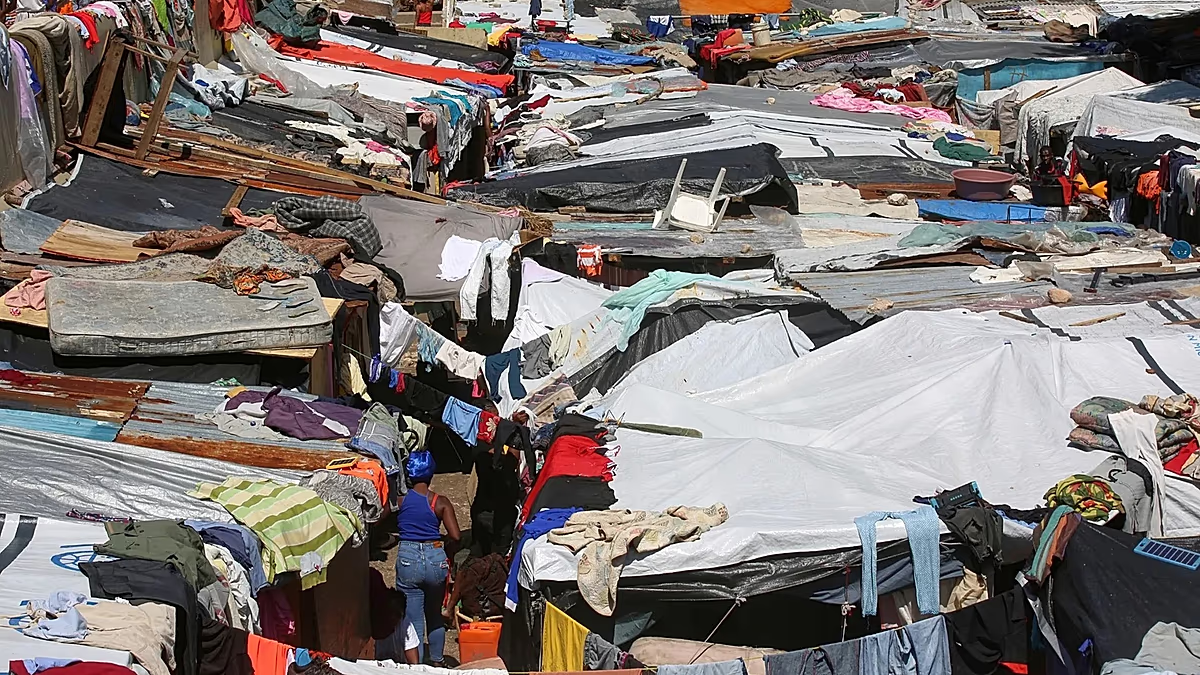
In a stark testament to a nation in crisis, United Nations Secretary-General António Guterres undertook a sobering one-day visit to Port-au-Prince, Haiti, this week. His arrival came against a backdrop of harrowing statistics: since the start of the year, gang violence has claimed over 2,300 lives, led to 100 kidnappings, and, most devastatingly, displaced 1.5 million people—more than one in ten Haitians. The urgency of his mission was underscored by a recent weekend of bloodshed in the Cité Soleil slum, where over 30 people were reported killed, injured, or missing. Guterres’s convoy moved through a cityscape scarred by conflict, passing decimated buildings pockmarked with bullet holes and graffiti denouncing the powerful gang federation, Viv Ansanm, which controls an estimated 70% of the capital. From his window, he witnessed the human cost of this turmoil: families living under makeshift canvas shelters, among the over 300,000 displaced in Port-au-Prince alone, their lives upended by relentless terror.
The Secretary-General’s first official stop was symbolic of the international response: the headquarters of the new multinational security support force approved by the UN Security Council. This force, intended to replace an earlier underfunded and understaffed mission, is slowly taking shape with contributions from nations like Jamaica, Chad, El Salvador, and Guatemala, though its current numbers fall below a thousand. The hope is that this force, expected to commence operations soon, will bolster Haiti’s own National Police and nascent Armed Forces. Hundreds of hopeful Haitian recruits lined dusty roads, seeking to join the effort to reclaim their country. Guterres then met privately with Prime Minister Alix Didier Fils-Aimé, who leads a transitional government grappling with the immense pressure to restore democratic order in a nation that has been without a president since the assassination of Jovenel Moïse in 2021. The Prime Minister emphasized that security is the paramount priority to enable elections and a return to “republican rule,” urging Guterres to ensure supporting nations fulfill their commitments.
However, the most poignant moments of the visit occurred not in meeting rooms, but in a former school turned overcrowded shelter. Here, Guterres confronted the raw, human reality of the displacement crisis. Dozens of families, some having lived within these walls for up to four years after fleeing gangs that shot and burned their communities, crowded around him. In a hot classroom, he listened as a group of women spoke of the profound indignities of their daily existence—a complete lack of privacy for showering or using the bathroom, the constant worry for their children’s safety in such an environment. “It’s skin-to-skin and mouth-to-mouth,” one woman lamented, describing the oppressive closeness of over 1,200 people sleeping side-by-side, sustained by only one guaranteed meal a day. Their words painted a picture of survival, not life.
The desperation within the shelter erupted as Guterres prepared to leave. A man began pounding on the metal siding of the building, his voice rising in a furious, plaintive cry: “We want to go back home!” His outburst, a powerful expression of collective anguish, cut to the heart of the crisis. For residents like 26-year-old Wendy Cejour, who has lived at the school for a year and a half, a fragile hope persists, but it is tempered by profound hardship. “We ask…to return to our neighbourhood to live better,” he told the Associated Press, “because we don’t have a life here.” This sentiment echoes across Haiti, where displacement is not a temporary inconvenience but a protracted state of suspended animation, eroding dignity and futures.
Ahead of Guterres’s visit, Human Rights Watch issued a crucial warning, stressing that security interventions alone are insufficient to heal Haiti. In a letter to the Secretary-General, the organization called for a “full-fledged UN mission” and a strategy that addresses root causes. They argued that any effective plan must extend beyond policing to include concrete protections for victims, credible pathways for gang members to disengage, rigorous accountability for human rights abuses, and a robust humanitarian response to restore access to basic goods and services. This holistic view recognizes that defeating gangs requires not only reclaiming streets but also reclaiming hope, offering alternatives, and rebuilding the social and economic fabric that violence has torn asunder.
As his plane departed, António Guterres left behind a nation balanced on a knife’s edge. His declaration on social media that “the situation can be turned around” stands as both a promise and a formidable challenge. The path forward hinges on the swift and fully-resourced deployment of the international security mission in partnership with Haitian institutions. Yet, as the testimony from the shelter so heartbreakingly revealed, true success will be measured not just in quelling violence, but in enabling Wendy Cejour and hundreds of thousands like him to safely return home and finally resume a life of peace, privacy, and possibility. The world’s response must match the scale of both the humanitarian catastrophe and the human resilience it seeks to support.