



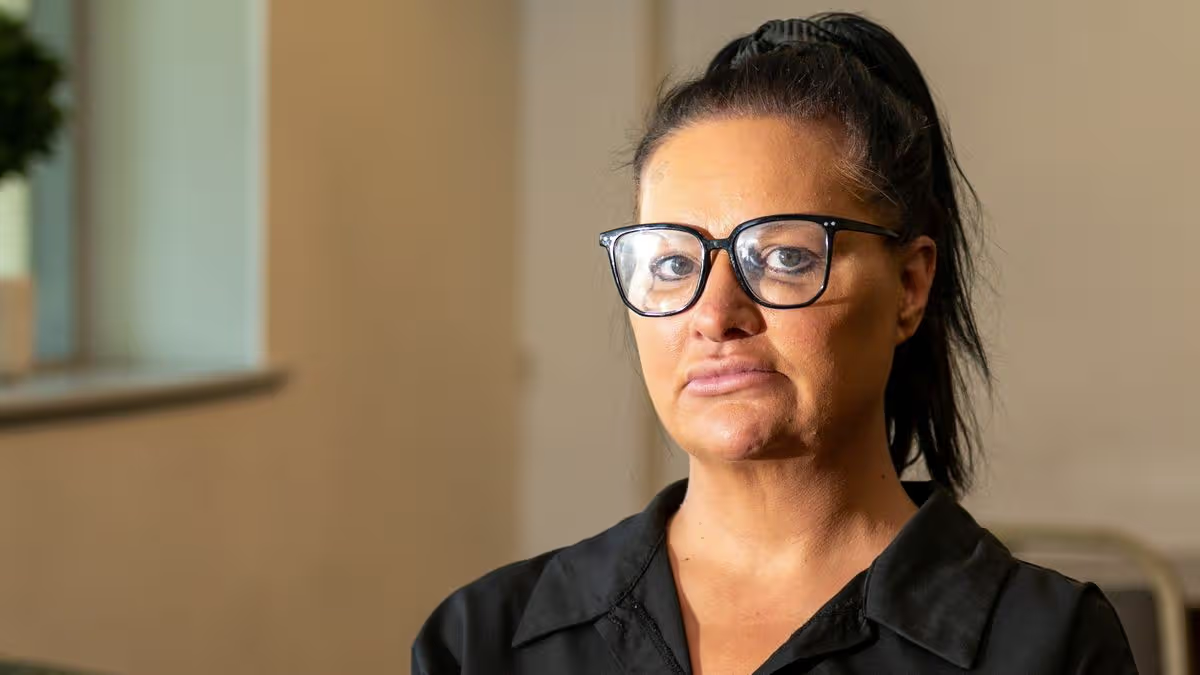
Caroline Willgoose knows the specific, shattering sound a community makes when a child is killed at school. It is a sound she has heard twice: first in the personal, unbearable silence that followed the murder of her 15-year-old son, Harvey, in his school courtyard in February 2025, and again this week, echoing from a secondary school in Blackley, Manchester. On Tuesday, the news broke of another stabbing at a school—two 14-year-old pupils and a 27-year-old staff member attacked, a 14-year-old girl arrested. For Caroline, the distance between Sheffield and Manchester collapsed in an instant. The familiar, dreadful script had played out again: the emergency vehicles, the terrified students, the shaken community, and somewhere, a family plunged into a nightmare she knows intimately. “It horrified me,” she said, her words heavy with a grief that is both old and newly raw. To her, these are not isolated tragedies, but relentless outbreaks of the same disease. “Knife crime,” she stated, “is a pandemic.”
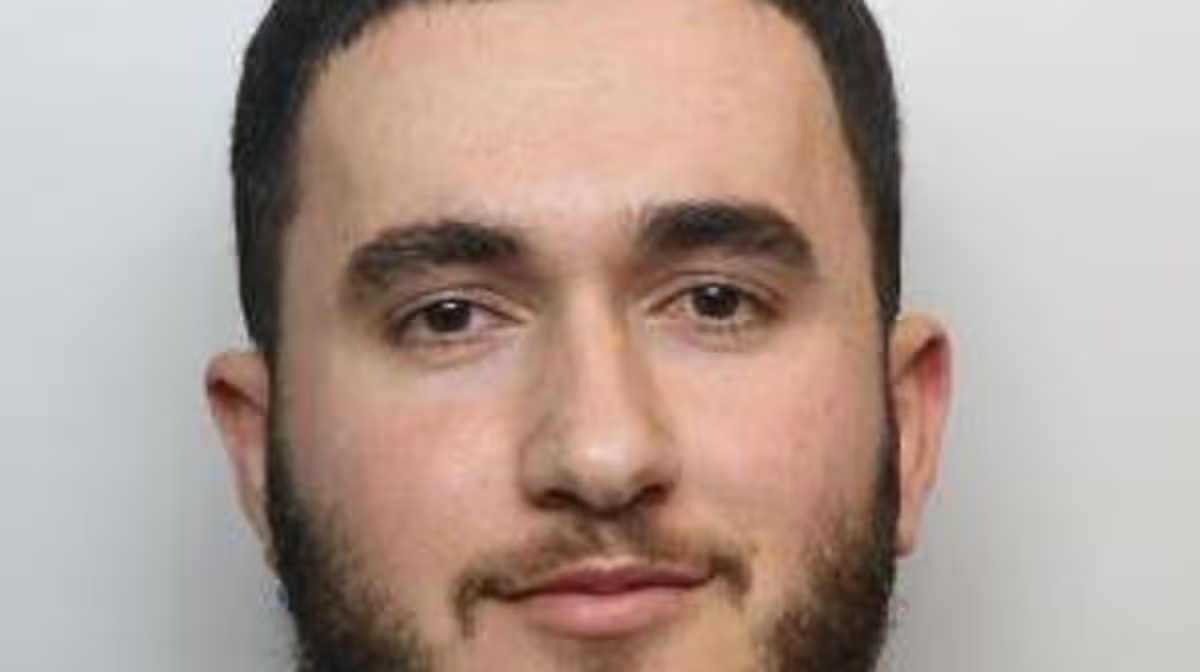
Caroline’s son, Harvey, was murdered by a former friend in a moment of senseless violence at All Saints Catholic High School. He lost consciousness and died within a minute from two fatal stab wounds. His killer, a fellow 15-year-old, is now serving a life sentence. In the weary, determined year since Harvey’s death, Caroline has transformed her anguish into a national campaign, crisscrossing the country to plead for one specific, tangible measure: the installation of metal detector arches in every school. She argues with the fervent logic of a mother who has seen the unthinkable happen in a place of supposed safety. “They should have gone into all schools as soon as what happened to Harvey,” she insists. Her campaign is not born of a desire to turn schools into fortresses, but from a desperate need to create a fundamental barrier, a chance to intercept a weapon before it can claim another young life and shatter another family.
The attack in Manchester felt like a grim validation of her fears and her mission. “How many times do students or teachers need to get injured before action is taken?” she asked, her question a mixture of sorrow and frustration. She is acutely aware of the misconceptions that surround knife crime, the dangerous assumption that it is solely a “gang-related thing” confined to city streets after dark. Harvey’s death, and now this latest incident, brutally dismantle that myth. The violence has moved inside the school gates, between classmates, in corridors and courtyards meant for learning and friendship. This, Caroline stresses, is what makes it a pandemic—it is pervasive, unpredictable, and claiming lives in the very spaces where children should feel most secure. The trauma, she notes, radiates far beyond the victim, infecting the entire school ecosystem. “Teachers at the school Harvey was killed feared for themselves,” she revealed. “Why should teachers and pupils be going into school and not feeling safe?”
Caroline’s appeal is directed squarely at the powers that be—the government and educational bodies she believes have failed to act with the urgency the crisis demands. “When are the government and school bodies going to listen?” she implores. There is a chilling resignation in her observation, “It doesn’t surprise me anymore to read about attacks in schools, if anything, I expect it now.” This normalization of school-based violence is what she is fighting against. Her call is for preventative leadership, for those in authority to “step in now and take control of the situation.” She underscores the profound tragedy that spans both sides of such events: a family mourns a child forever, while another child is lost to the justice system. “How sad is it that the pupil who killed Harvey is suffering in prison,” she reflects. “I think he should be, but it is tragic.” Her perspective acknowledges the complex, wholesale ruin that a single blade can cause.
Alongside her policy demands, Caroline speaks directly to parents, urging a difficult but necessary conversation. She advises them to ask their children a simple, direct question: have you seen or heard of someone having a knife in school? “I am sure they will be surprised by what they have to say,” she suggests, pointing to a hidden reality that may exist beneath the surface of school life. For her, awareness is the first step toward safety. Every new headline about a school stabbing, like the one in Manchester, is a brutal blow. “Reading about school stabbings opens up old wounds for me,” she admits. Her heart breaks not only for the victims but for the collective fear that settles over a school community in the aftermath—the pupils and teachers who walk in scared, the parents who kiss their children goodbye with a newfound dread.
In Manchester, police sought to provide reassurance after Tuesday’s attack. Chief Inspector Jon Shilvock confirmed the incident was “swiftly and quickly dealt with by staff,” and that there was believed to be no wider threat, with officers remaining for a visible presence. While such statements aim to calm public fear, for Caroline Willgoose, they are a temporary response to a permanent problem. The visible police presence arrives after the fact; her campaign is about preventing the fact from occurring at all. Her voice, forged in unimaginable loss, continues to rise above the cycle of shock, response, and gradual forgetting. She stands as a testament to the enduring cost of inaction, a mother advocating not just for the memory of her own son, but for every child who walks through a school gate, and for every parent who trusts that they will walk back out safely at the end of the day. The pandemic, she warns, is still raging within our school walls, and until decisive, systemic action is taken, the community will keep hearing that terrible, familiar sound.