



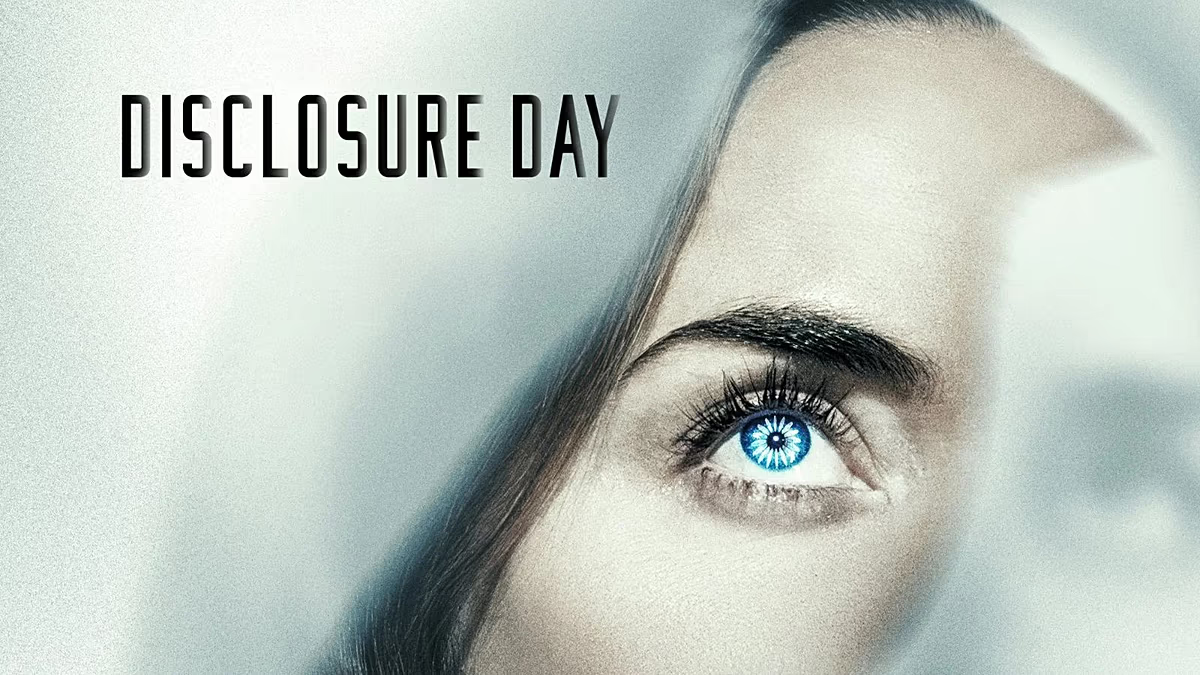
The concept of extraterrestrial life is deeply woven into the cinematic legacy of Steven Spielberg, a filmmaker who has spent decades shaping our collective imagination of first contact. From the wondrous musical dialogue of Close Encounters of the Third Kind to the heartfelt bond in E.T., from the harrowing invasion in War of the Worlds to the ancient mysteries in Indiana Jones and the Kingdom of the Crystal Skull, his work has presented a spectrum of possibilities. Now, with his latest film Disclosure Day focusing on a government conspiracy to hide alien truth, Spielberg himself has voiced a personal conviction. In a recent interview, he stated that based on a lifetime of absorbing testimonies and evidence, he believes extraterrestrials have visited Earth and may even be here now. This belief from such a definitive pop culture architect naturally leads to a profound question: if they are among us, what form might they take?
Our most common mental image—a humanoid figure with a large head and eyes—says more about us than about any potential cosmic visitor. This anthropomorphic tendency is a comfort, a way to render the utterly unknown in familiar terms, a template endlessly reinforced by popular media. Cinema itself has established a visual shorthand, from George Méliès’ moon dwellers to the “greys” of The X Files. Yet, the most compelling and often terrifying alien depictions are those that break from this mold, destabilizing our expectations and forcing us to confront the genuinely incomprehensible. These innovative visions challenge the very framework through which we anticipate contact, suggesting that alien life might be so fundamentally different that it bypasses our terrestrial categories of anatomy, motive, and even consciousness.
Some films have conjured aliens of such radical simplicity that they become uniquely horrifying. The 1958 classic The Blob presented extraterrestrial life as an amorphous, ever-consuming goo—a shape without limits. Its sheer, indefinable nature, a metaphor for creeping existential threats of its era, sparked a primal fear of the formless. Similarly, Stanley Kubrick’s 2001: A Space Odyssey offered not a creature, but a monolith: a silent, geometric enigma representing alien influence so advanced it transcends physical representation. This approach taps into a Lovecraftian dread of the truly unknowable, suggesting that our minds cannot encompass the reality of a vastly superior intelligence. These depictions remind us that alien life might not be a “who” to communicate with, but an “it” to be weathered—a force or a phenomenon.
Other narratives explore the horror of infiltration, where the alien threat lies in its perfect deception. John Carpenter’s The Thing stands as a pinnacle of this idea, featuring an organism with no true shape of its own, capable of grotesquely mimicking any life it absorbs. The resulting paranoia—the fear that trust and identity are meaningless—is far more terrifying than any overt monster. In a different register, Alex Garland’s Annihilation presents contact not as an invasion but as an ambient, indifferent process. The alien presence in The Shimmer is a terraforming entity, a biological prism that refracts and combines all DNA within its reach. It has no malicious plan; it simply is, performing its function and rendering our questions of motive irrelevant. This concept of a passive, transformative force is perhaps one of the most scientifically plausible and philosophically unsettling visions of all.
When filmmakers do envision a tangible creature, the most effective designs often draw inspiration from earthly biology, twisted into new configurations. The aliens in Attack the Block are essentially predatory wolf-gorilla hybrids, their animalistic viciousness making them a force that cannot be reasoned with. Jordan Peele’s Nope presents perhaps one of the most original designs in recent memory: Jean Jacket, a creature that is both UFO and organism, resembling a vast, morphing oceanic predator or an apocalyptic kite. It defies easy categorization, forcing the characters—and the audience—to slowly decipher its behavior, which is as inscrutable as that of a wild animal. These depictions ground the alien in a kind of ferocious or elusive naturalism, suggesting that cosmic life might follow evolutionary logic utterly alien to our own.
Perhaps the most sophisticated explorations consider how alien biology might dictate a completely different mode of existence and perception. Denis Villeneuve’s Arrival achieves this masterfully. The heptopods, whose full form is never revealed, communicate via complex inky circles—a language that mirrors their non-linear perception of time. Here, the alien is not defined by its threat level, but by its profound difference in consciousness. The film suggests that true contact would require not just translation, but a fundamental rewiring of human thought. It is a vision that moves beyond warfare or fear to a more profound existential challenge. As we await Spielberg’s latest contribution to this cinematic conversation, the history of these films teaches us that the most enduring alien depictions are those that do more than scare or delight us. They force us to question our place in the cosmos, to humble ourselves before the vast unknown, and to consider that first contact might change us in ways we cannot yet begin to imagine.