



The Hidden Engine of AI: A Continent’s Power Grid Under Strain
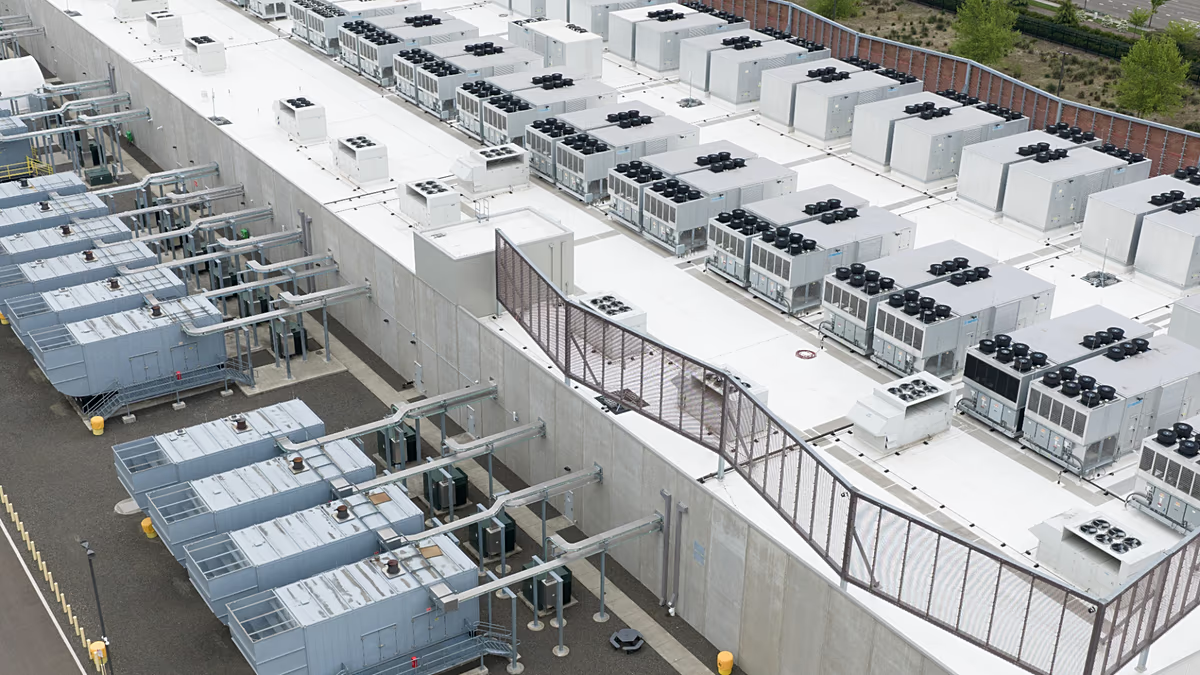
Every time you ask a chatbot a question, you’re not just tapping into a vast digital mind—you’re activating a physical, energy-intensive industrial process. Somewhere, often thousands of miles away, in a warehouse humming with supercomputers, a staggering amount of electricity is consumed to craft that instant reply. This is the invisible engine of our AI age: the data centre. These facilities, housing the specialized chips that train and run models like ChatGPT, are fundamental to modern innovation. Yet, their explosive growth has triggered a silent crisis, particularly in Europe, where the continent’s ambitions for technological sovereignty are crashing against the hard limits of its ageing electricity infrastructure. The convenience of artificial intelligence, it turns out, comes with a very real and voracious appetite for power.
The scale of this appetite is difficult to overstate. While a typical European home uses about 10 kilowatt-hours of electricity per day, a single advanced AI data centre can consume the daily equivalent of tens of thousands of homes before lunch. A major study by the European think tank Interface lays out the alarming progression: the power capacity of top AI clusters has ballooned from about 13 megawatts in 2019 to a projected 280-300 megawatts for facilities being built in 2025. To put that in perspective, such a cluster demands as much power as roughly 250,000 European households. Training a single advanced model like GPT-4 reportedly consumed enough energy to power the entire Brussels Capital region for over four days. These are not mere server farms; they behave like electro-intensive industrial plants, running at maximum capacity for weeks on end, placing a unique and constant strain on the grid.
This strain is exposing the profound inadequacy of Europe’s existing electricity grid. This vast, interconnected network of cables and substations was designed for a different era—one without artificial intelligence. It is already struggling with the simultaneous demands of electrifying transport, heating homes, and integrating variable renewable energy sources. Now, it faces a new challenge: connecting single facilities that demand sudden, massive injections of power equivalent to a small city. This doesn’t just require “plugging them in”; it forces costly, time-consuming upgrades to the entire local system and can crowd out other vital users, from factories to new housing developments. The grid, in many places, is simply full.
The consequence is a development logjam stalling Europe’s AI ambitions. In the continent’s most coveted tech hubs—the “FLAP-D” cities of Frankfurt, London, Amsterdam, Paris, and Dublin—the queue for a grid connection has become a de facto ban. New data centre projects now face average waits of 7 to 10 years, stretching to 13 years in the most congested areas. Ireland has halted new data centre connections in Dublin until 2028, while the Netherlands and Frankfurt have similar bans extending to 2030. Even the world’s best-funded AI companies are being thwarted; the report notes that OpenAI has paused planned investments in the UK and Norway due to high electricity prices and infrastructure constraints. Europe’s dream of competing globally in AI is being short-circuited by its own power lines.
Compounding this infrastructural crisis is a pressing economic and climate dilemma. The International Energy Agency projects global data centre electricity use will more than double by 2030, driven largely by AI. In Europe, building “multi-hundred-megawatt facilities” that then fail to operate efficiently—perhaps because better, cheaper options emerge elsewhere—would create costly “stranded assets.” These white elephants would represent a catastrophic waste of both public funds and precious energy resources, undermining climate goals. The continent is thus caught in a trap: it needs to build AI capacity to stay relevant, but doing so carelessly could consume the very power needed for its green transition and economic stability, all for potentially obsolete technology.
The path forward, as outlined by the Interface report, requires a fundamental rethink. We can no longer treat AI data centres as generic real estate projects. They must be recognized, regulated, and operated as critical energy infrastructure from the outset. Their placement must be strategically tied to regions with abundant, under-utilised renewable energy capacity, transforming them from grid burdens into potential stabilizers for green power networks. This means integrating these facilities into national and EU grid planning years in advance. The long-term value and social acceptability of AI will depend on this shift. Ultimately, the question is not just whether Europe’s grid can power its AI future, but whether it can develop an AI future that strengthens, rather than breaks, its energy system. The race for intelligence must not be lost to a failure of power.