


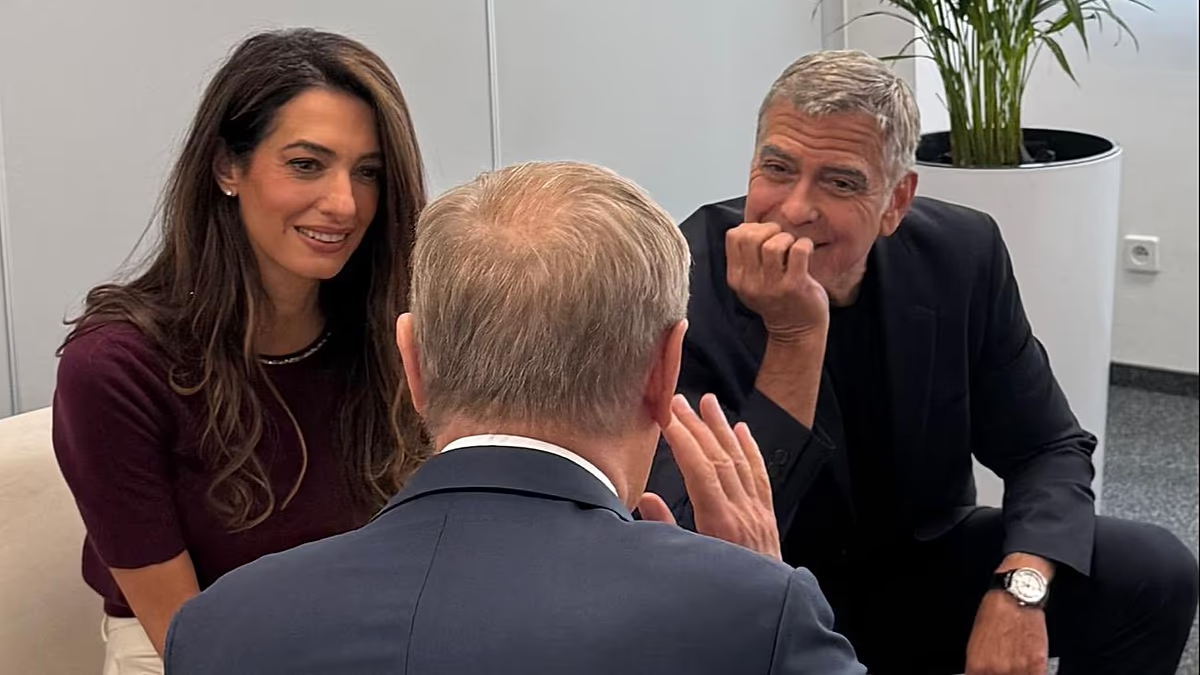
In a week dominated by stark political divisions, a moment of disarming levity emerged from Poland, where Prime Minister Donald Tusk showcased a masterclass in personal diplomacy. During a meeting at a major international conference, Tusk was introduced to the renowned Hollywood actor and activist George Clooney. With a knowing twinkle, Tusk extended his hand and offered a self-deprecating introduction: “My name is Donald. It’s not my fault. It wasn’t my choice.” The witty reference to the name he shares with former U.S. President Donald Trump—a figure Clooney has frequently and publicly criticized—immediately broke the ice. The actor, clearly amused, laughed and reassured him, “It’s okay.” The elegant exchange was completed by Clooney’s wife, the distinguished human-rights lawyer Amal Clooney, who greeted Tusk in Polish with a warm “Good day.” This brief, human interaction stood in stark contrast to the often-grating discourse of international politics, highlighting Tusk’s skillful ability to connect on a personal level.
The charm offensive was part of a broader narrative Tusk was promoting about Poland itself. Earlier, he had shared a joint photograph with the power couple, captioning it with the cheeky assertion: “Amal and George Clooney agree with me that Poland is the best place on Earth.” This was a direct nod to his own speech at the conference, where he had painted a picture of a dynamic and ambitious nation. Tusk argued that contemporary Poland is “the fastest growing country in Europe and one of the most ambitious nations on the continent,” positioning it as “the best place on earth to live and fulfil your dreams.” By aligning this optimistic national vision with the glamour and credibility of the Clooneys, Tusk cleverly leveraged celebrity to amplify a message of Polish progress and potential on the world stage.
The subtext of Tusk’s joke, however, pointed to a much deeper and more contentious transatlantic rift. The “beef” between George Clooney and Donald Trump is long-standing and intensely personal. Clooney has been an open critic of Trump’s policies and conduct for years, a stance that has only solidified since Trump’s return to the political forefront. The tension recently boiled over publicly when Trump, on his Truth Social platform, launched a New Year’s Eve tirade against the actor. He dismissed Clooney’s film career as “mediocre,” claimed he gained fame through politics, and labeled him “just an average guy” who complains. This feud underscores a broader cultural schism, noted by reports that the Clooneys, like some other high-profile figures, have made France their primary residence—a decision partly influenced by the political climate in the United States following Trump’s electoral resurgence.
The Clooneys were in Poznań not for a social call, but in their serious capacities as advocates for justice. They appeared as keynote speakers at the Impact’CEE conference, where Amal Clooney delivered a sobering assessment of the global state of human rights and international law. Drawing from her extensive work representing victims of Russian aggression in Ukraine and advocating for the Yazidi community, she warned the audience, “The system of international law is in crisis today, with world leaders increasingly openly ignoring the law.” She described the current period as the most difficult of her legal career, crucially adding, “The system is in crisis when the leadership of the United States is missing.” Her comments framed the couple’s presence not as a celebrity visit, but as a strategic stop in their ongoing, foundation-led work to combat systemic injustice in courtrooms worldwide, lending profound gravity to their Polish engagement.
The setting for this convergence of politics, celebrity, and activism was itself significant. The Impact’CEE conference in Poznań is a premier gathering designed to shape the future of Central and Eastern Europe, connecting titans of business, technology, science, and culture. This year’s event featured nearly 650 speakers, including Nobel laureate author Olga Tokarczuk, historian Timothy Snyder, and economist Daron Acemoglu. Its roster of past attendees—from Barack and Michelle Obama to Natalie Portman—signals its stature as a forum where global influence is curated. Within this context, the Clooneys’ participation and Tusk’s interactions with them were strategic maneuvers, enhancing Poland’s and the conference’s profile as a nexus for meaningful dialogue on the world’s most pressing issues.
Ultimately, the week’s events presented a fascinating study in contrasts. On one hand, there was the sharp, personal animosity emanating from the United States between a former president and a celebrity activist. On the other, there was the polished, proactive diplomacy of the Polish prime minister, who managed to forge a moment of genuine connection and shared humor. Tusk’s quick-witted introduction did more than elicit a laugh; it acknowledged a global political reality while deftly sidestepping its negativity, instead fostering a moment of unity. In doing so, he successfully used a personal touch to advance a national message of optimism and ambition, demonstrating that in a fragmented world, human rapport remains an indispensable political currency.