

London’s “Unite the Kingdom” Rally Faces Preemptive Crackdown Amid Rising Political Temperatures
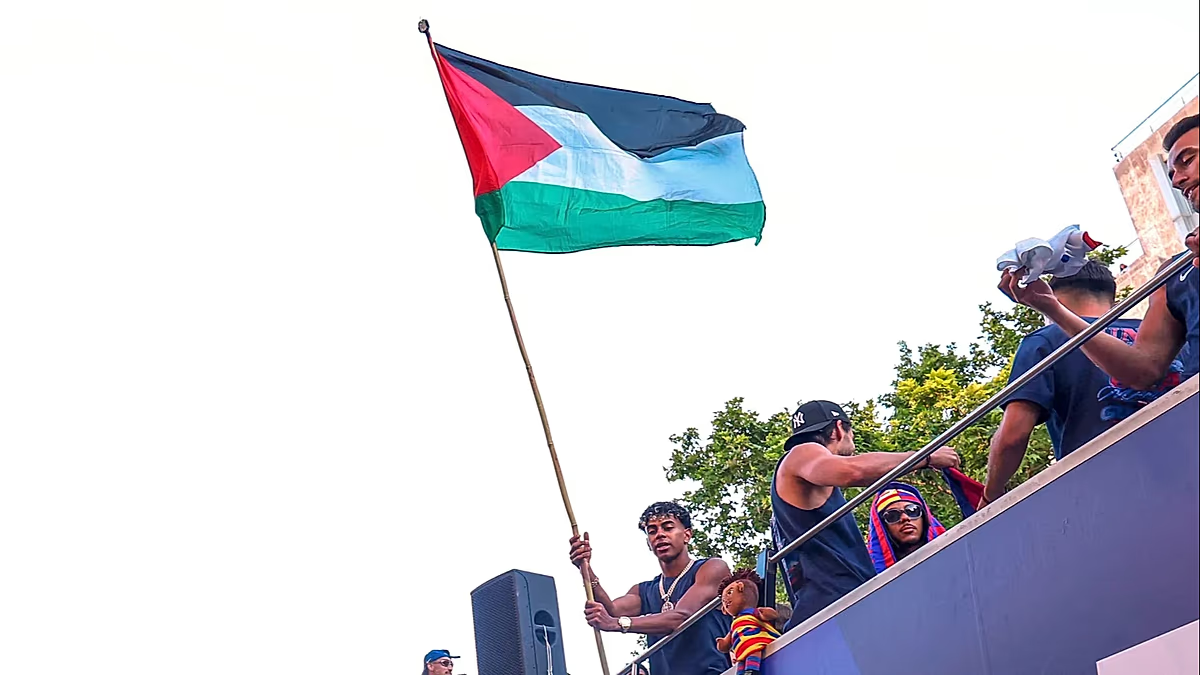
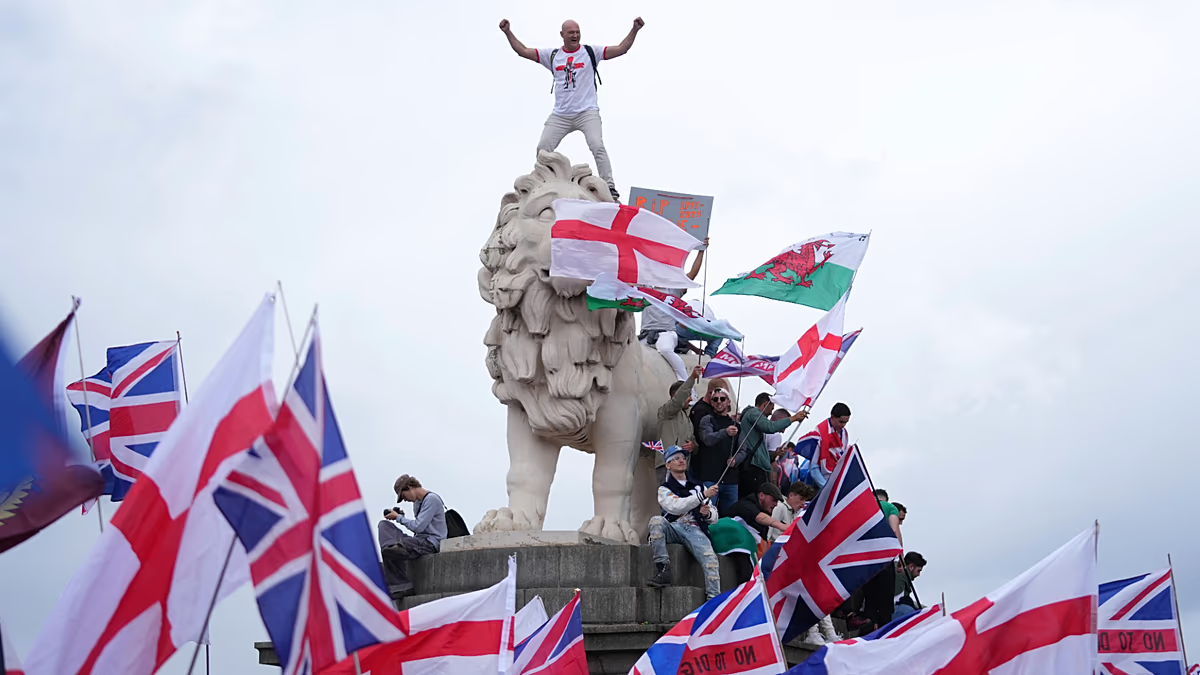
In a significant preemptive move, the British Home Office has barred at least seven individuals from attending a major far-right rally organized by activist Tommy Robinson in central London on May 16, 2026. The event, dubbed “Unite the Kingdom,” is a sequel to a large gathering the previous year that drew over 100,000 people, resulted in 25 arrests, and left two dozen police officers injured. This year’s event coincides with other major London engagements—a demonstration marking Palestinian Nakba Day and the FA Cup Final at Wembley Stadium—prompting the Metropolitan Police to warn that it will be “one of the busiest days for policing in London in recent years.” The police have explicitly warned organizers they will be held responsible if any speech at the rally crosses into hate speech. The banned individuals, many of whom were slated to address the crowd, were refused Electronic Travel Authorisation (ETA), a new digital visa system. Home Secretary Shabana Mahmood stated plainly that their presence in the UK was “not conducive to the public good.”
The Banned Figures: A Network of European and American Far-Right Voices
The list of those excluded reveals a network of influential far-right voices from across Europe and the United States. From Europe, the banned include Dutch political commentator Eva Vlaardingerbroek, Spanish Catalan influencer Ada Lluch, Flemish MP Filip Dewinter, and Polish MEP Dominik Tarczyński. From the U.S., commentators Joey Mannarino and Valentina Gomez, who spoke at the 2025 rally, were also denied entry. These figures publicly announced their bans on social media, sharing screenshots of the official notifications. Prime Minister Keir Starmer, without naming the individuals, branded them as “far-right agitators,” asserting his government would not tolerate people entering the UK to “threaten our communities, and spread hate on our streets.” While supporting peaceful protest, he vowed to “ban those coming into the UK” specifically to stir up violence.
Controversial Rhetoric and the Ideology of “Remigration”
The banned individuals are known for their extreme and often inflammatory rhetoric, particularly focused on anti-immigration and anti-Muslim narratives. Central to their shared ideology is the concept of “remigration”—a term championed by Europe’s far-right. While proponents frame it as a policy of immigration control, critics, including human rights groups, define it as a white supremacist concept advocating the mass, forced removal of immigrants and their descendants based on race, ethnicity, or perceived lack of assimilation. It is closely linked to the “Great Replacement” conspiracy theory, which alleges that native Western populations are being deliberately replaced by non-white immigrants. The banned commentators have actively promoted this ideology. Ada Lluch responded to her ban by shouting on social media, “WE WANT REMIGRATION. AND WE WANT IT NOW!” Eva Vlaardingerbroek has described mass migration as “the rape, replacement and murder of our people.” Valentina Gomez, at the previous rally, warned the crowd about “rapist Muslims” taking over the UK. Dominik Tarczyński has declared Poland should not accept “a single Muslim immigrant.” Filip Dewinter once posted a hashtag translating to “I am a racist and proud of it.”
The Legal Framework and Historical Context of Exclusion
The decision sparked immediate online debate, with many decrying it as an assault on freedom of speech. Tommy Robinson accused the government of “banning Americans en masse” while hypocritically “chaperoning” asylum seekers “in every week.” However, the legal authority to exclude individuals whose presence is not “conducive to the public good” is long-standing and not unique to Starmer’s Labour government, which took power in July 2024. According to parliamentary research, successive Conservative governments between 2010 and 2022 excluded 369 people—averaging about 30 per year—primarily targeting extremists and “hate preachers,” often with an Islamist focus. In 2013, Conservative Home Secretary Theresa May banned two anti-Islam U.S. bloggers. UK law protects freedom of speech under the Human Rights Act but explicitly permits limitations to prevent crime or protect national security. Legislation like the Public Order Act criminalizes speech that incites racial or religious hatred. Therefore, the government’s action aligns with established legal principles and historical precedent, not a novel crackdown on dissent.
Tommy Robinson: The Divisive Organizer and the Misinformation Ecosystem
The rally’s organizer, Tommy Robinson (real name Stephen Yaxley-Lennon), remains a deeply divisive figure with multiple criminal convictions. While urging peaceful protest for the 2026 event, his own rhetoric often fuels tension. He routinely labels asylum seekers as “invaders” and has spread dangerous misinformation. Following the July 2024 Southport attacks, he falsely claimed the perpetrator was a Muslim asylum seeker who arrived on a small boat. In reality, the attacker was a 17-year-old born in Wales to Rwandan parents, with no known link to Islam. These false claims contributed to mass rioting. Last year’s rally also featured a video address from tech billionaire Elon Musk, who warned the crowd “violence is coming” and “you either fight back or you die,” drawing condemnation from Downing Street. This ecosystem of misinformation and inflammatory rhetoric underscores the government’s concern about the event’s potential to escalate into violence and communal strife.
Migration Trends and the Political Landscape
The rally and the bans occur within a charged political landscape where immigration is a focal point. Robinson and the banned speakers consistently attack Starmer’s immigration policies. Ironically, official data shows net migration to the UK fell by more than two-thirds in Labour’s first year, to 204,000 in the year ending June 2025—the lowest since 2021 and a dramatic drop from the peak of 944,000 under the Conservatives in March 2023. This reduction, driven by fewer arrivals for work and study, challenges the narrative of an unchecked influx. Furthermore, research from the University of Oxford’s Migration Observatory complicates claims about immigrant criminality. While detailed statistics are lacking, available data suggests that when factors like age are considered, non-UK citizens are underrepresented in the prison population for crimes like robbery or violence, though overrepresented for drug offenses. The government’s preemptive bans, therefore, can be seen as a measure to prevent the sowing of discord and hatred based on misleading or false narratives, aiming to maintain public order during a tense period rather than stifle legitimate political debate.