


The Unfortunate Fire: When a Football Match Ignites a Nation’s Tensions
In a nation where the line between sport and politics is often blurred, a football match in western Libya became the spark for a series of violent events that shook the capital and underscored the fragile state of the country’s peace. On Thursday, May 14th, 2026, a tense playoff match in Libya’s top football division was held behind closed doors in the town of Tarhunah, roughly 80 kilometers south of Tripoli. The contenders were Tripoli’s Al-Ittihad SC and Misrata’s Asswehly SC, teams whose rivalry carries the weight of regional loyalties. The game itself was suspended near its conclusion following a controversial refereeing decision—a penalty kick Al-Ittihad’s players fiercely believed they deserved but were denied. This moment of perceived injustice on the pitch swiftly escalated into a far more dangerous confrontation off it.
From Pitch Protest to Street Battles
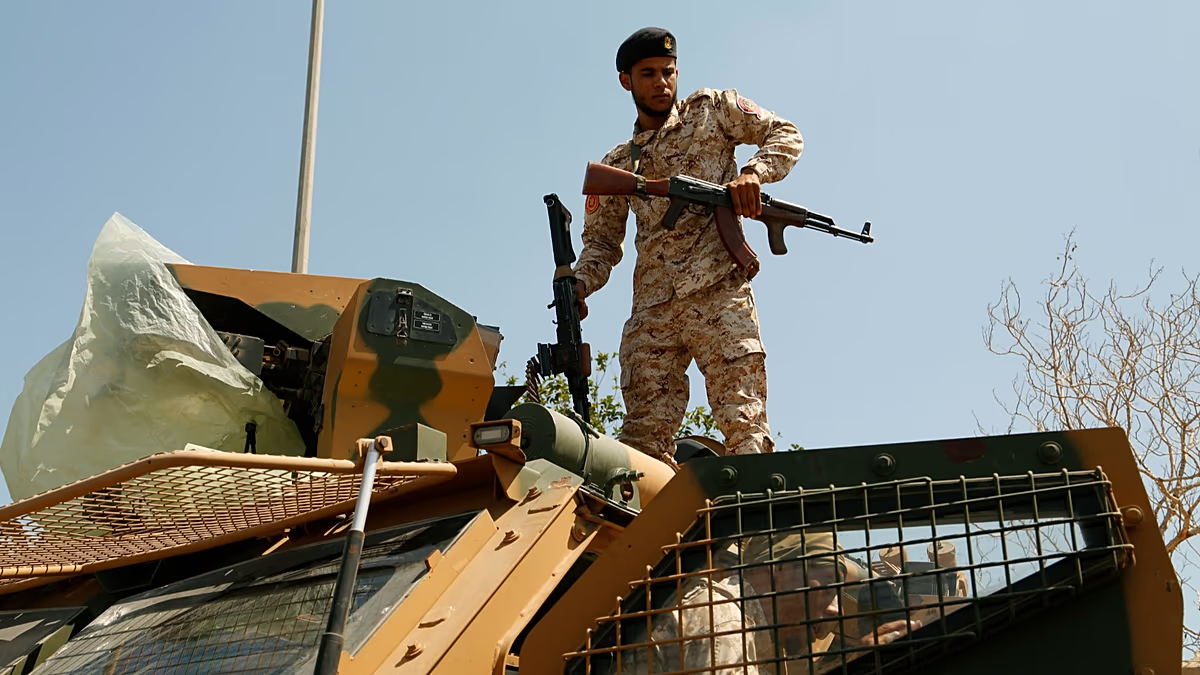
According to reports from the Libyan news agency LANA, the frustration within the stadium quickly spilled outside. Supporters, already agitated by the closed-door policy that barred them from attending, clashed with security forces near the venue. The situation deteriorated so rapidly that the Tripoli-based Government of National Unity (GNU) felt compelled to deploy one of its most powerful military assets: the 444th Combat Brigade. This armed faction’s intervention marked a severe escalation. Arabic-language media reported that the brigade claimed one of its members was killed by gunfire and admitted its units had fired live rounds at protesters. While the soldier’s death was not independently confirmed by authorities, the use of live ammunition signaled a transition from a sports-related dispute to a serious security crisis. The violence was not limited to clashes; players and journalists covering the match were among those injured, and several vehicles, including a broadcast van belonging to a Libyan sports channel, were burned—a stark symbol of how the incident was silencing media coverage itself.
The Flame Spreads to the Heart of Power
Perhaps the most alarming development of the day was not in Tarhunah, but in the nation’s capital. As news of the clashes spread, a group targeted the very seat of Libya’s provisional government. The Libyan Presidential Council stated that the Council of Ministers’ headquarters in Tripoli was attacked “with acts of sabotage and arson.” Local media described several offices inside the government compound being set ablaze. Though the fire was reportedly contained quickly, the imagery was potent and deeply troubling. This was not a random act of vandalism; it was a direct assault on the symbolic center of state authority. The Presidential Council’s subsequent call for an investigation into these “unfortunate events” emphasized that feelings of injustice must be addressed through legal channels, “not through violence.” This plea highlighted the government’s struggle to maintain a rule of law in a climate where public frustration can so easily manifest as physical destruction.
A Pattern of Fragility in a Divided Nation
The events of May 14th represent the most serious civil disturbance in Tripoli for several months, but they are not an isolated incident. They fit into a pattern of localized violence that continues to plague Libya despite a relative calm in the capital. Just earlier in May, armed clashes in the western city of Zawiya—another area under the control of the Tripoli government—resulted in nine deaths and 23 injuries. These recurring flashes of conflict, often tied to the complex web of armed factions that hold real power in various regions, show how superficial the national unity can be. The deployment of the 444th Combat Brigade in Tarhunah itself brings its own controversial shadow. This brigade has been reportedly linked to the February killing of Saif al-Islam Gaddafi, the son of the former Libyan leader, though it denies involvement. Its presence at a football riot underscores how Libya’s security landscape is populated by groups with their own histories and agendas, further complicating any simple response to civil unrest.
Football as a Mirror of Societal Divisions
Beyond the immediate security analysis, this incident speaks to the profound role football plays in Libyan society. In a country still deeply fractured along regional, political, and tribal lines, club loyalties often serve as proxies for these broader identities. A match between teams from Tripoli and Misrata is never just a game; it is a contest between communities. Holding such a high-stakes playoff behind closed doors likely inflamed feelings of exclusion and suspicion among fans. The disputed penalty kick then became a catalyst, transforming bottled-up tension into a release of collective anger. The violence, therefore, was not merely about a refereeing error, but about a perceived injustice that resonated with deeper, ongoing feelings of marginalization and unfairness experienced by many Libyans in the post-revolution era.
The Path Ahead: Justice Versus the Spark of Violence
Libya’s journey toward stable governance remains fraught. The events following the Tarhunah match illustrate a critical challenge: how to channel legitimate public grievance through institutions that are still weak and contested. The government’ call for a legal investigation is a step in principle, but its ability to conduct one transparently and effectively is hampered by the very realities the day exposed—the reliance on powerful armed brigades for security and the vulnerability of state symbols to attack. For ordinary Libyans, the sight of a government building burning over a football dispute is a disheartening reminder of how easily order can disintegrate. The hope must be that this “unfortunate” series of events serves as a stark lesson: that building a nation requires not only keeping the peace on the streets, but also fostering a sense of shared justice and fair play, both on the football pitch and in the halls of power. Without that, any spark, however small, risks igniting another destructive flame.