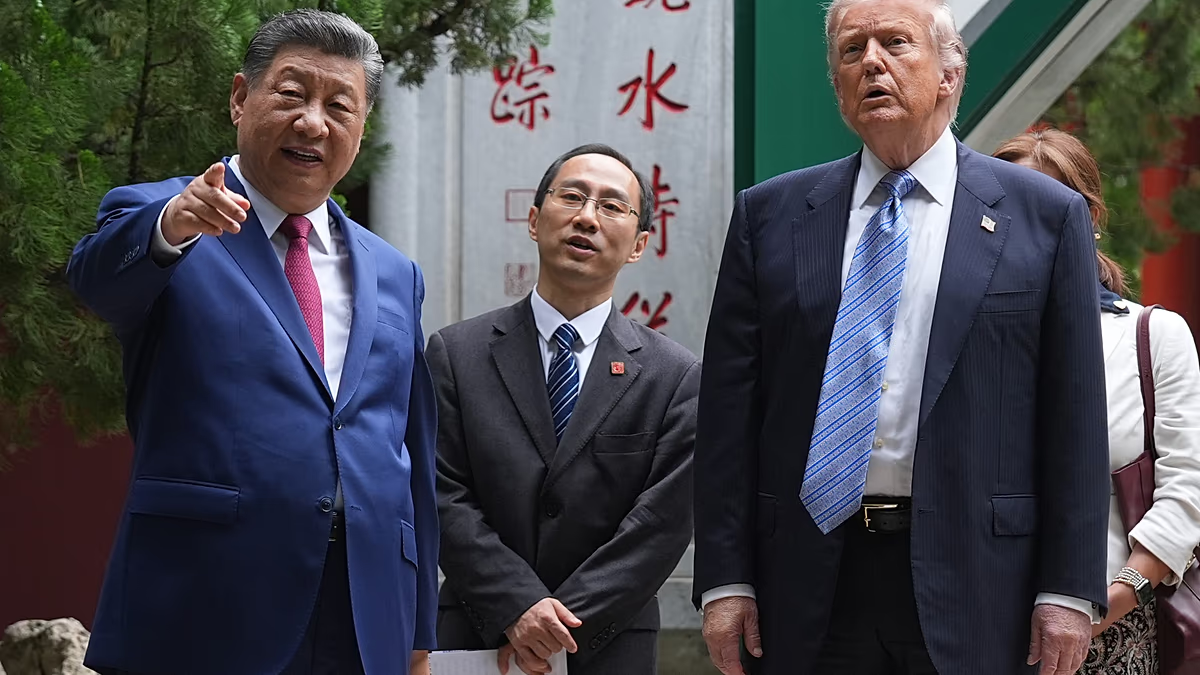




The much-anticipated summit between former U.S. President Donald Trump and Chinese President Xi Jinping arrived burdened by outsized expectations, many of which Trump himself had cultivated. Promising a delegation of top American CEOs and hinting at monumental deals, the stage was set for a transformative economic breakthrough. However, the complex and often adversarial nature of the U.S.-China relationship swiftly reasserted itself, revealing a sobering reality where China held considerable strategic leverage. Rather than a grand reset, the immediate outcome was a modest, though crucial, stabilization of ties—an effort to prevent the simmering superpower rivalry from boiling over into uncontrolled conflict. As European Parliament member Helmut Brandstätter observed, the tangible accomplishments seemed scarce, with little immediate economic gain for America or the global community.
Economically, the summit’s deliverables fell conspicuously short of the pre-trip fanfare. While President Xi did agree to a purchase of 200 Boeing aircraft, this figure paled beside the 500 planes Trump had previously suggested were forthcoming. The muted market reaction—a drop in Boeing’s share price—spoke volumes about investor disappointment. This order, significant in isolation, highlighted a broader stagnation; it was the sole major commercial agreement announced, echoing a similar deal from 2017 before relations deteriorated. Hints of other potential agreements, such as on agricultural exports or Nvidia chips, remained vague and undeveloped. The most concrete positive was a mutual commitment to preserve a fragile trade truce and establish better mechanisms to manage future disputes, a tacit acknowledgment that escalation benefits neither side.
For observers in Europe, the underwhelming nature of the summit came as a subtle relief. There was no sweeping bilateral pact that might have economically marginalized the European Union. As expert Ling Chen noted, the EU’s critical role as a trading partner for both giants, particularly for China’s green energy exports, ensures its continued relevance. The summit’s failure to produce a dramatic realignment allowed the EU to avoid immediate economic sidelining, preserving its space to navigate between the two competing powers. This outcome underscored that the U.S.-China relationship is not a closed binary contest but a triad where third parties, like Europe, retain significant agency.
Beneath the surface of orchestrated banquets and lavish mutual praise, deep geopolitical fissures remained starkly evident. The public pageantry, where Xi called the visit a “milestone” and Trump touted “fantastic” deals, masked persistent disagreements on critical security issues. China’s foreign ministry issued a blunt critique of U.S. and Israeli actions in the Middle East, advocating for a peace deal to end a conflict disrupting global energy supplies. Although Trump suggested Xi offered help regarding the Strait of Hormuz and pledged to halt military shipments to Iran, China pointedly refrained from confirming such commitments. The hope for Chinese pressure on Iran to resolve the conflict did not visibly materialize, with experts speculating that any future influence would be exercised quietly and behind the scenes.
The most potent and perennial flashpoint, Taiwan, received strikingly asymmetric treatment in the post-summit statements. While the American readout omitted the topic entirely, China emphasized that Xi had starkly warned Trump it was the “most important issue” in bilateral relations and a potential trigger for conflict. This was an unusually direct caution, underscoring Beijing’s view that Taiwan is a non-negotiable core interest. The U.S., bound by law to provide Taiwan with self-defence capabilities, sought to downplay the exchange, with Secretary of State Marco Rubio stating policy was “unchanged.” Taiwan’s foreign minister thanked him for the reassurance. Analysts interpreted the dynamic as a form of diplomatic shadow-boxing, noting that as long as China remains dependent on advanced semiconductors manufactured in Taiwan, and given the island’s formidable defensive capabilities, a precipitous military move remains unlikely.
In final analysis, the summit was a testament to the intractable nature of great-power competition. It succeeded in its most basic goal: halting a further downward spiral and installing rudimentary guardrails. However, it failed to deliver the dramatic economic or geopolitical breakthroughs that had been previewed. The relationship remained defined by a fundamental tension: deep economic interdependence locked in a struggle with profound strategic distrust. The core issues—trade imbalances, technological supremacy, Taiwan, and divergent global security priorities—were managed, not resolved. As both leaders departed, the world was left with a relationship that was merely stabilized, not transformed, setting a stage where competition would continue within carefully, and perhaps only temporarily, negotiated bounds.