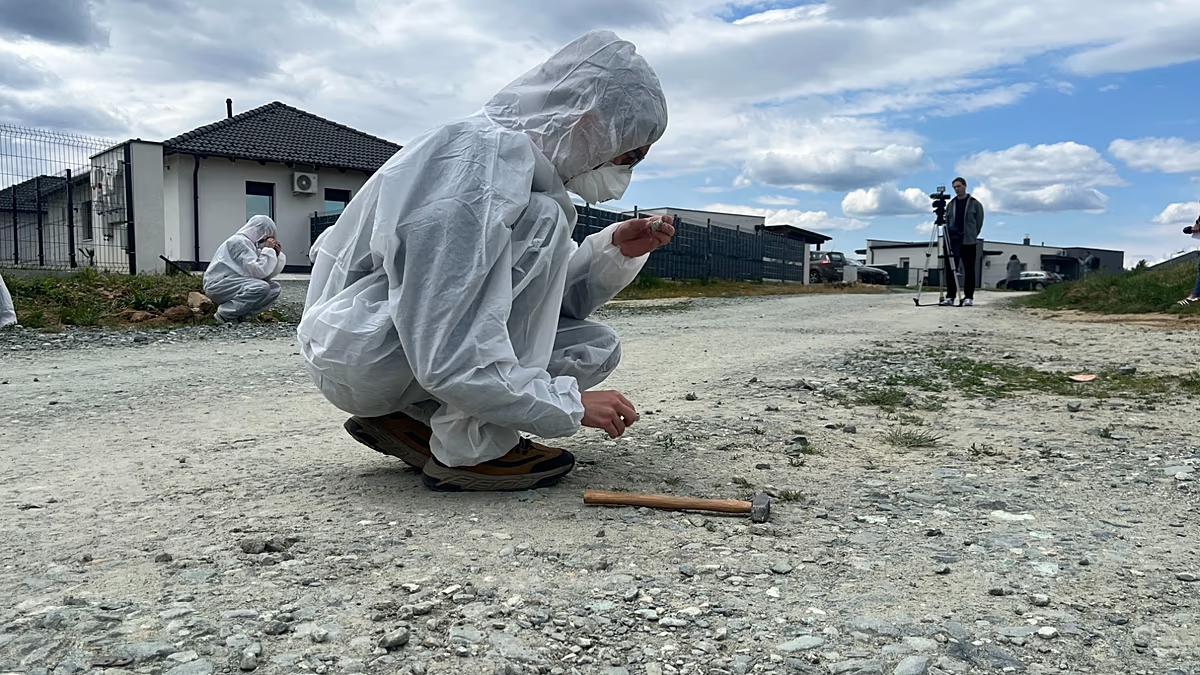



Beneath the tires of vehicles and the feet of pedestrians in western Hungary, a silent and decades-old legacy of industrial activity may be posing a persistent, if invisible, health threat. Recent investigations have revealed that hundreds of road surfaces and construction areas across several counties, most notably around the cities of Szombathely, Sopron, and Kőszeg, could be contaminated with asbestos. The issue traces back approximately eight to ten years, when stones and aggregates were transported from certain Austrian mines for use in local construction projects, such as road bases and the development of areas like the Oladi plateau in Szombathely. This suburban neighborhood, now home to many young families, was built upon this potentially hazardous material, meaning residents may have been unknowingly exposed to its risks for the better part of a decade. The situation highlights a profound failure in material tracking and preventive regulation, turning ordinary community infrastructure into a source of deep concern.
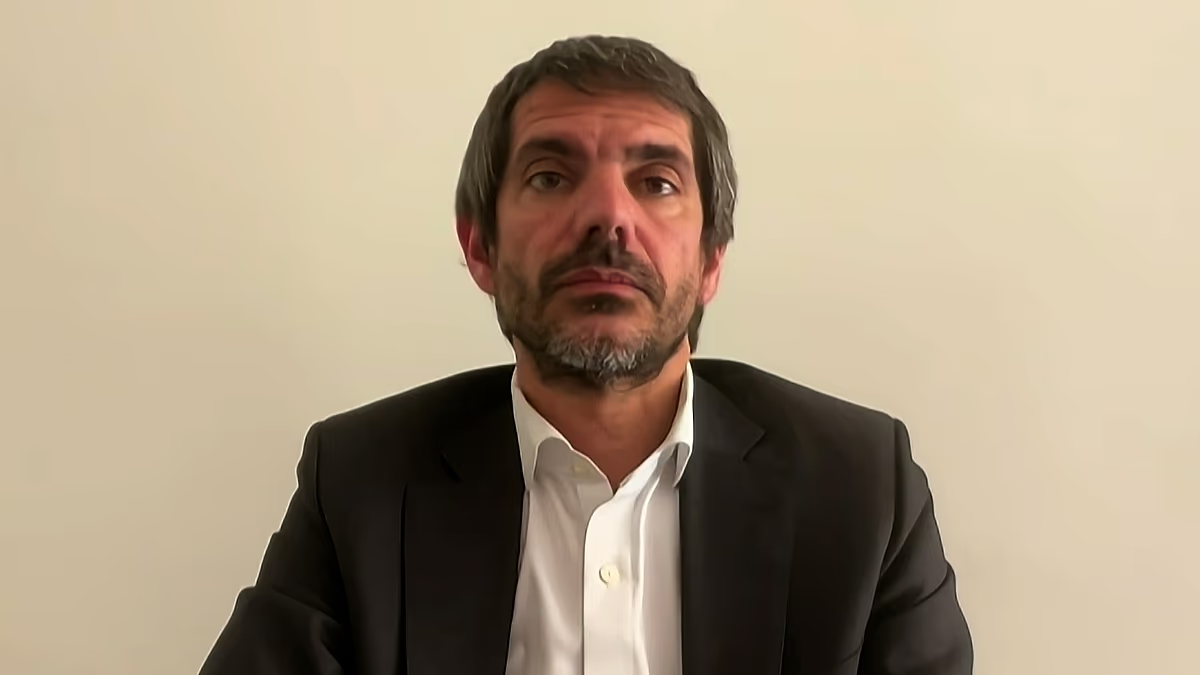
The danger, as explained by geologist Tamás Weiszburg, a former head of the mineralogy department at Eötvös Loránd University, lies not in the rock itself but in its physical form. When disturbed, asbestos can break into microscopically fine, needle-like fibers that become airborne. These fibers are so small they bypass the body’s natural respiratory defenses—like a sneeze or cough—and are inhaled deep into the lungs. Their slender, elongated shape makes them impossible for the body’s cleanup cells, the phagocytes, to fully engulf and remove. This leads to a state of permanent inflammation and scarring in lung tissue. As Weiszburg starkly describes it, asbestos is a “slow killer”; the cancerous tumors it causes, such as mesothelioma, can take twenty to forty years to develop after the initial exposure. This lengthy latency period means the consequences of today’s exposure may not be fully realized for generations.
Crucially, Weiszburg stresses that the risk is primarily one of exposure to airborne dust. When asbestos-containing material is properly bound and sealed—for instance, under a thick, intact layer of asphalt—it generally does not pose a direct threat to the public. The problem in western Hungary is that many of the affected roads are unsealed gravel or dirt surfaces, or their asphalt covering has degraded. Every passing car, construction vehicle, or strong wind can kick up dust, releasing the hazardous fibers into the air where they can be inhaled. While hundreds of kilometers of properly paved roads in the region are considered safe, any future construction or demolition that disturbs the road base becomes a high-risk activity, requiring strict worker protection, including specialized masks, until the site is once again securely sealed.
The human and political dimensions of this crisis came into sharp focus recently when Hungarian Environment Minister László Gajdos visited the affected Oladi plateau in Szombathely. In a community built for families, the anxiety is palpable. Local officials described interim measures, like reducing speed limits to minimize dust and regularly watering the roads, as temporary stopgaps. Minister Gajdos confirmed that three counties are affected and admitted a significant investigative challenge: the government still does not fully know where all the contaminated Austrian stone was ultimately used. “I think this issue should be discussed between ministries and a decision should be taken quickly,” Gajdos stated, announcing his intention to bring the matter before the national government for urgent action and, presumably, for the allocation of funds needed for testing, containment, and remediation.
A central question rising from this situation is one of responsibility. According to Weiszburg, this appears to be a case of tragic oversight rather than deliberate malice. A significant legal and knowledge gap exists across Europe regarding naturally occurring asbestos. Unlike industrial asbestos products, which are heavily regulated, there are no continent-wide preventive regulations governing the mining and use of natural aggregates that may contain asbestos veins. As Weiszburg explains, in a geological mine, one section can be asbestos-free while another is contaminated, making oversight complex. While acknowledging that a legal loophole exists and that those responsible should be identified, he notes that it was neither feasible nor legally required to ban all mining in the Austrian region simply because asbestos was geologically known to be present in some areas. This regulatory vacuum allowed a dangerous material to enter the construction supply chain unchecked.
The path forward now involves a complex blend of science, bureaucracy, and public reassurance. With contamination identified at over 300 sites, the immediate tasks are comprehensive mapping to identify all at-risk locations, rigorous risk assessment of each site, and the development of a clear, funded plan for remediation. This will likely involve either fully removing the contaminated base material or permanently sealing it under impervious surfaces. For residents, transparent communication and ongoing environmental monitoring will be essential to restore trust. Ultimately, the crisis in western Hungary serves as a stark, real-world lesson for all nations: natural hazards require proactive regulatory frameworks. It underscores the critical need for robust material traceability and testing protocols in the construction industry to ensure that the very materials used to build our communities do not, years later, become a threat to their health.