


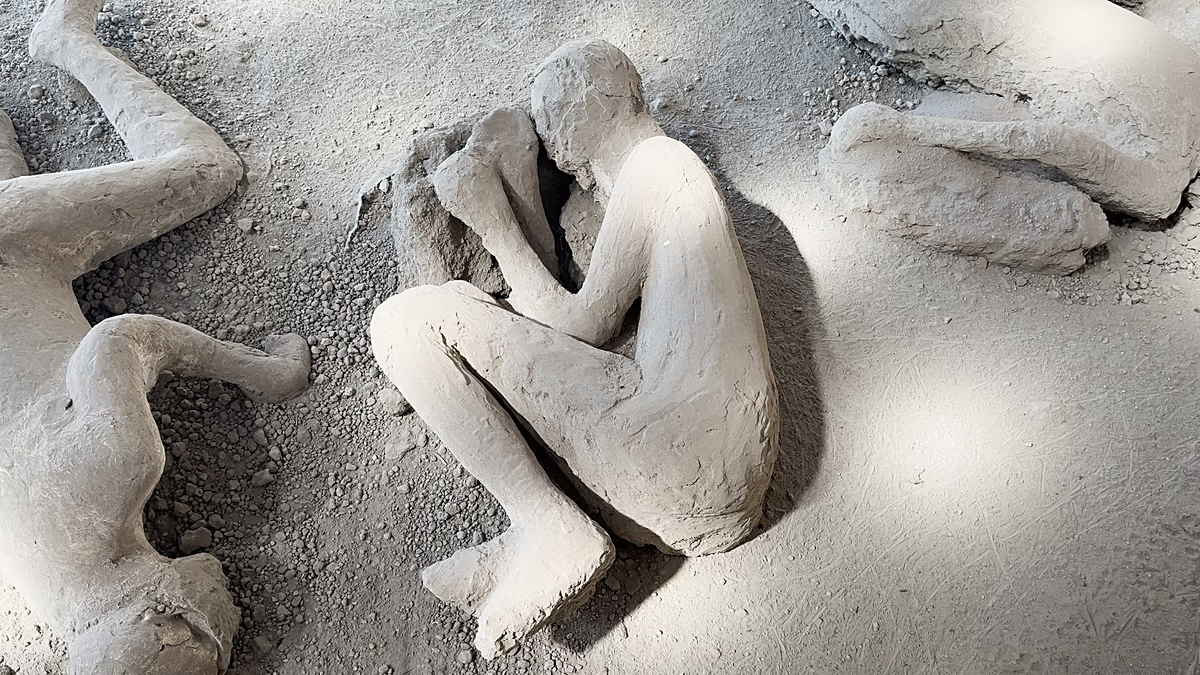
Of all the stories frozen in time by the eruption of Mount Vesuvius in 79 AD, few are as poignant as that of the fugitives discovered in a place now known as the “Garden of the Fugitives.” More than six decades ago, in 1961, the renowned archaeologist Amedeo Maiuri excavated a site that was then a simple vineyard. What he uncovered were the haunting plaster casts of fourteen individuals, their bodies captured in their final moments as a searing pyroclastic cloud overtook them in a desperate bid for escape through the city’s Porta Nocera gate. For years, these figures stood as a solemn, anonymous testament to the disaster. However, recent re-examinations using modern technology have performed a kind of archaeological resurrection, transforming one of these anonymous victims from a statistic into a person with a name, a role, and a story of tragic dedication.
The breakthrough began not in the field, but within the storage deposits of the Archaeological Park of Pompeii, where materials from older excavations are meticulously preserved. Researchers turned their attention to the personal effects found with one of the 1961 casts. Their focus landed on a small, deteriorated organic case with metal fittings and a fabric bag containing coins. Advanced diagnostic techniques, including X-rays and CT scans supported by Artificial Intelligence, were employed to peer inside the plaster cast without damaging it. This digital archaeology revealed the cast’s hidden secret: a sophisticated personal kit containing a slate plate for mixing ointments or medicines, and a series of finely crafted metal instruments. The design of the case itself, featuring a complex toothed-wheel locking mechanism, spoke of its value to its owner.
The contents were unmistakable. The slate plate and the specialized tools—likely used for procedures like bleeding, stitching, or bone setting—led researchers to a compelling conclusion: this man was a physician. He was not merely a citizen fleeing for his life; he was a professional caught in the act of safeguarding the very instruments of his craft. As Gabriel Zuchtriegel, the Director of the Archaeological Park, poignantly noted, this discovery shows that even two thousand years ago, there were those who were “doctors at all times.” In his final, frantic moments, this physician made a conscious choice to grab his medical kit. It was a decision that speaks volumes about his identity and his hopes, representing both his means to rebuild a livelihood in a new place and, perhaps, his inherent duty to offer aid to others along the perilous journey.
This revelation is the fruit of truly interdisciplinary collaboration, uniting archaeologists, restorers, physical anthropologists, radiologists, and digital modelling specialists. Their work has moved beyond simply cataloging an artifact; they have pieced together an interrupted life narrative. The physician’s story, emerging from the combined study of his bones, his tools, his coins, and the context of his death, adds profound human depth to our understanding of Pompeii. We now see not just a victim of a natural disaster, but a skilled individual whose societal role was so integral to his sense of self that he clung to it even in the face of annihilation.
In many ways, this ancient doctor’s story resonates powerfully with our modern experience. Director Zuchtriegel dedicated the discovery to the healthcare workers of today, who carry out their profession “with a very high sense of responsibility and service to the community.” The parallel is striking and deeply human. The Pompeian physician, equipped to heal, faced an unstoppable force of nature. Today’s medical professionals, equally dedicated, have faced global pandemics and crises, often putting their own safety at risk. The find bridges two millennia, reminding us that the ethos of care and commitment is a timeless human constant.
Ultimately, the identification of the Pompeian doctor is a milestone that opens new chapters in archaeological methodology and historical empathy. The non-invasive technologies used here promise to unlock secrets from other casts without disturbing their solemn integrity. But more importantly, it returns a face and a purpose to one of history’s nameless casualties. As he ran, his medical kit close at hand, he carried with him the symbols of healing and hope. That his journey was cut short is our tragedy; that his story has now been recovered, allowing us to recognize his humanity and his vocation, is our extraordinary gain. In this small, significant discovery, Pompeii offers a lesson that transcends archaeology: even in the shadow of cataclysm, the most enduring artifacts are not merely objects, but the enduring values of duty, identity, and service they represent.