
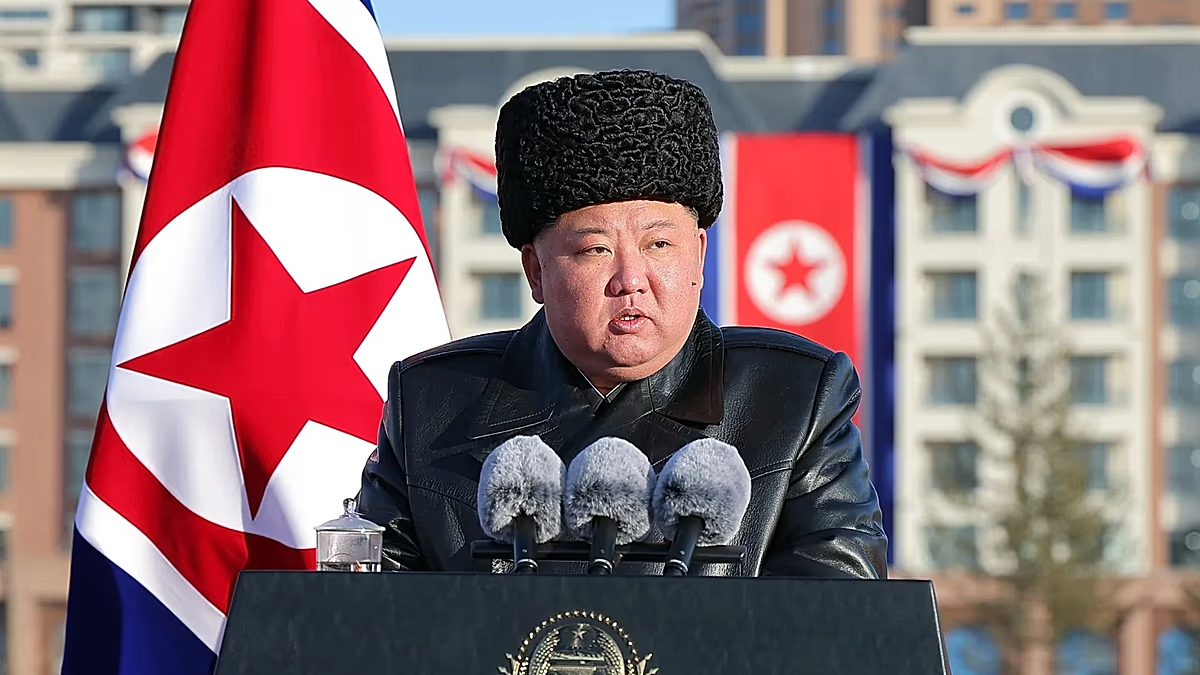


Based on reports from state media and analysis from experts, North Korean leader Kim Jong Un has issued a new, aggressive directive to his top military commanders, fundamentally reshaping the country’s stance towards South Korea and modernizing its military strategy in light of contemporary conflicts.
During a meeting on Sunday, Kim presided over commanding officers in full dress uniform and delivered instructions that mark a significant shift in policy. He called for frontline units to be bolstered and for the border with South Korea to be transformed into what he termed an “impregnable fortress.” This directive comes at a time of exceptionally strained relations between the two nations, with Pyongyang ignoring Seoul’s repeated offers for dialogue. Kim emphasized that a “great change” must be made to more thoroughly deter war and that officers must sharpen their “outlook on the arch enemy,” a clear reference to South Korea.
Analysts interpret these commands as a direct reflection of observations from recent global conflicts, particularly Russia’s war in Ukraine. Senior analyst Hong Min from the Korea Institute for National Unification suggested that Kim’s language shows an awareness of modern warfare elements seen in Ukraine and Middle Eastern conflicts, such as drone warfare, precision strikes, and electronic warfare. Kim’s plans specifically mention stepping up projects to modernize the military and redefine operational concepts “in all spheres,” indicating a move toward a multi-domain battlefield strategy that extends beyond traditional land, sea, and air domains to include underwater, space, electronic, and cyber warfare.
This hardening of military posture aligns with a recent, profound political shift. Earlier this month, North Korea removed all references to reunification with South Korea from its constitution. This symbolic act underscores Pyongyang’s abandonment of a long-stated goal and formalizes a new, more hostile policy towards Seoul, framing the South not as a sibling nation but as a permanent adversary.
The timing of this militant meeting is noteworthy, as it occurred on the same day the North Korean women’s football team arrived in South Korea for a competition—the first such visit in eight years. This small gesture of exchange briefly raised hopes for a thaw in relations, but Kim’s concurrent military instructions starkly contradict that possibility, prioritizing fortress-building over diplomacy.
In summary, Kim Jong Un’s latest commands signify a dual strategy: an immediate, tangible hardening of the physical border and frontline military presence against South Korea, coupled with a long-term, comprehensive drive to modernize North Korea’s military across all modern domains of warfare. This approach, inspired by contemporary battlefields and cemented by constitutional change, suggests North Korea is permanently redefining South Korea as its principal enemy and preparing for a new era of confrontation, even as fleeting cultural exchanges occur.