
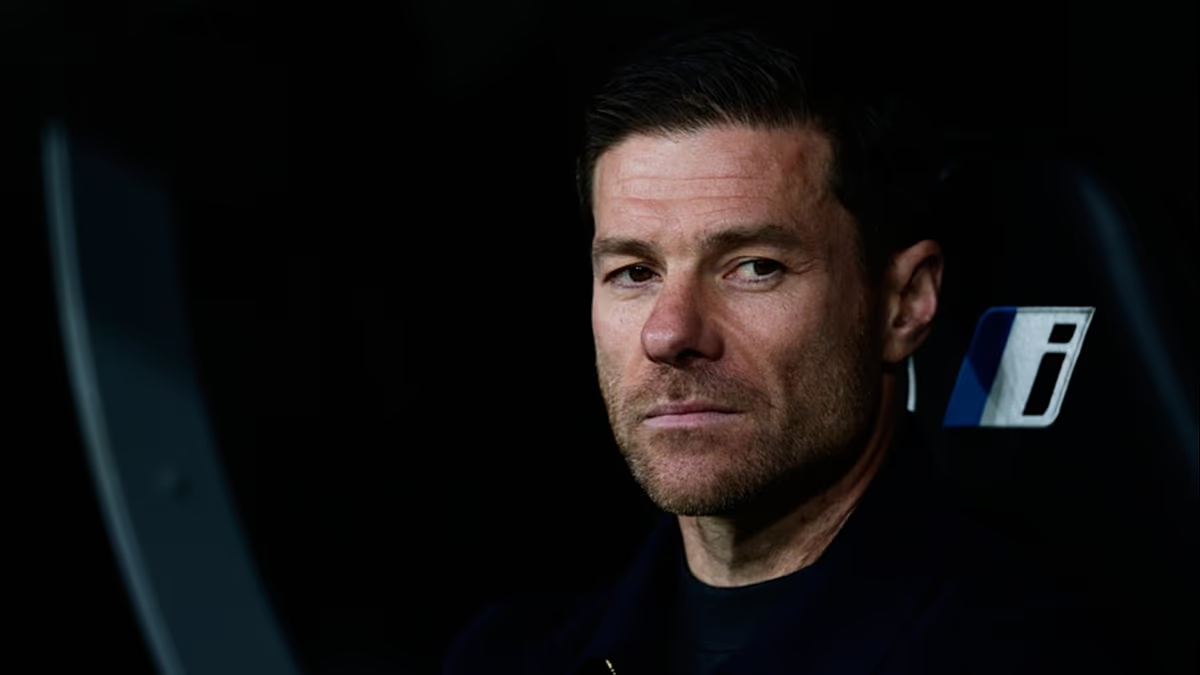


Chelsea Football Club has embarked on a bold new chapter, appointing Xabi Alonso as their manager on a four-year deal commencing next season. The announcement on Sunday marks a significant moment for the club, which has been seeking stability amidst a period of notable turbulence. Alonso returns to management after a brief and challenging stint at Real Madrid, which concluded in January after just eight months. His task at Chelsea is formidable: to restore coherence, competitive edge, and a winning culture to a club that has become emblematic of dysfunction under its new American ownership. He replaces Liam Rosenior, who was dismissed last month, and becomes the fifth permanent head coach appointed by owners Todd Boehly and Clearlake Capital since their takeover in 2022. This frequent change in leadership underscores the restless and often chaotic search for a formula that works.
The appointment is a fascinating gamble on reputation versus recent experience. Alonso’s tenure at Madrid was marred by poor results and reported locker room discord, a stark contrast to his previous, glorious achievement at Bayer Leverkusen. There, he crafted a team that secured the German title and completed an unbeaten domestic campaign in the 2023-24 season, cementing his status as one of Europe’s most tactically astute and respected coaches. Chelsea’s statement explicitly highlighted this pedigree, describing him as “one of the most respected figures in the modern game.” Alonso himself echoed the club’s ambition, stating, “From my conversations with the ownership group and sporting leadership, it is clear we share the same ambition. We want to build a team capable of competing consistently at the highest level and fighting for trophies.” This shared vision will need to translate quickly into tangible progress.
The context Alonso inherits is one of glaring underachievement and mounting pressure. Despite a surprising Club World Cup victory last summer, Chelsea has not won a domestic trophy for eight years. The recent loss to Manchester City in the FA Cup final guaranteed another trophyless season. More urgently, the club’s dramatic dip in form in the second half of the current campaign means they are highly unlikely to qualify for next season’s Champions League, potentially missing out on European competition entirely. This represents a significant fall for a club that was European champion in 2021. Alonso acknowledged the scale of the task and the raw materials at his disposal: “There is great talent in the squad and huge potential at this football club and it will be my great honour to lead it. Now the focus is on hard work, building the right culture and winning trophies.”
However, the challenge extends far beyond the pitch into the very foundations of the club’s current model. Following Rosenior’s departure, the ownership group pledged a “process of self-reflection,” a nod to the growing discontent among supporters regarding the club’s direction and its severe financial constraints. The spending strategy under Boehly and Clearlake has been aggressive and unprecedented: approximately $2.5 billion has been invested in a squad of mostly young, unproven players on long-term contracts, while the club’s debt now approaches $2 billion. The most recent financial results laid bare the cost of this approach, revealing pre-tax losses of $350 million—a record in the Premier League era. Alonso’s success, therefore, is inextricably linked to not only his tactical acumen but also his ability to operate effectively within this fraught financial landscape.
For Alonso, this move also represents a compelling personal narrative, stepping into a role at a club he calls “one of the biggest clubs in world football,” despite long-standing speculation linking him to a return to Liverpool, another of his former teams. Chelsea’s statement framed his appointment as a holistic choice, based on his “broad set of experiences, coaching quality and game model, leadership attributes, character and integrity.” They regard him not just as a coach, but as a “proven leader and partner” capable of driving the team forward across multiple fronts. This emphasis on character and leadership suggests the club recognizes that the repair job requires more than just training drills; it needs a unifying figure who can mend morale and establish a clear identity.
For now, the immediate future remains in the hands of interim coach Calum McFarlane, who will lead the team for its two final Premier League fixtures against Tottenham and Sunderland. The real work begins on July 1st, when Alonso formally takes charge. He arrives at a club burdened by expectation, financial scrutiny, and a recent history of instability, but also one possessing a talented squad and a deep hunger for revival. The hope at Stamford Bridge is that Xabi Alonso, with his blend of proven success and learned resilience, can be the architect who finally aligns the pieces of this complex puzzle.