



Paragraph 1: A Sudden and Unprecedented Closure
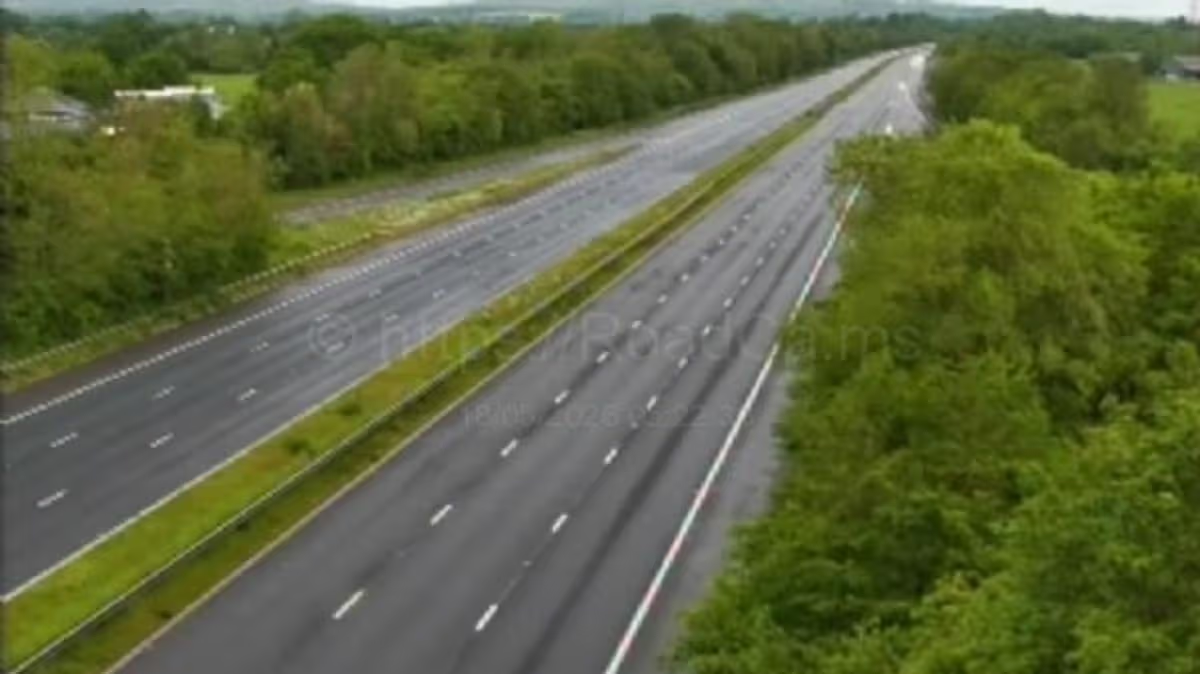
In the early hours of Monday, May 18, the rhythm of daily life across a significant stretch of the country was abruptly disrupted. At approximately 4:30 a.m., a major national artery, a vital conduit for thousands of morning commuters, freight lorries, and long-distance travelers, was suddenly sealed. National Highways, the authority responsible for the nation’s strategic road network, announced the closure with urgent brevity. The specific cause of the incident was not immediately detailed in public communications, leaving a vacuum filled with speculation and concern. For those reliant on this route, the news transmitted via travel apps, radio bulletins, and social media was not just a traffic update; it was the first domino to fall in a cascade of personal and logistical challenges. The closure represented an immediate fracture in the planned trajectories of countless individuals, turning familiar routes into dead ends and predictable schedules into uncertainties.
Paragraph 2: The Ripple Effects of a Standstill
The impact of such a closure is never confined to the asphalt itself; it radiates outward with remarkable speed and force. Within minutes, alternative routes began to swell with redirected traffic, transforming normally manageable roads into sluggish queues. Commuters faced the grim reality of significantly extended journeys, with school runs, workplace arrivals, and crucial appointments thrown into jeopardy. The economic ripple effect was equally instantaneous: delivery schedules for goods and supplies were compromised, with logistics companies forced into costly recalibrations and delays. For emergency services, the incident necessitated careful rerouting and potentially slower response times to critical calls in affected areas. The closure acted as a massive obstruction in the circulatory system of the region, causing congestion, frustration, and financial strain far beyond the immediate site. Every delayed driver, every rescheduled delivery, and every anxious passenger became part of the story of this single, disruptive event.
Paragraph 3: The Critical Void of Information
In the midst of this operational chaos, one piece of information emerged as the most critical and, frustratingly, the most absent: a timeline for resolution. National Highways, while managing the incident response, stated clearly that there was “no estimated reopening time.” This declaration, though necessary for accuracy, created a profound void for the public. The absence of an estimate meant an absence of certainty. People could not plan their tomorrows; businesses could not confidently adjust their operations. The “unknown” became the dominant condition, fostering a climate of sustained inconvenience and anxiety. This lack of a forecast is often a sign of a complex incident—perhaps involving serious structural assessment, extensive cleanup, or detailed investigation—which requires careful, unhurried work before any safe restoration can be promised. While authorities worked behind the scenes, the public faced an open-ended suspension of normality, a waiting game without a visible clock.
Paragraph 4: The Human Stories Behind the Headlines
Beyond the official statements and traffic maps, this incident is composed of countless human narratives. It is the story of the family, already stressed, whose journey to a vital hospital appointment became an ordeal of navigation and stress. It is the story of the small business owner whose fresh produce sat idly in a van, losing value with every passing hour on a congested detour. It is the story of the long-distance traveler, hoping to reach a loved one, now facing the exhaustion of indefinite delay. For many, the road is not just a strip of tarmac; it is a lifeline connecting them to their responsibilities, their care networks, and their livelihoods. The closure forced improvisation, tested patience, and incurred real emotional and financial costs. These individual experiences, often unseen in broad news summaries, form the true fabric of the disruption, reminding us that infrastructure failures are, ultimately, human inconveniences and hardships.
Paragraph 5: The Unseen Work Towards Resolution
While the public experiences the standstill, a parallel universe of activity unfolds at the incident site. Engineers, safety officers, cleanup crews, and investigators are engaged in meticulous, often arduous work to diagnose the problem and restore safe passage. The declaration of “no estimated reopening time” is a testament to the complexity and seriousness of their task. It acknowledges that safety is paramount and that a premature or inaccurate prediction could be dangerously misleading. This team must work methodically, assessing any damage, coordinating potentially heavy machinery, ensuring environmental safety if hazards are present, and adhering to strict protocols. Their goal is not merely to open the road, but to open it safely and sustainably. This behind-the-scenes effort, though it prolongs the period of uncertainty, is a necessary investment in preventing further risk and ensuring the long-term integrity of a critical public asset.
Paragraph 6: Navigating Uncertainty and Looking Forward
As the situation continues without a clear end time, the public and authorities alike are navigating a shared space of uncertainty. The advice remains consistent: avoid the area, plan for extensive delays on alternative routes, and rely on official National Highways channels for the very latest updates. The incident serves as a stark reminder of our collective dependence on complex infrastructure and the fragility of our daily routines when it is compromised. It also highlights the importance of robust contingency planning for both individuals and organizations. Ultimately, the reopening will come, and traffic will flow again. But until that moment, the episode underscores a simple, powerful truth: in our interconnected world, the closure of a single road is not a local traffic issue; it is a regional event that tests adaptability, patience, and the resilience of the entire community it serves.