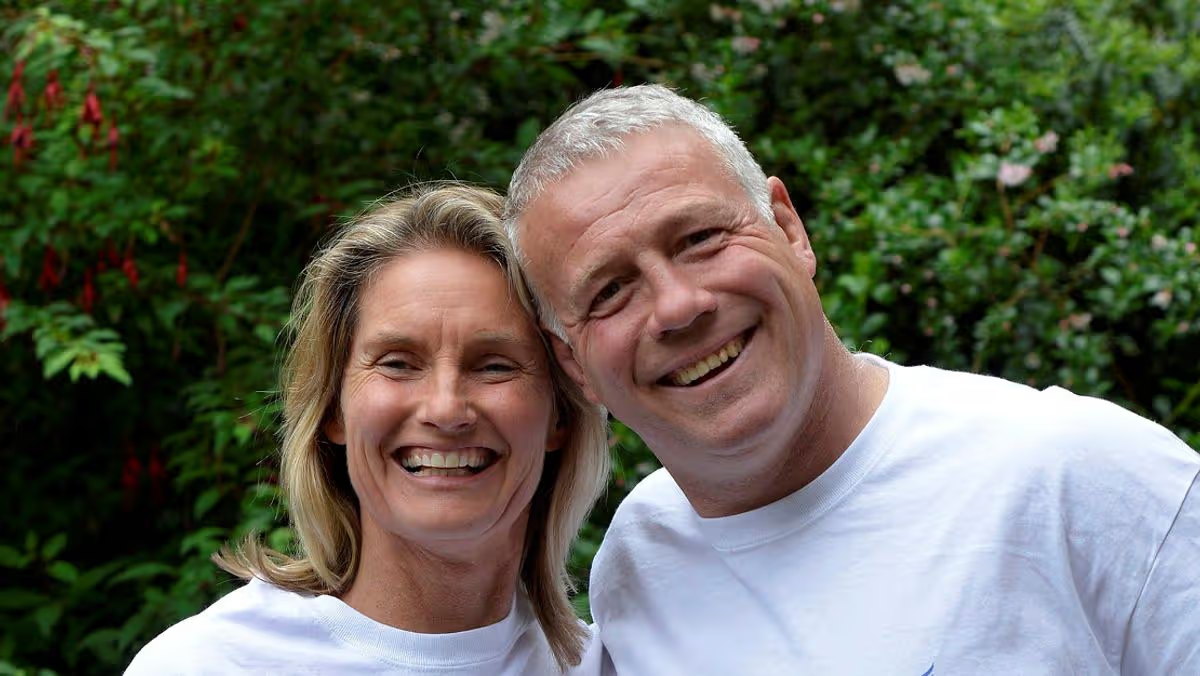




The world of rugby and beyond is mourning the loss of Scottish legend Scott Hastings, who died peacefully at the age of 61 on Sunday, May 17th, after a four-year battle with Non-Hodgkin lymphoma. His passing marks a profoundly poignant and sorrowful chapter for his family and the wider sporting community, coming just two years after the devastating loss of his beloved wife, Jenny. In a heartbreaking twist of fate, Scott’s death occurred on Jenny’s birthday, a detail his family highlighted as a sign that he is now “safe and with his beloved Jenny.” The former centre, who remains Scotland’s most-capped male player in his position with 65 appearances and a storied British & Irish Lions career, had been undergoing treatment before complications led to a rapid decline. Surrounded by family in the Western General Hospital ICU, his departure was peaceful and pain-free, yet it leaves a void compounded by the family’s earlier tragedy.
Scott’s death is inextricably linked to the profound grief his family has endured since the tragic disappearance of his wife, Jenny Hastings, in 2024. A mother-of-two who had bravely and publicly shared her two-decade struggle with severe depression, Jenny went missing while swimming at Wardie Bay in Edinburgh, a place she found healing. Her body was discovered on what would have been the couple’s wedding anniversary, September 7th. The family’s statement at the time spoke of a woman who, when well, was “radiant and beautiful and outgoing,” but who was ultimately “unable to cope” with her suffering. Scott himself had spoken movingly of the challenge of seeing someone he loved grapple with poor mental health, stating, “I miss Jenny every day.” These twin losses—Jenny’s to mental illness and Scott’s to cancer—weave a narrative of enduring love shadowed by immense personal hardship.
On the field, Scott Hastings was a titan—a defining figure of Scottish rugby’s golden era in the late 1980s and early 1990s. Inducted into the Scottish Rugby Hall of Fame just last October, his legacy is sealed by a career built on formidable defence, fierce competitiveness, and unwavering passion. Former Scotland and Lions coach Sir Ian McGeechan, who began his international coaching journey alongside Scott and his brother Gavin, remembered him as “single-minded and determined about winning,” a right-hand man on the pitch. Hastings’s most iconic performance came in the 1990 Five Nations Grand Slam decider against England, where he marshalled the defence and famously gave “nothing away” to his Lions teammate and English rival, Jeremy Guscott. That day at Murrayfield, his combination of “passion, confidence and aggression,” as recalled by former teammate and Scotland head coach Gregor Townsend, epitomized what it meant to wear the navy blue jersey.
Beyond the raw statistics—65 Scotland caps, 12 Lions appearances across two tours, 13 games for the Barbarians—Scott Hastings was remembered for the spirit and leadership he brought to every team. A proud Watsonian who also wore the Edinburgh jersey with distinction, he was described by Scottish Rugby as a player whose “stellar stats tell far from the whole story.” He was a cornerstone of a successful national side and a leader on historic Lions tours, his presence elevating those around him. Tributes from teammates, coaches, and commentators, including an emotionally charged BBC broadcast, have painted a picture of a man who was as respected for his competitive fire as he was admired for his character off the pitch. In his honour, the flag at Scottish Gas Murrayfield Stadium flies at half-mast, a silent tribute to a man who helped define the fortress it represents.
The cumulative weight of these events—Jenny’s long struggle and tragic death, followed by Scott’s own courageous fight against cancer—presents a narrative of heartbreaking symmetry and profound sadness. That Scott passed on Jenny’s birthday offers a fragile solace to a family that has borne too much, a suggestion of a reunion that transcends the pain of the last few years. Their children, Corey and Kerry-Anne, now grieve both parents, their request for privacy and space to process their loss a stark reminder of the very human reality behind the public tributes. The family’s openness about Jenny’s mental health struggles and Scott’s illness has also brought difficult but vital conversations about these challenges into the light, amidst the celebration of a sporting life.
As the rugby world remembers Scott Hastings the legend—the granite-tough centre, the Lions tourist, the Hall of Famer—it also mourns Scott Hastings the man, who loved and was loved deeply, and who faced profound personal adversity with dignity. His legacy is dual: etched in the record books and in the memories of iconic victories, but also woven into a story of enduring partnership and tragic loss. The tributes pouring in honour not just the athlete, but the person who lived with great heart through both triumph and despair. In this moment of reflection, the family’s experience also serves as a poignant reminder of the importance of support for those battling illness, both physical and mental. For anyone struggling, organizations like the Samaritans, reachable at 116 123, offer a crucial lifeline, a echo of the compassion needed in stories like that of Scott and Jenny Hastings.