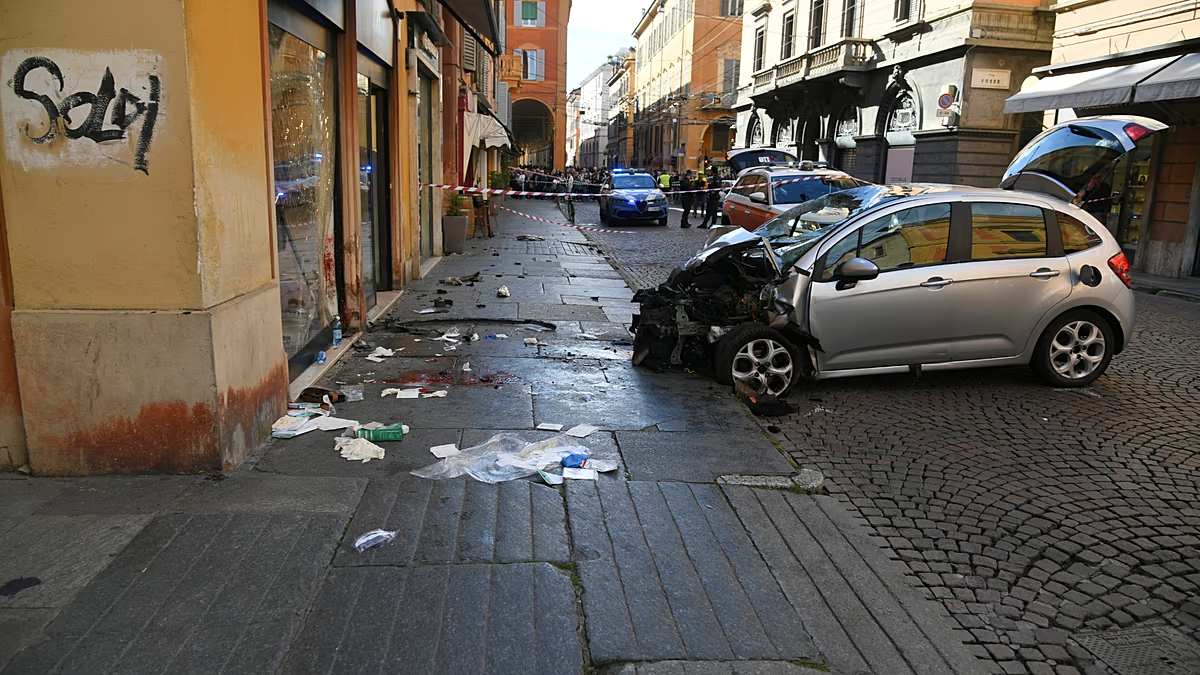


On a Saturday afternoon in the Italian city of Modena, a moment of ordinary life was shattered when a car, driven at speed, veered into pedestrians. The vehicle struck several people before crashing through a shop window, culminating in a head-on collision with a woman. The incident left eight individuals injured, with four in critical condition. Authorities quickly investigated the motive, and while the driver was a 31-year-old Italian man of Moroccan heritage, investigators have definitively ruled out terrorism as a factor. The focus shifted instead to a profound personal tragedy, rooted in mental health.
The driver, identified as Salim El Koudri, was an economics graduate not previously known to police. Officials revealed he had experienced a period of “psychological disturbance” in 2022 related to a schizoid illness. He had been under treatment at local mental health centres but subsequently disappeared from their care. Modena’s Mayor, Massimo Mezzetti, stated the man “reappeared in this form today in a dramatic and unfortunate way.” A search of his home near Modena found no signs of radicalisation, corroborating the assessment that this was not an act of ideological violence but a catastrophic manifestation of individual crisis.
The human cost of the event is severe and heart-wrenching. Among the injured were a German tourist and a Polish woman. A 55-year-old woman, crushed against the shop window, had her legs amputated and remains in life-threatening condition at a Bologna hospital. A 52-year-old man is in intensive care there, and another injured man also suffered amputations of his lower limbs. Others, including a 53-year-old woman, a 69-year-old woman, and a 69-year-old man, were admitted to a Modena hospital. While a 27-year-old woman, a 71-year-old woman, and a 47-year-old man sustained minor injuries, the overall picture is one of profound physical trauma inflicted upon innocent bystanders.
In the chaotic aftermath, moments of remarkable courage emerged. After crashing, El Koudri abandoned the car and attempted to flee on foot. He was chased and cornered by four passers-by, who demonstrated extraordinary bravery. When the suspect pulled a knife with a 20-centimetre blade and injured one of them, the group nonetheless managed to immobilise and contain him until police arrived. Their intervention ensured the perpetrator was swiftly handed over to authorities. The Modena Public Prosecutor’s Office later formalised his arrest on heavy charges of massacre and injuries aggravated by the use of a weapon.
The national response saw Italian Prime Minister Giorgia Meloni and President Sergio Mattarella visit Modena on Sunday. Meloni, who had quickly condemned the attack online, expressed her trust that the person responsible would “answer to the full for his actions” and thanked the courageous citizens who intervened. However, some political figures attempted to instrumentalize the tragedy. Despite the attacker being an Italian citizen, members of the League party, part of Meloni’s coalition, called for stricter controls on immigration, with leader Matteo Salvini labelling him “a second-generation criminal.” This narrative was directly countered by Modena’s mayor, who pointed out that two Egyptian nationals had been among those who helped stop the armed driver. Mayor Mezzetti urged the city to “unite against those who want to divide and sow hatred” and called for a collective embrace in the city centre.
In the wake of the violence, community leaders sought to foster unity and context. Mayor Mezzetti appealed for reflection, noting that “foreigners are not all similar to those who committed this act.” The imam of Ravarino, Abdelmajid Abouelala, a contact for the local Islamic community, expressed the group’s distress. He confirmed he did not know Salim El Koudri but knew his father well, describing him as a good, hard-working, and educated person. “We are really upset by what happened,” the imam said, underscoring that the small community was shocked by an act committed by someone they did not recognize. The event thus stands as a complex tragedy: a violent act stemming from personal mental illness, met with public bravery, whose aftermath tested the community’s cohesion against attempts to exploit it for division.