
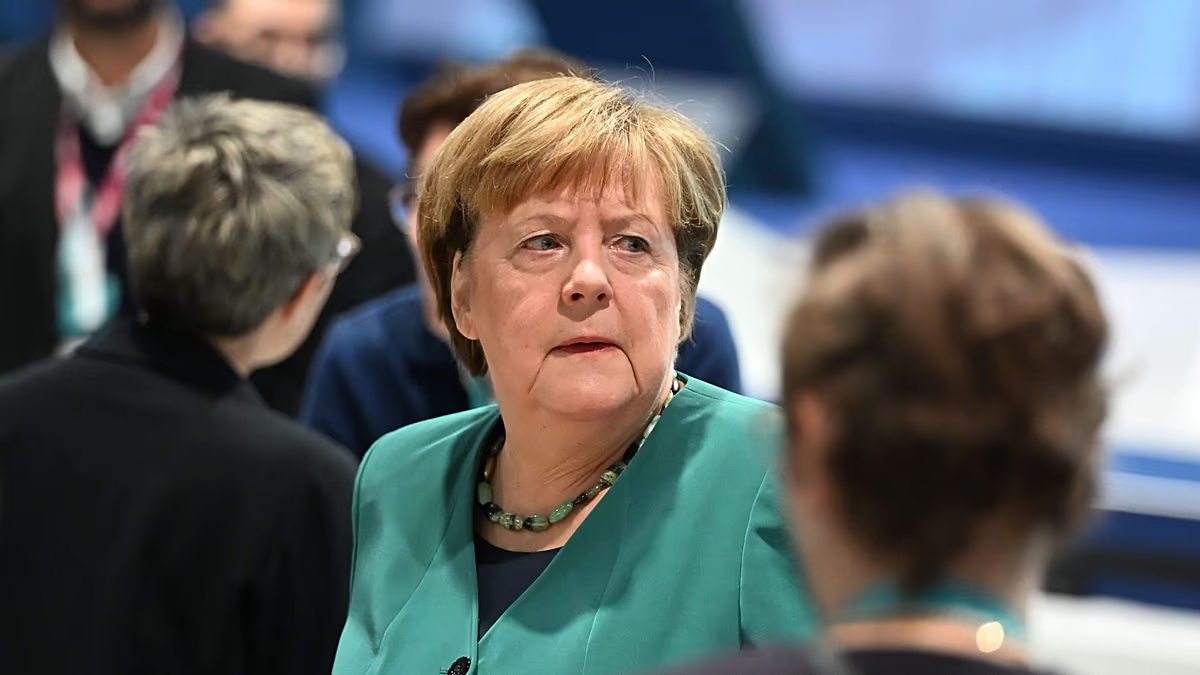


When Angela Merkel receives the European Order of Merit in Strasbourg, the ceremony transcends the honoring of a former German chancellor. It represents a broader European judgment on an era and a deliberate statement about the qualities of leadership the European Union values in an age of profound instability. By elevating Merkel to the rank of “Distinguished Member”—alongside figures like Volodymyr Zelenskyy and Lech Wałęsa—the European Parliament is crafting a symbolic trinity: democratic resistance, political endurance, and the quiet work of unity. This award, for “significant contributions to European integration,” interprets her 16-year legacy not as one of flamboyant vision, but of indispensable stability. In a union shaken by successive existential crises, from financial collapse to geopolitical rupture, Merkel came to be seen as the essential stabilizer, the “Mutti” or mother figure who ensured the German—and by extension, the European—boat would not capsize.
Her leadership was defined by a cautious, pragmatic, and resolutely non-ideological style. Trained as a physicist, she governed through incremental compromise and fact-driven crisis management, a technocratic approach that became her signature. For European institutions, honoring this style is a conscious defence of consensus politics and institutional respect at a time when both are under assault by populists and strongmen. As the EU faced division, Merkel repeatedly acted as its anchoring force. During the eurozone debt crisis, she insisted on keeping Greece within the euro despite fierce domestic opposition. Through the Brexit negotiations, she helped maintain a remarkably united EU front. And as Donald Trump questioned NATO’s very purpose, her 2017 declaration that Europe must “take our destiny into our own hands” marked a pivotal awakening to a new, more self-reliant geopolitical reality. For many, her great achievement was preserving European cohesion precisely when fragmentation seemed not just possible, but inevitable.
Yet, the award simultaneously reignites the fierce and unresolved debate over the limitations and consequences of her approach. Critics argue that her management style often stabilized a crisis in the moment without solving its root causes, effectively “kicking the can down the road.” They see a leader who prioritized temporary compromise over visionary transformation. Her insistence on strict fiscal austerity during the euro crisis bred deep and lasting resentment in Southern Europe, exacerbated by comments that seemed to invoke stereotypes of “lazy” Mediterranean nations. The 2015 decision to open Germany’s borders to refugees, guided by the humanitarian conviction of “Wir schaffen das” (“We can manage this”), was perhaps her most polarizing act. While hailed as a moral stand, it bitterly divided the EU, inflamed East-West tensions over sovereignty, and fueled the rise of far-right movements across the continent—a backlash even some within her own party now acknowledge.
Most consequentially, her long-standing strategic and economic philosophy is now viewed with profound scepticism. The pursuit of economic interdependence with authoritarian regimes, a cornerstone of her policy, is seen by many as a historic miscalculation. Germany’s deep dependence on Russian gas, cemented by the Nord Stream pipelines, is now viewed as a strategic vulnerability that enriched and empowered the Kremlin ahead of its invasion of Ukraine. Similarly, Germany’s heavy reliance on the Chinese market and export-led growth model is criticized for fostering European dependencies and straining transatlantic ties. In hindsight, this approach prioritized economic stability and short-term comfort over strategic resilience and geopolitical foresight. The EU’s current urgent drive for “strategic autonomy” is, in many ways, a direct reaction against the assumptions that underpinned the Merkel era.
This complex mix of admiration and critique explains why Merkel remains such a uniquely resonant European figure. She is honored not because Europeans believe she was always right, but because she came to personify the EU’s own central and enduring tension: the immense challenge of reconciling peace, prosperity, and democratic values within a framework of deep interdependence, all while navigating an increasingly hostile world. Even some of her staunchest critics concede that the union emerged from her tenure more institutionally unified than many had predicted at the height of its crises. She embodied the messy, grinding, and often frustrating work of holding a disparate project together, day by day and crisis by crisis.
The timing of this award is, therefore, politically revealing. As Europe confronts a resurgent Russia, the prospect of a second Trump presidency, and intensified global competition, the Parliament is sending a signal of continuity. It is canonizing a model of leadership defined not by charisma or revolutionary change, but by endurance, restraint, and the preservation of the European center. Ultimately, the European Order of Merit represents a provisional verdict. The final historical judgment—whether Merkel was the leader who saved the European project through steady management or the one who postponed its necessary reckoning with harsh new realities—remains unwritten. For now, Brussels has decided that her contribution to holding Europe together in its most fragile moments outweighs the consequential mistakes that later came into sharp relief. The ceremony is less about the past than about the present, a statement of what Europe believes it must cherish from its recent history as it navigates an uncertain future.