

Poland’s Hydrogen Bus Dream Faces a Cold, Economic Reality
Poland’s vision of a hydrogen-powered public transport future is encountering significant and practical roadblocks, as revealed by a recent analysis from the NGO Central and Eastern Europe Bankwatch Network. Initially, the allure was strong: generous EU and state subsidies, sometimes covering up to 100% of the purchase price for hydrogen buses compared to 60-80% for electric models, made them an attractive shortcut for municipalities aiming to green their fleets. However, the operational reality has proven harsh. Once these buses hit the streets, operators were confronted with dramatically higher fuel costs compared to electricity and a critically underdeveloped refueling infrastructure. This economic shock is now causing many cities to reconsider their strategy, retreating towards more proven and cost-effective battery-electric alternatives.
The Staggering Cost of “Green” Fuel
The financial burden is stark. Cities like Rybnik reported that running hydrogen fleets was more than three times as costly as diesel and four times as costly than hybrids. In Rzeszów, projections indicated that fuel costs over a 15-year period would exceed the entire purchase price of the buses themselves. This is compounded by a severe infrastructure gap. By the end of 2025, Poland had only nine hydrogen refueling stations in operation, a far cry from the 32 stations envisaged in the government’s 2021 strategy. This stands in sharp contrast to the over 12,500 electric charging stations available by early 2026, highlighting a mature network for battery-electric vehicles. Despite ambitious numbers—247 hydrogen buses either deployed or contracted—the ecosystem to support them sustainably is missing.
Questioning the “Zero-Emission” Label
Beyond economics, the report raises profound questions about the environmental credentials of Poland’s current hydrogen bus program. Under EU rules designed to decarbonize public transport, hydrogen was championed as a flagship clean technology. However, the NGO argues that the “zero-emission” label applied to these buses is misleading, as it only considers tailpipe exhaust. Over 97% of the hydrogen fuel used in Poland is produced from fossil gas, generating significant emissions at the production stage. Even hydrogen produced using electrolysis often relied on electricity from biomass, which the report contends does not meet strict EU renewable standards. This creates a paradox: buses promoted as a clean solution are largely dependent on a fossil fuel supply chain, undermining their climate benefits.
The Shift Towards Pragmatic Electric Solutions
In contrast, battery-electric bus technology has advanced rapidly in range, infrastructure, and economics. Poland’s electricity grid itself is transitioning, with renewables now generating about 30% of power, offering a progressively cleaner source for electric buses. Recognizing this divergence, several municipalities are pivoting. Cities including Wrocław, Płock, and Żory revised procurement plans after concluding electric vehicles offered lower risk and cost. Kraków scaled back its hydrogen ambitions due to uncertainties over fuel supply and infrastructure. This pragmatic shift suggests a reassessment based on operational experience rather than initial subsidy appeal.
Funding Amidst Uncertainty
Despite these challenges, hydrogen investment continues. In April, Poland received a new batch of EU funds, including €500 million earmarked to boost private sector growth in renewable and low-carbon hydrogen production. The government is considering deploying over 1,000 new electric or hydrogen buses. Questions remain about which technology will be prioritized. The CEE Bankwatch Network report criticizes past funding allocations, noting that over €120 million in grants and loans backed hydrogen bus and station projects. The author, Diana Maciaga, argues these vast public funds were spent to “artificially create demand” for an unready technology, instead of deploying tried-and-tested solutions that offer immediate community and climate benefits.
A Divergent Path from Germany and Future Prospects
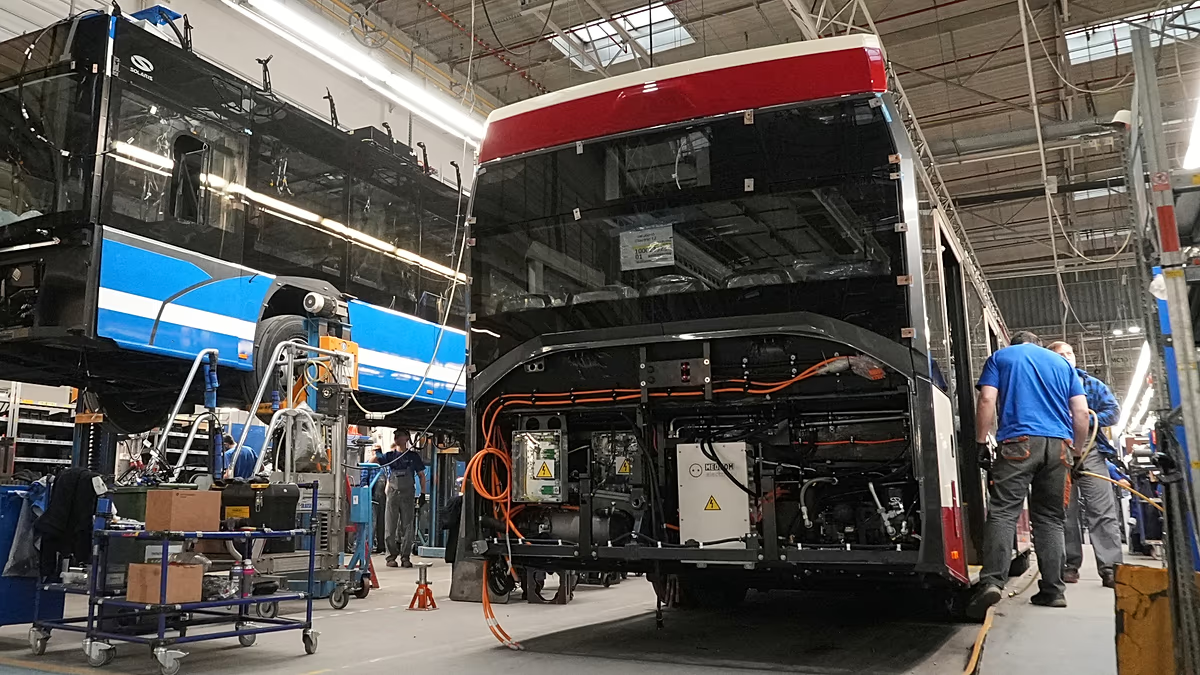
Poland’s struggles stand in contrast to neighboring Germany, a hydrogen success story currently operating over 600 hydrogen buses in public transport. Polish manufacturer Solaris, a leader in fuel-cell bus production in Europe, continues to supply buses abroad, including a recent order for 19 more to Germany. Industry representatives, like Laurent Donceel of Hydrogen Europe, view Poland’s early-stage hurdles as “completely normal” for a nascent industry. They acknowledge Poland as a leading EU producer and argue that with proper incentives and regulatory support, it can catch up. They also posit that, given Poland’s current coal-heavy energy mix, clean hydrogen remains a vital long-term decarbonization option. However, the current report underscores that for Polish municipalities today, the promise of hydrogen is overshadowed by its prohibitive costs and logistical frailties, forcing a more cautious and economically grounded approach to cleaning up public transport.