

A Shift in Summer Travel: Embracing the Near and Dear
As the summer of 2026 approaches, a significant transformation is taking place in how Europeans plan their holidays. Driven by mounting concerns over soaring jet fuel prices, travellers are fundamentally rethinking their getaways. According to new data from Airbnb, a clear trend is emerging: the era of the long-haul, budget-busting flight is giving way to more economical, intimate, and locally focused travel experiences. This isn’t merely about cutting costs; it’s a conscious recalibration towards sustainability, simplicity, and rediscovering the beauty much closer to home.
The Staycation and Short-Haul Surge
The most striking evidence of this shift is the dramatic rise in domestic travel, or “staycations.” Across major European nations like France, Germany, Sweden, Portugal, and the Netherlands, a full quarter of travellers are choosing to holiday within their own borders in 2026. For those who do venture abroad, the journey is getting notably shorter. In Sweden, for instance, the median distance travellers are booking has plummeted by 26% since 2023, now sitting comfortably under 500 kilometres—a distance easily covered by train, car, or a brief flight. This pivot suggests a collective deep breath, a decision to forgo the stress of distant airports in favour of accessible, often overlooked gems within a few hours’ reach.
Travel as a Shared, Social Affair
Another key adaptation to economic pressures is the growing preference for group travel. The data shows a marked increase across Portugal, Spain, and Sweden in bookings for four people or more. This trend points to a savvy, social strategy: splitting the costs of accommodation and transport makes a holiday more affordable for everyone involved. It transforms a vacation from an individual luxury into a shared, communal experience—be it a multi-generational family reunion, a trip with friends, or a collective retreat. This move towards group travel reinforces the idea that the value of a holiday lies not in its extravagance, but in the quality of connection and shared memories it fosters.
The Allure of Rural Escapes
Simultaneously, there is a powerful gravitational pull towards nature and tranquility. More than half of all summer bookings in tourism powerhouses like Germany and France are for rural destinations—encompassing the serene countryside, refreshing coastlines, and majestic mountains. This surge speaks to a post-pandemic desire for space, fresh air, and a slower pace of life that contrasts with bustling city breaks. Travellers are seeking immersion in landscapes that offer hiking, cycling, swimming in lakes, and simply unwinding in settings where the horizon is defined by trees or sea, not skyscrapers.
Europe’s Trending Hideaways
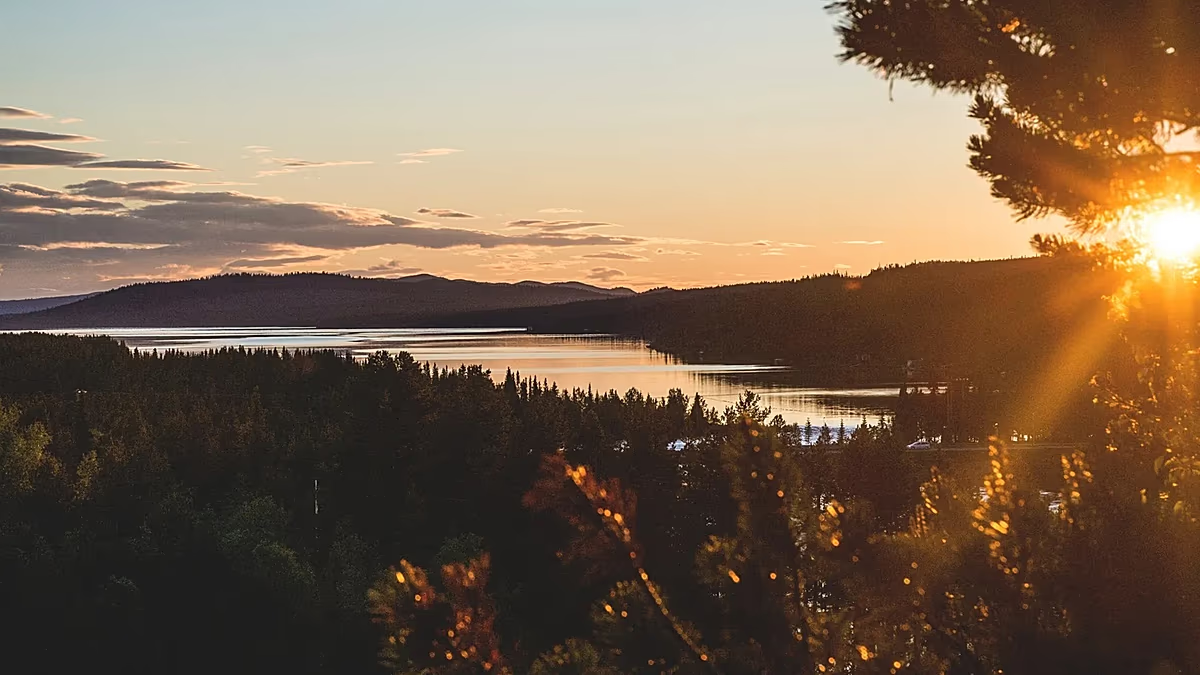
So, where exactly are these cost-conscious, nature-seeking travellers heading? Airbnb’s data, comparing early 2025 bookings for summer 2026 to previous years, reveals a fascinating map of emerging hotspots. In Italy, the alpine region of Trentino-South Tyrol, famed for the dramatic peaks of the Dolomites, is drawing visitors for its unparalleled hiking and crystal-clear lakes. For the British, the lesser-known Veneto Mountains offer a similar alpine appeal. In France, the rustic charm and profound history of Normandy are captivating British and Dutch tourists, particularly its picturesque villages like Beuvron-en-Auge. Germans are seeking the vast, forested tranquility of rural Sweden, in areas around Växjö and Kalmar. Meanwhile, the sunny, affordable coastline of Albania is having a moment, with interest in the city of Vlorë nearly doubling. Even the subtropical island of Madeira, already crowned a global trending destination, continues to grow in popularity for those seeking scenic grandeur without venturing too far from Europe.
The Deeper Meaning of the Journey
This collective shift is more than a simple economic reaction; it represents an evolution in the philosophy of travel. The pursuit is no longer solely about ticking iconic foreign landmarks off a list. It is increasingly about depth over distance, authenticity over prestige, and well-being over whirlwind itineraries. Travellers are finding that a deep exploration of a neighbouring region or a peaceful week in a domestic forest can be more rewarding and restorative than a costly, hectic transcontinental journey. The emphasis is on the experience itself—the taste of local produce, the rhythm of rural life, the laughter shared with companions in a rustic cottage—rather than the passport stamp acquired.
A Sustainable Path Forward
Ultimately, the travel landscape of summer 2026, as illuminated by these trends, paints a picture of adaptation and intentionality. Faced with economic headwinds, European travellers are not cancelling their holidays; they are reinventing them. They are choosing connections—to their own countries, to nature, and to each other—in more meaningful and sustainable ways. This new pattern suggests a lasting change in mindset, one that prioritizes resilience, community, and a renewed appreciation for the remarkable diversity and beauty found much closer to home. The great European adventure, it seems, is no longer measured in miles flown, but in the richness of the experience discovered just around the corner.