

The Missing Peace: How Gender Imbalance Undermines Lasting Diplomacy
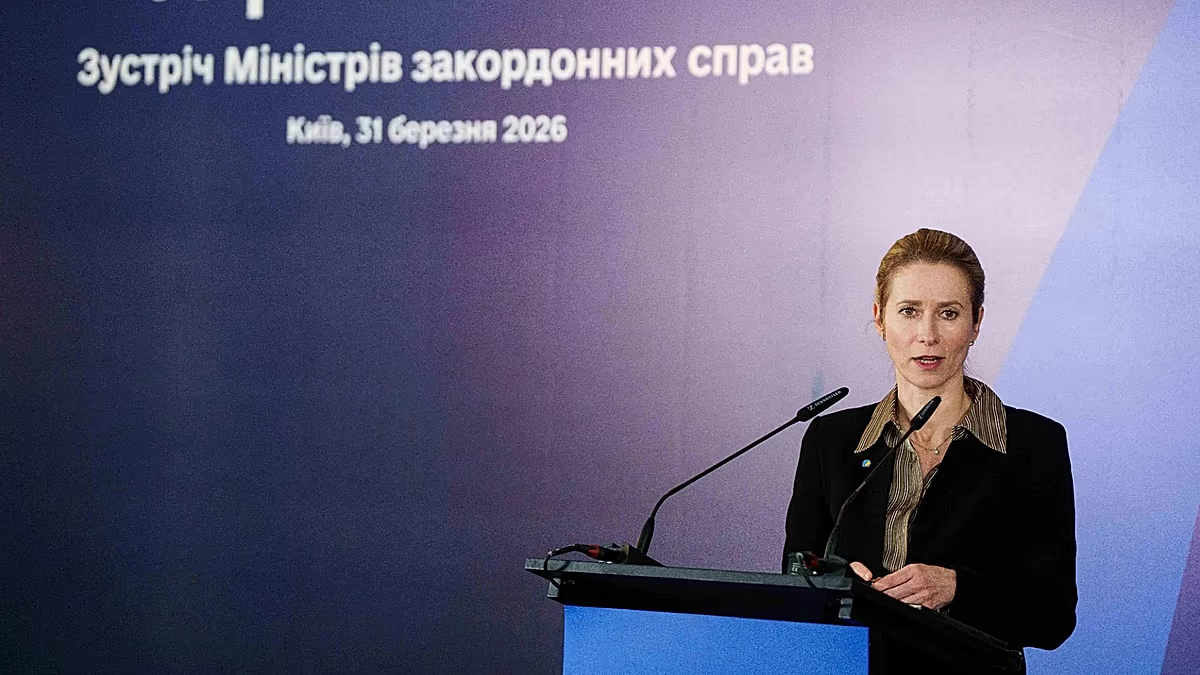
In an era where global conflicts seem increasingly intractable, the European Union’s foreign policy chief, Kaja Kallas, has issued a profound critique that strikes at the heart of modern diplomacy’s failures. Speaking in Tallinn, Estonia, she highlighted a pervasive, global pattern in peace negotiations: they are overwhelmingly dominated by men. Kallas argues that this gender imbalance is not merely a symbolic issue of representation but is intrinsically linked to the short-term, fragile nature of contemporary peace accords. The ceasefires that emerge from these male-dominated rooms, she contends, too often serve as mere pauses in hostilities—declarations that fighting has stopped without resolving the deep-seated, underlying grievances that fuel cyclical violence. Her critique suggests that the very structure of our diplomatic efforts, by excluding diverse perspectives, is designed to produce temporary truces rather than enduring peace, leaving communities in a perpetual state of precarious recovery.
The Data-Driven Case for Inclusive Negotiations
Kallas’s argument is powerfully supported by a growing body of international research and precedent. She pointedly referenced studies demonstrating that when women are part of negotiation processes, the resulting peace agreements are significantly more durable and comprehensive. This view is echoed by institutions like the United Nations Security Council, which has long advocated for the meaningful participation of women in conflict resolution through resolutions like UNSCR 1325. Despite this consensus, the reality on the ground remains starkly different. Data from the Council on Foreign Relations reveals a sobering statistic: in 2022, women constituted a mere 16 percent of negotiators in UN-led or co-led peace processes. This discrepancy between recognized best practice and on-the-ground reality reveals a critical implementation gap. The image Kallas evoked—of a negotiation room filled with “a lot of masculinity,” as seen in recent U.S.-China talks—is the global norm, not the exception, actively undermining the potential for sustainable outcomes.
A European Quandary: Who Gets a Seat at the Table?
Kallas’s comments were made amidst a live, contentious debate within the European Union regarding its role in one of the world’s most urgent conflicts: the war in Ukraine. The central question is whether the EU should have a formal seat in any future negotiations between Russia and Ukraine, and if so, who would embody the bloc’s voice. This discussion took a curious turn when Russian President Vladimir Putin suggested former German Chancellor Gerhard Schröder as a potential EU lead negotiator—a proposal swiftly dismissed by European leaders. Beneath the surface of this political maneuvering lies a more insidious tension concerning gender. Diplomatic sources have indicated that Russia would “never” accept a woman as a lead negotiator, a stance that casts a long shadow over the EU’s internal values of equality and inclusion. While one Brussels source confirmed that a female envoy is not currently under consideration, another emphasized that “equality is an important factor,” highlighting a fundamental clash of principles at the negotiation’s very threshold.
Balancing Ideals with Political Realities
Faced with this clash, EU officials are navigating a complex path between advocating for inclusive diplomacy and confronting geopolitical hardball. Anitta Hipper, spokesperson for foreign affairs at the European Commission, clarified that while Chief Kallas is a respected feminist with substantial political experience as Estonia’s first female prime minister, the Commission cannot speculate on Russia’s potential objections to a female negotiator. The immediate focus, she explained, is on substance over symbolism. Ahead of a crucial European Council summit in June, the priority for EU leaders meeting in Cyprus is to solidify a unified position on the concrete demands to be placed on Russia, rather than fixating on the personal identity of the negotiator. “This is something that we will be looking into—into the what, and not into the who,” Hipper stated, underscoring the pragmatic, albeit fragile, balance between upholding values and engaging in realpolitik to achieve a semblance of dialogue.
The Larger Struggle for a Transformative Peace
This European dilemma microcosmizes the global challenge Kallas identified. The resistance to female negotiators, particularly from parties like Russia, is a symptom of a broader diplomatic culture that often equates authority and toughness with masculinity. This culture perpetuates a model of conflict resolution focused on military ceasefires and power-sharing among armed actors, while marginalizing the perspectives of those—often women—who disproportionately bear the long-term burdens of war: displacement, the collapse of social services, and the intergenerational trauma that threatens community fabric. Lasting peace requires addressing these human security dimensions, and evidence suggests that women negotiators are more likely to prioritize such issues, from refugee return and human rights to economic reconstruction and societal reconciliation. Excluding them is not just a matter of fairness; it is a strategic error that dooms societies to repetitive cycles of violence.
Toward a More Effective Diplomacy
Ultimately, Kaja Kallas’s critique is a call for a fundamental reimagining of how peace is built. It challenges the international community to move beyond performative inclusivity and to structurally integrate gender perspectives into the core of diplomatic machinery. This means insisting on diverse negotiation teams as a non-negotiable standard for legitimacy and effectiveness, supporting the training and accreditation of female mediators, and leveraging diplomatic pressure to counter regressive stances that would bar women from the table. The goal is a more robust, resilient, and humane diplomacy. As the EU grapples with its role in Ukraine and beyond, its commitment to this principle will be a true test of its identity. Ensuring that peace processes include those who best understand the meaning of lasting peace is not a peripheral “women’s issue”; it is the central imperative for a more stable and just world. The quality and durability of peace, it turns out, depends significantly on who is in the room to shape it.