
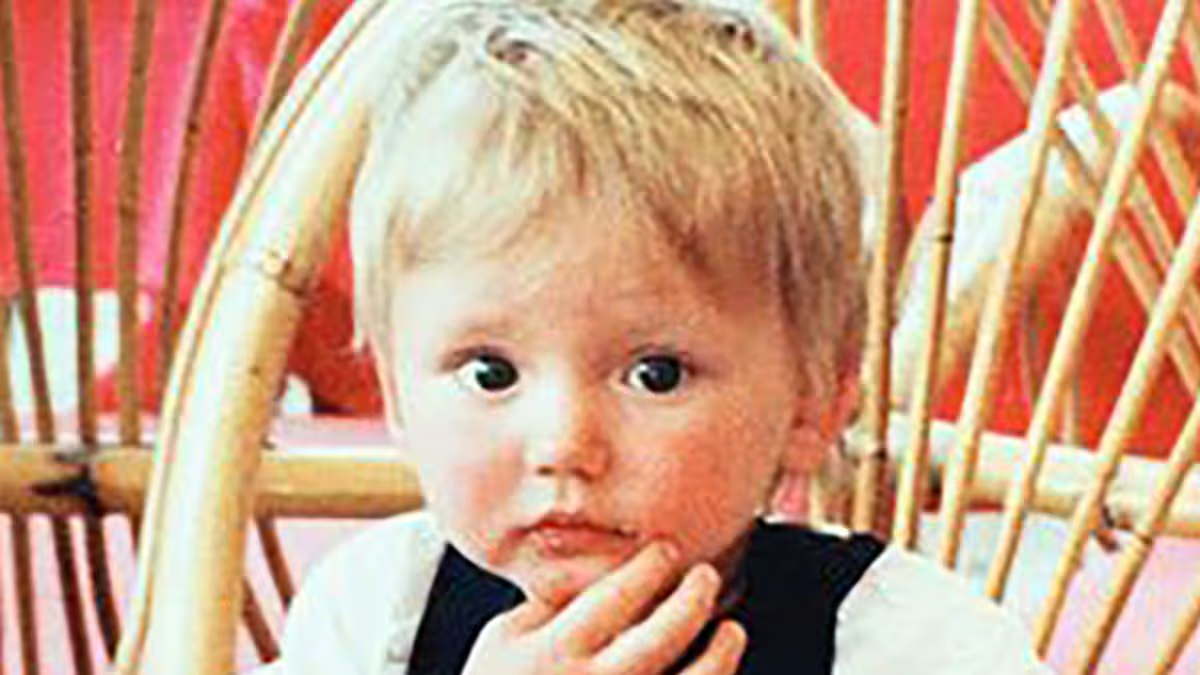



For thirty-five agonizing years, Kerry Needham has clung to a single, fragile thread of hope: that the British police force she trusts would never stop looking for her son, Ben. That thread has now been severed. In a devastating blow, South Yorkshire Police have informed her that they will no longer actively investigate Ben’s disappearance, effectively handing the case back entirely to the Greek authorities. The news, delivered via a video call, left Kerry in a state of profound shock and despair. “I sat there with my hand over my mouth shaking my head,” she recalls. “Then it was devastation… I just cried and cried and cried.” This decision feels not like an administrative change, but a profound abandonment, stripping away her primary conduit for action and leaving her terrified that Ben will be quietly forgotten.
Kerry’s desperation has compelled her to write directly to the Prime Minister, Sir Keir Starmer, pleading for his personal intervention. In her letter, she frames her plea not just as a grieving mother’s request, but as a matter of fundamental justice and equality. She outlines how South Yorkshire Police have been her lifeline, the only entity she could rely on to meticulously follow up on information and ensure it reached the proper channels in Greece. “South Yorkshire police are the only police force I can rely on,” she writes. Without them, she fears any new leads will simply languish in a foreign file. Her request is simple yet urgent: she seeks a meeting with the PM to argue that Ben’s case needs “more funding and resources – not less,” and to implore the British government to reaffirm its moral responsibility for a missing British child.
The shadow of another high-profile case looms large over Kerry’s fight, underscoring her sense of injustice. She draws a stark and painful comparison to the investigation into the disappearance of Madeleine McCann. Both are missing British children; both families have endured decades of unimaginable suffering. Yet, as Kerry points out, the disparity in support is staggering. The Metropolitan Police’s Operation Grange has cost over £13 million, while South Yorkshire Police’s efforts over a longer period have received less than £2 million. “I do not begrudge any missing child receiving support,” Kerry insists. “What I cannot accept is the clear inequality in how these cases have been treated.” To her, the message is chilling: some children remain a perpetual national priority, while others, like Ben, risk being “quietly allowed to fade into history.”
Her profound distrust of the Greek police is rooted in the traumatic early days of the investigation and the decades of stagnation since. When 21-month-old Ben vanished from outside a Kos farmhouse on July 24, 1991, Kerry believes critical errors were made, including a failure to lock down the island. Worse, she and her family were subjected to a campaign of discredit. Greek police propagated a narrative of them as an “unfit” travelling family, and a witness later admitted to British detectives that he was coerced into signing a false statement to smear Kerry’s name. A previous Mirror investigation even uncovered claims of a local “conspiracy of silence” to cover up police mistakes. “How can I trust them now?” Kerry asks. She believes handing the case solely to Greece would be a death knell for the investigation, a sentiment underscored by her stark declaration: “I will never get to know anything if the Greek police are in charge.”
Despite the crushing setback, Kerry Needham’s resolve remains unbroken. She is rallying the public, urging them to contact both South Yorkshire Police and the Prime Minister to demand a reversal of this decision. She refuses to accept that the passage of time diminishes a parent’s right to answers or a government’s duty to seek them. “I refuse to accept silence, indifference, or the suggestion that we should simply move on,” she states. Her fight is no longer just for Ben; it has become a crusade for the principle that every missing child, regardless of media profile or elapsed years, deserves an equal commitment to truth.
South Yorkshire Police, for their part, state they remain “ready to support Greek authorities should any new evidence come to light” and are committed to supporting Kerry through a family liaison officer. They emphasize that Greece holds primacy over the investigation and that Interpol is now the formal channel for information. But to a mother who has spent a lifetime battling, these assurances feel like a bureaucratic retreat. For Kerry, the withdrawal of active British investigative will is a devastating step backwards in a lifelong journey marked by heartbreak. Her final, powerful words hang in the air, a challenge to the authorities and a testament to a love that will not yield: “Ben was a little boy who disappeared without a trace. His life mattered then, and it matters just as much today.”