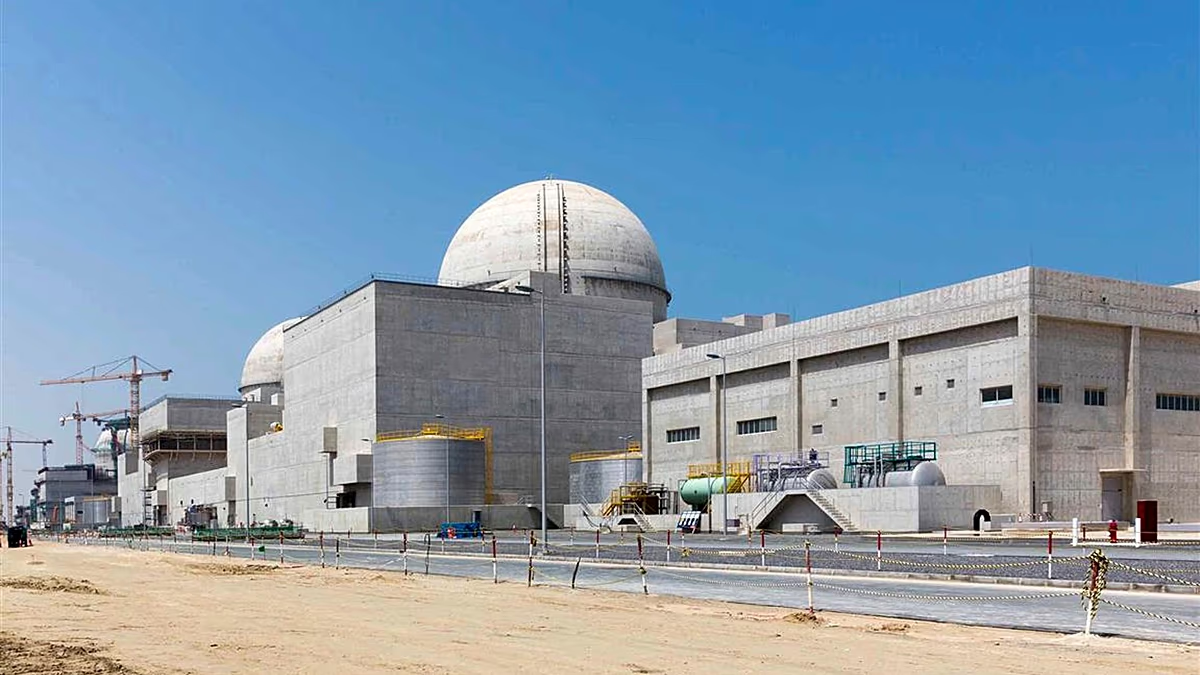


Twenty-four hours after a drone breached its sovereign airspace, the United Arab Emirates issued a formal statement labeling the incident at the Barakah nuclear power plant “an unprovoked terrorist attack.” The Emirates revealed a critical detail: the unmanned aircraft had entered the country’s territory from the direction of its western border. This geographical specificity is noteworthy, as it opens a line of inquiry distinct from the region’s most common antagonist. The Gulf states, including the UAE, maintain sophisticated air defense networks specifically calibrated to detect and intercept threats originating from Iran, their perennial regional rival. The immediate absence of accusations leveled against Tehran by the UAE or its neighbors suggests investigators are pursuing alternative possibilities regarding the drone’s origin. This initial restraint underscores the complex geopolitical landscape of the Middle East, where overt attribution can carry profound diplomatic and military consequences.
The target of this incursion was not just any facility; it was Barakah, the UAE’s flagship nuclear energy project—a symbol of national ambition, technological progress, and a commitment to a future beyond fossil fuels. The attack, occurring on Sunday, resulted in a fire damaging an electric generator located within the plant’s security perimeter. Fortunately, the UAE’s statement confirmed there were no injuries, and crucially, that radiation safety levels were completely unaffected, with no impact on the reactor’s core or its containment structures. This outcome speaks to the plant’s robust design and safety protocols, but it does not diminish the grave symbolism of the act. An attack on a nuclear facility, regardless of the immediate physical damage, carries an inherent psychological weight and risk, deliberately targeting a nation’s critical infrastructure and its sense of security.
In response, the Emirates adopted a tone of steely resolve. The government warned unequivocally that it “will not tolerate any threat to its security and sovereignty under any circumstances,” asserting its full rights to respond through diplomatic and military means. This language reflects a broader shift in the UAE’s foreign policy posture, moving towards a more assertive and independent defense of its national interests. The sentiment was powerfully echoed by Dr. Sultan Ahmed Al Jaber, the UAE’s Minister of Industry and Advanced Technology and CEO of the state-owned ADNOC. On Monday, he declared that the nation’s “resolve only grows stronger” following the assault. He framed the attack not merely as a security breach, but as an assault on progress itself: “a terrorist attack on a peaceful project… on the right of every nation to build, to progress, and to deliver clean energy to its people.” His statement elevated the incident from a military skirmish to a philosophical conflict between development and destruction.
The international reaction from within the region was largely one of condemnation, highlighting a shared anxiety over the targeting of such sensitive infrastructure. Qatar’s foreign ministry, for instance, called the attack “a blatant violation of international law and a serious threat to regional security.” This consensus underscores a common Gulf understanding: attacks on critical energy and civilian infrastructure represent a dangerous escalation that threatens the stability of all. Beyond the Middle East, the global nuclear industry voiced its profound concern. The World Nuclear Association confirmed the plant’s safe operation but issued a stern reminder of international obligations, calling on all parties to “revisit the agreements of the Geneva conventions” regarding the protection of civilian energy facilities. The Association also highlighted the vital role of the International Atomic Energy Agency (IAEA) in monitoring such incidents and upholding the frameworks of international law.
This event sits within a troubling pattern of low-intensity, asymmetric warfare in the region, where drones and missiles have become the preferred tools for shadowy attacks on economic and symbolic targets. The Barakah plant represents the pinnacle of the UAE’s vision for a sustainable and technologically advanced future. An attack on it is, therefore, an attack on that vision itself—a attempt to instill vulnerability at the heart of national pride. While the immediate physical danger was contained, the successful penetration of airspace to strike such a high-profile target raises inevitable questions about defense capabilities and the evolving nature of threats in the modern Middle East.
Ultimately, the drone attack on Barakah is a multifaceted event. It is a security incident with a yet-unclear perpetrator; a psychological strike against a nation’s symbols of progress; a test of international safety protocols for nuclear infrastructure; and a stark reminder of the fragile security environment in the Gulf. The UAE’s measured yet firm response—focusing on investigation, reaffirming sovereign rights, and highlighting the plant’s peaceful purpose—aims to project strength and stability. However, the incident leaves a lingering unease. It demonstrates that even the most modern, defended, and internationally significant facilities are not beyond the reach of those who seek to undermine regional stability through covert and provocative acts. The path forward now depends on the investigation’s findings, the UAE’s chosen response, and the ability of the international community to reinforce the absolute prohibition against targeting civilian nuclear infrastructure.