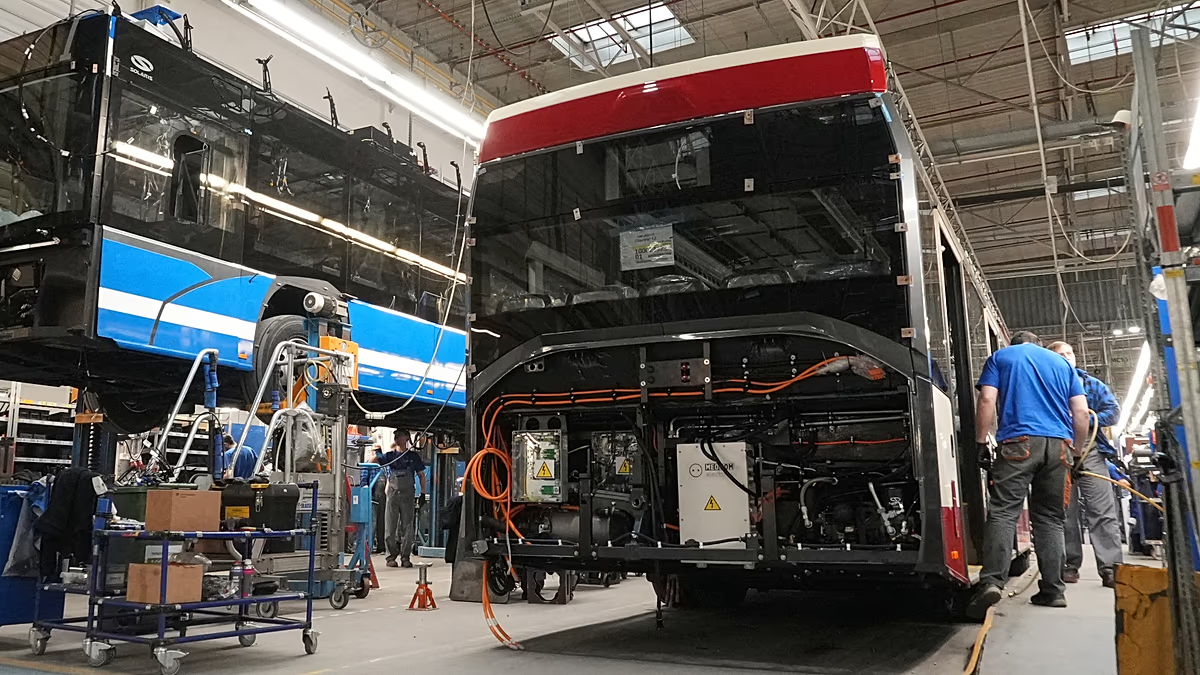


The European Union stands at a critical economic crossroads, its market increasingly flooded by competitively priced Chinese goods. This surge in imports, from electric vehicles to critical chemicals, is perceived in Brussels not merely as a market shift but as an existential threat to the bloc’s industrial base and the thousands of jobs it sustains. The urgency is underscored by stark trade data, showing an ever-widening deficit with China that reached a colossal €359.9 billion in 2025 and continues to grow. This economic pressure is compounded by geopolitical tension, as Beijing responds to EU regulatory measures with threats of retaliation and bans on cooperation, creating a cycle of action and reaction. Faced with this challenge, the European Commission is mobilising a suite of defensive strategies, aiming to protect its economic sovereignty while navigating the complex reality of deep, established interdependence with the world’s second-largest economy.
In response, EU policymakers are crafting tools aimed at bolstering resilience from within. A primary focus is reducing critical dependencies, a lesson sharply reinforced by China’s past restrictions on rare earths and semiconductors. One proposed measure would mandate that EU companies source key components from a minimum of three different suppliers, preventing over-reliance on any single country, notably China. This “de-risking” logic extends to strategic sectors like telecommunications, where a push to phase out equipment from “high-risk” suppliers such as Huawei and ZTE faces its own practical hurdles. While motivated by security, this strategy collides with economic reality: Chinese suppliers are often significantly cheaper, partly due to state subsidies, and are deeply embedded in Europe’s digital infrastructure. European telecom operators warn that replacing this equipment would carry a staggering price tag, one that neither the EU nor national governments have yet shown willingness to pay.
When it comes to direct competition, the EU is increasingly reaching for its traditional trade defence toolkit. The threat of imposing anti-dumping or anti-subsidy duties on Chinese imports is a significant lever, designed to counteract products sold below market value or bolstered by unfair state support. The recent move to impose double tariffs on steel imports, a sector dominated by Chinese overcapacity, signals a hardening stance. The chemical industry is now in the spotlight, as a staggering 81% surge in Chinese imports over five years pressures European producers. However, this path is fraught with complexity and delay. Trade investigations can take up to 18 months, and the Commission’s trade department is reportedly overwhelmed with cases, a significant portion relating to chemicals. More importantly, such measures are a double-edged sword for export-oriented EU industries that still rely on China as a major market, risking severe retaliatory measures.
Recognising the limitations of piecemeal tariffs, the Commission is also developing broader, more aggressive instruments. Its proposed economic security strategy aims to introduce new measures by late 2026 to protect industry from unfair trade and overcapacity. The ultimate “trade bazooka” in its arsenal is the Anti-Coercion Instrument, a tool of last resort designed to respond to economic blackmail. It would allow the EU to retaliate with severe actions, such as blocking access to public contracts or restricting licenses. Yet, unleashing this weapon requires a qualified majority of member states—a consensus that is far from guaranteed. Past divisions are revealing: Germany opposed the recent EU tariffs on Chinese electric vehicles, while Spain’s leader has actively pursued closer ties and Chinese investment. This lack of unity is perhaps Beijing’s greatest strategic advantage, allowing it to potentially divide and conquer by dealing separately with more receptive European capitals.
This internal discord is the core vulnerability in Europe’s strategy. The ideal of a unified, coherent EU front against economic coercion is fractured by the divergent economic interests and diplomatic relationships of its 27 member states. As seen in the debates over telecoms security and EV tariffs, national governments weigh the geopolitical warnings from Brussels against immediate economic benefits, investment inflows, and cost considerations. China is adept at exploiting these rifts, playing capitals against one another. Consequently, the EU’s “de-risking” agenda faces significant resistance from within, transforming the challenge from a purely external economic conflict into a delicate internal political balancing act. The critical question becomes whether the shared perceived threat is potent enough to overcome the entrenched individual interests of member states and forge a truly collective will.
Ultimately, the EU’s trajectory is not towards a swift decoupling from China, but a painful and expensive recalibration. The bloc is grappling with the high political and economic costs of reducing dependencies, defending industries, and maintaining unity. Each potential tool—from supply chain diversification to retaliatory tariffs—carries its own trade-offs, potential for backlash, and price tag. The coming years will test Europe’s resolve and cohesion, determining whether it can successfully build a fortified economic model that protects its workers and industries without triggering a destructive trade war or fracturing from within. The outcome hinges on a difficult calculation: whether the long-term risk of dependency and industrial erosion is deemed more dangerous than the immediate pain and cost of assertive, unified action. The answer to that question will define Europe’s economic future in an increasingly contested world.