


Paragraph 1: A Diplomatic Dance of Timing and Ambition
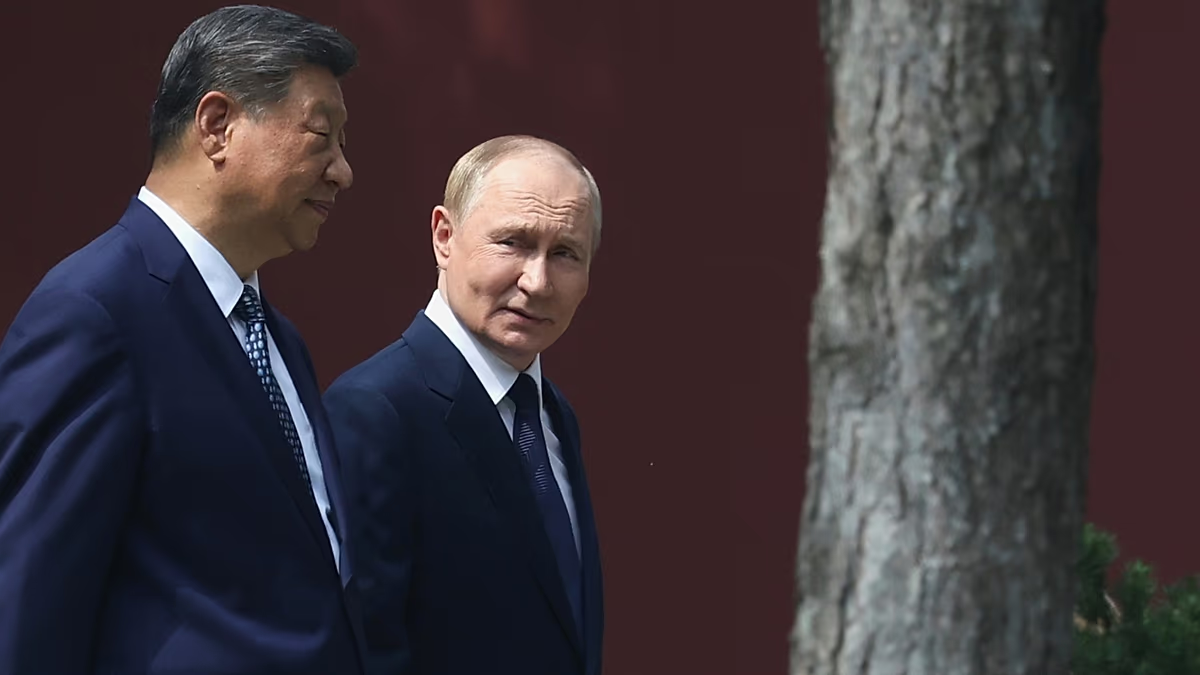
As world leaders crisscross the globe, a particularly significant diplomatic journey is set to begin. Russian President Vladimir Putin will shortly arrive in Beijing for an official state visit, an event laden with high expectations from the Kremlin, which seeks to further cultivate a “privileged partnership” with China. The timing of this visit is impossible to ignore, coming just days after U.S. President Donald Trump concluded his own trip to China. While Moscow officially downplays any connection, insisting the agenda was set months in advance, the geopolitical chessboard suggests otherwise. Putin’s arrival so swiftly on the heels of Trump’s underlines the intense, three-way diplomatic maneuvering defining this moment, with China positioned squarely at the center of gravity between East and West.
Paragraph 2: Contrasting Visits, Divergent Agendas
The substance and style of the two visits could not be more different. Trump’s recent trip, accompanied by a cadre of American business leaders, was widely viewed as lacking in concrete achievements on pivotal issues like trade, Ukraine, and Iran. In contrast, Putin’s delegation signals Russia’s deep-seated priorities: it includes a phalanx of top officials—five deputy prime ministers, eight ministers, governors, and the head of the central bank. This formidable entourage reveals the profound economic dimension of the relationship and Moscow’s growing reliance on Chinese trade and financial systems. The inclusion of Kirill Dmitriev, a key figure in back-channel talks with the U.S. on Ukraine, underscores that strategic security matters will be paramount in private discussions.
Paragraph 3: The Core of the Partnership: War and Sustenance
At the heart of Putin’s mission is a urgent need to secure China’s unwavering support. Since the launch of its full-scale invasion of Ukraine, Russia has found itself increasingly isolated, with China emerging as its most critical economic and diplomatic partner. Western nations watch with concern, convinced that Beijing’s backing—through trade in dual-use goods, energy purchases, and diplomatic cover—has been instrumental in sustaining Russia’s prolonged war effort. For Putin, reinforcing this lifeline is essential. The talks will undoubtedly seek assurances and explore ways to deepen cooperation that helps Russia navigate international sanctions and maintain its military campaign, now dragging into a fifth grueling year with no resolution in sight.
Paragraph 4: China’s Strategic Calculus: Taiwan Trumps Ukraine
However, analysts caution that while Ukraine is Putin’s foremost concern, it is likely a secondary priority for Chinese President Xi Jinping. Beijing’s overriding strategic fixation remains Taiwan, the self-governing island it claims as its own territory. From this perspective, the back-to-back visits from Trump and Putin are less about Ukraine and more about pieces in a grander bargaining strategy. Trump himself hinted at this dynamic after leaving Beijing, curiously casting doubt on a major U.S. arms package for Taiwan and openly calling it a “very good negotiating chip.” This statement signaled to China that American support might be malleable, offering Beijing a potential pathway to its ultimate goal: weakening Western military assistance to Taipei.
Paragraph 5: The High-Stakes Bargaining Chip
The potential suspension of U.S. arms sales to Taiwan represents a diplomatic prize for China that could far outweigh the benefits of its partnership with Russia. For Beijing, ensuring its territorial integrity and eventual reunification with Taiwan is a non-negotiable, century-long ambition. Supporting Russia in Ukraine carries risks, including secondary sanctions and damage to relations with Europe. In contrast, securing a concession from Washington on Taiwan would be a historic victory, reshaping the security architecture of the Indo-Pacific. Therefore, in its dialogues with both Washington and Moscow, China holds significant leverage. It can use its influence with Russia as a point of pressure in talks with America, and vice-versa, skillfully playing the great powers against each other.
Paragraph 6: An Evolving World Order
Ultimately, President Putin’s trip to Beijing is a vivid snapshot of a world order in turbulent transition. It highlights a Russia leaning ever more heavily into an asymmetrical partnership with its powerful neighbor, driven by wartime necessity. It showcases a China that is confident, patient, and strategically opportunistic, prioritizing its core interests above all else. And it reveals a United States whose foreign policy signals can appear unpredictable, creating openings for other nations to exploit. The outcomes of these intertwined diplomatic dances will reverberate far beyond the meeting rooms in Beijing, influencing the future of European security, the balance of power in Asia, and the contours of global diplomacy for years to come. The “privileged partnership” between Moscow and Beijing is less a steadfast alliance and more a complex, pragmatic bond, tested and defined by the high-stakes games of modern geopolitics.