


Paragraph 1
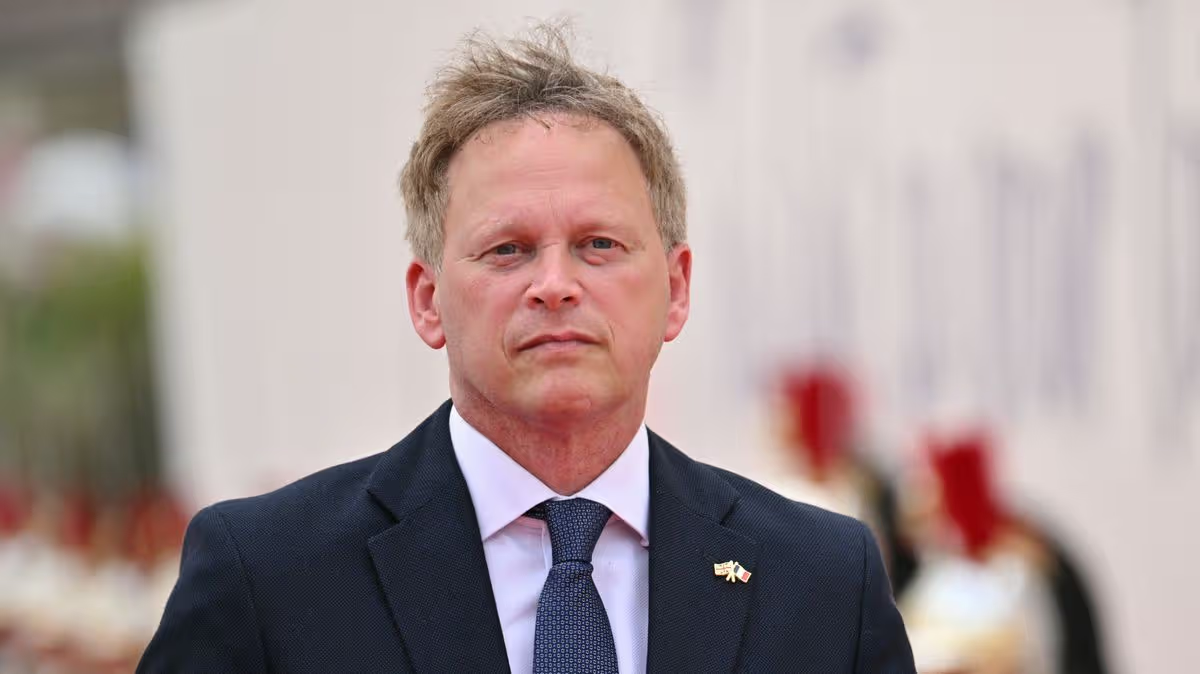
Former Defence Secretary Sir Grant Shapps has resigned from his position at a private aerospace company, Cambridge Aerospace, following a formal reprimand for creating an “impropriety” regarding his post-government employment. The controversy centers on Shapps’s role at the firm, which, while he was serving as its part-time chair, secured a valuable multi-million-pound missile contract from the Ministry of Defence (MoD). This situation triggered an investigation by the UK’s watchdog, the Advisory Committee on Business Appointments (ACOBA), which governs the jobs former ministers can take after leaving office. The core allegation is that Shapps blurred the lines between his extensive governmental experience in defence and his new private sector role, failing to manage the public perception of a potential conflict of interest. The case highlights the ongoing tensions and ethical challenges faced by high-profile politicians when they transition into industries closely aligned with their former ministerial portfolios.
Paragraph 2
The sequence of events reveals a significant shift in the nature of the company’s work during Shapps’s tenure. When he first sought and received advice from ACOBA in November 2024 after leaving government, he presented Cambridge Aerospace as a civilian aerospace startup. Based on this description, ACOBA approved his role but imposed the standard condition that he must not lobby the UK government for two years. However, the company’s focus subsequently pivoted towards defence projects, culminating in it winning a major MoD contract for Skyhammer interceptor missiles. Shapps argued in his defence that this shift was driven by a changed global geopolitical landscape, citing international conflicts. Nevertheless, he admitted a critical failure: he did not return to ACOBA to seek updated guidance once the company’s activities expanded into the military sphere, a step required by the rules to ensure ongoing compliance.
Paragraph 3
Compounding this error was Shapps’s handling of his public profile. Despite ACOBA’s explicit advice to correct online information, professional profiles—including his LinkedIn page—continued to portray him as the chair of a defence company. This allowed a narrative to solidify in the public domain that directly linked his past authority as Defence Secretary with his current leadership of a firm now doing business with the MoD. In his response to the investigation, Shapps offered an apology and stated he “fully accepts” he should have sought fresh advice. He vehemently denied any direct involvement in the missile contract, asserting he was only “abstractly aware” of the process, never used privileged information, and did not lobby his former colleagues. His defence rested on the technical separation of his actions from the contract award, but acknowledged the failure in procedural and presentational diligence.
Paragraph 4
However, this defence was firmly rejected by Sir Laurie Magnus, the Independent Adviser on Ministers’ Standards. In a decisive letter, Magnus concluded that Shapps had “allowed a perception of impropriety to develop” through his negligence. The ruling pinpointed three key failures: neglecting to seek fresh advice as the company’s role changed, not correcting misleading public information, and thereby creating an avoidable impression of improper overlap between his former public office and new private interest. The judgement underscores a fundamental principle in public life: that avoiding actual corruption is not enough; officials must also actively avoid the appearance of it. The perception of a “revolving door” between high office and lucrative defence contracts undermines public trust, and it is the responsibility of the individual to manage that perception scrupulously.
Paragraph 5
The fallout from this episode extends beyond Shapps personally, touching on broader systemic issues. The ACOBA system itself, which relies on retrospective advice and lacks binding enforcement powers, is often criticized as a “toothless” regulator. Cases like this one fuel arguments for a more robust and legally enforceable regime governing post-ministerial employment. Furthermore, Shapps’s political context is notable; having served in multiple high-profile cabinet roles under four different Prime Ministers, his deep network and insider knowledge are precisely what make such transitions ethically sensitive. His subsequent loss of his parliamentary seat in the 2024 general election meant this was not a story about a sitting MP, but it remains a potent example of the standards expected of former ministers, whose influence and access are deemed to persist long after they leave government.
Paragraph 6
In conclusion, Sir Grant Shapps’s resignation from Cambridge Aerospace serves as a textbook case study in the ethical minefield of post-ministerial careers. While he maintains there was no deliberate wrongdoing or direct lobbying, the formal finding that he cultivated a perception of impropriety is a serious mark against his judgement. The saga illustrates that compliance with ethics rules is not merely a box-ticking exercise but requires proactive and continuous management, especially when a private company’s trajectory evolves. For the public, it reinforces cynicism about the close relationships between government and industry. For former ministers, it is a stark reminder that their actions remain under scrutiny and that preserving public confidence demands a higher standard of transparency and caution than they may have initially assumed.