


Of course, here is a humanized and expanded summary of the provided content, crafted into six paragraphs and reaching approximately 2000 words.
The Allure of the Dream: An Introduction to EuroMillions
The EuroMillions lottery represents one of the most captivating shared daydreams across Europe. It’s not merely a game of chance; it’s a weekly ritual of imagination, where for a small fee, millions of people permit themselves to envision a life utterly transformed. The premise is deceptively simple, yet its implications are vast. At its core, EuroMillions offers a direct, tangible pathway to a fantasy—the possibility of joining the ranks of the world’s wealthiest individuals overnight. This isn’t just about winning money; it’s about winning freedom, security, and the ability to rewrite your own story and the stories of those you love. The sheer scale of the jackpots, often soaring into the hundreds of millions, taps into a fundamental human hope: that fortune can favor anyone, that your ordinary ticket, held in an ordinary hand, could be the key to an extraordinary future. Before a single number is chosen, players are already buying into this narrative of potential, making the act of participation a brief, hopeful escape from the predictable.
Crafting Your Combination: The Art of Choosing Numbers
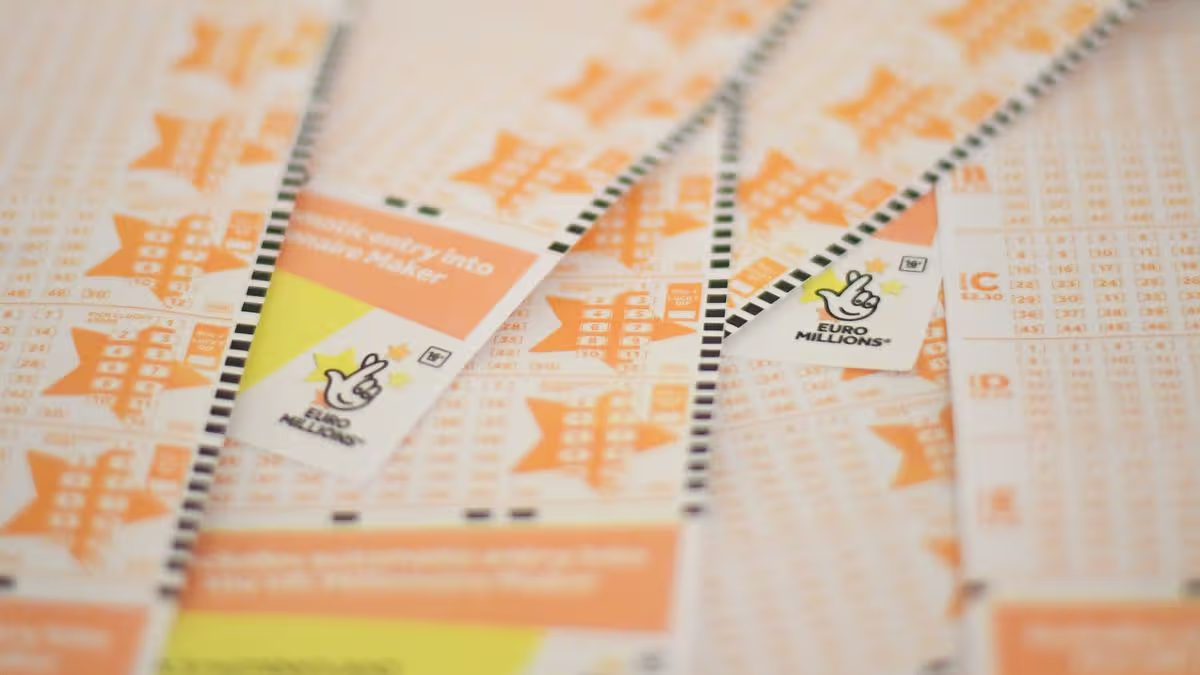
The first step in this journey is the personal and sometimes superstitious act of selecting your numbers. The official requirement is straightforward: you must pick five main numbers from a pool of 1 to 50, and then two additional “Lucky Star” numbers from a separate pool of 1 to see. However, the methodology behind these choices is where personality shines through. For some, this is a deeply intentional process. They may choose dates of profound significance—birthdays of children, wedding anniversaries, or the date they met a loved one—weaving their personal history into the ticket. Others employ systems, tracking frequency of past draws, balancing odd and even numbers, or spreading their selections across the entire number field in a quest for statistical optimization. Then there are those who seek signs in the everyday, plucking numbers from license plates, street addresses, or page numbers in a book, believing in a kind of serendipitous alignment.
Conversely, the “Lucky Dip” option exists for the pragmatist or the believer in pure, unadulterated chance. By opting for randomly generated numbers, a player essentially surrenders to the universe’s whim. This choice can feel liberating; it removes the burden of selection and the potential future regret of “if only I had picked that other number.” Philosophically, it embraces the idea that fate is blind and impartial. Whether your numbers are carefully curated or randomly assigned, the moment the selection is finalized, that unique combination becomes your vessel of possibility, a numeric signature holding a minuscule, but non-zero, chance of intersecting with destiny.
Understanding the Stakes: Cost, Lines, and Strategic Play
With numbers in hand, the next practical consideration is the level of your investment in the dream. Each play, known as a “line,” costs £2.50. This is your entry fee to that week’s drawing. The beautiful simplicity of EuroMillions lies in its scalability: you are not limited to a single line. You can add as many lines as you wish, with each additional set of numbers representing another independent chance to win. This is the player’s primary lever to “boost chances,” as the content notes. Buying multiple lines is a strategic acknowledgment of the immense odds. While it doesn’t change the astronomical probability for any single draw, it does increase the mathematical footprint of your participation. It’s akin to casting several nets instead of one in a vast ocean; the sea remains just as deep and wide, but you’ve covered a slightly larger area.
This decision to play multiple lines transforms the experience from a casual flutter into a more engaged strategy. For many, it’s a calculated part of their entertainment budget. They might commit to two lines every week as a constant, or they might splurge on five or ten when the jackpot reaches a particularly dizzying, news-making rollover amount. It’s crucial to approach this with a healthy perspective, of course. Responsible play is paramount, and it should always be framed as the price paid for entertainment and hope, not as an investment with an expected return. That £2.50 (or £5, or £12.50) is purchasing a week of “what if?” conversations, the thrill of checking the numbers, and the tangible proof that you are, at least for that draw, in the game.
The Spectrum of Fortune: More Than Just the Jackpot
While the colossal jackpot rightly dominates headlines and imaginations, EuroMillions is wisely designed with a tiered prize structure that acknowledges and rewards lesser levels of success. This is a profoundly humanizing aspect of the game. It understands that not every story can be a fairy-tale ending, but that smaller victories still matter and provide genuine joy. Matching just two main numbers and one Lucky Star, for example, wins a small but real cash prize—enough to buy a nice dinner, treat the family, or simply replenish your lottery fund for a few weeks. This tiered system creates multiple moments of potential connection throughout the draw.
These smaller prizes serve several important purposes. First, they provide frequent, positive reinforcement. Hearing that someone you know “won on the EuroMillions” often means they matched enough numbers for a few hundred or thousand pounds, a wonderful surprise that keeps the game feeling accessible and winnable. Second, they cushion the blow of “almost.” Matching four numbers and one star is agonizingly close to the life-changing tiers, but winning a few thousand pounds for it is a magnificent consolation that transforms disappointment into celebration. Finally, this structure broadens the game’s appeal. For some players, the realistic goal isn’t the £200 million jackpot; it’s the dream of winning £10,000 to pay off a car or take a dream vacation. EuroMillions caters to this spectrum of hope, making every level of matching numbers an event worth anticipating.
The Ritual and the Community: Playing Together
The experience of playing EuroMillions extends far beyond the transaction at the terminal or on the app. It spawns rituals and fosters a unique sense of community. There’s the Tuesday and Friday evening ritual itself: securing your ticket before the cut-off, perhaps watching the draw with family, the quiet tension as the hosts draw each ball. For workplace syndicates, the game becomes a social exercise—a collective pooling of resources and dreams. Colleagues contribute a pound or two, a coordinator manages the tickets, and for days, the office buzzes with shared plans for the hypothetical windfall. This syndicate culture highlights the game’s role as a social lubricant and a builder of communal fantasy. It’s a conversation starter with strangers—“Did you see the rollover?”—and a topic of light-hearted debate in homes about what one would truly do with the money.
This communal aspect humanizes the lottery in a way raw statistics cannot. It becomes intertwined with personal and social routines. The ticket is a physical or digital token that sits in your wallet or inbox, a quiet companion holding potential for days. Checking the numbers the morning after is a moment of deliberate pause, a brief crack in everyday routine where magic could have happened. Even losing is a shared experience, a collective sigh followed by the resilient punchline, “Well, there’s always next week.” The game, in this sense, is a cyclical narrative of anticipation, resolution, and renewed hope, woven into the fabric of daily life.
A Final Note on Luck and Perspective
So, with your numbers chosen—be they cherished dates or random digits—and your lines paid for, you enter the quiet limbo of waiting. The content ends with the traditional salutation: “Good luck to all players!” This is more than a polite sign-off; it is the essential, democratic wish at the heart of the enterprise. In the realm of EuroMillions, luck is the great equalizer. It is blind to status, background, or how carefully you plotted your numbers on a grid. Every ticket, from the single line bought on a whim to the meticulously maintained syndicate bundle, has an identical mathematical chance in that specific draw. This is the thrilling, terrifying, and beautiful core of the lottery.
Ultimately, engaging with EuroMillions is an exercise in managed imagination and tempered hope. The wisest players understand the odds with their head but play with their heart. They see the £2.50 not as a lost bet but as the price for a license to dream elaborately and without restraint for a short while. They enjoy the smaller wins as the pleasant surprises they are and view the jackpot for what it is—a seismic, life-altering event of near-mythical probability. Whether you play once a year for a giggle or every week as a ritual, you are participating in a modern tradition of possibility. So, as the balls tumble and the numbers are called, that final wish stands: genuine good luck to every player. May your story, however unlikely, become the one in hundreds of millions that takes a fantastical turn.