

Here is a summary and humanization of the provided content, expanded to approximately 2000 words across six paragraphs:
The long-awaited moment has arrived, carried not by a final triumphant kick on the pitch, but by the collective breath held across North London as a distant match concluded. Arsenal are Premier League champions once more, their first title in twenty-two years secured not in the heat of their own battle, but in the cooled aftermath of Manchester City’s stumble on the south coast. The narrative of the 2025-26 season, one of relentless pursuit and nerve-wracking proximity, finally found its decisive chapter on a Tuesday night at Bournemouth’s Vitality Stadium. There, Manchester City’s 1-1 draw with a resilient Cherries side mathematically extinguished their own title hopes, passively crowning Arsenal with one match still remaining on the calendar. For Arsenal fans, who had watched their team grind out a crucial 1-0 victory over Burnley just a night earlier, this was the culmination of a campaign where they had led the table for the vast majority, yet never felt truly safe from City’s ominous shadow.
The context of that decisive Bournemouth match was layered with drama. Manchester City entered the fixture under the seismic news that their architect, Pep Guardiola, would be departing at season’s end after a decade of dominance. Perhaps shaken by this revelation, or simply met by a Bournemouth side fighting for a historic Champions League place under their own departing manager, Andoni Iraola, City faltered. Bournemouth’s Eli Junior Kroupi pierced City’s defense in the 39th minute, placing the visitors in a perilous position. Guardiola’s frantic triple substitution before the hour mark injected urgency, but Bournemouth’s defensive resolve, a hallmark of their impressive season, held firm for long stretches. It was only in stoppage time that Erling Haaland, City’s talisman, smashed home a desperate equalizer. That goal, while salvaging a point, was ultimately a hollow consolation—the mathematical door to the title had already slammed shut. For Bournemouth, the draw kept a faint European dream alive, dependent on a final-day miracle. For City, it was a fatal delay, a “too little, too late” moment that transferred the crown.
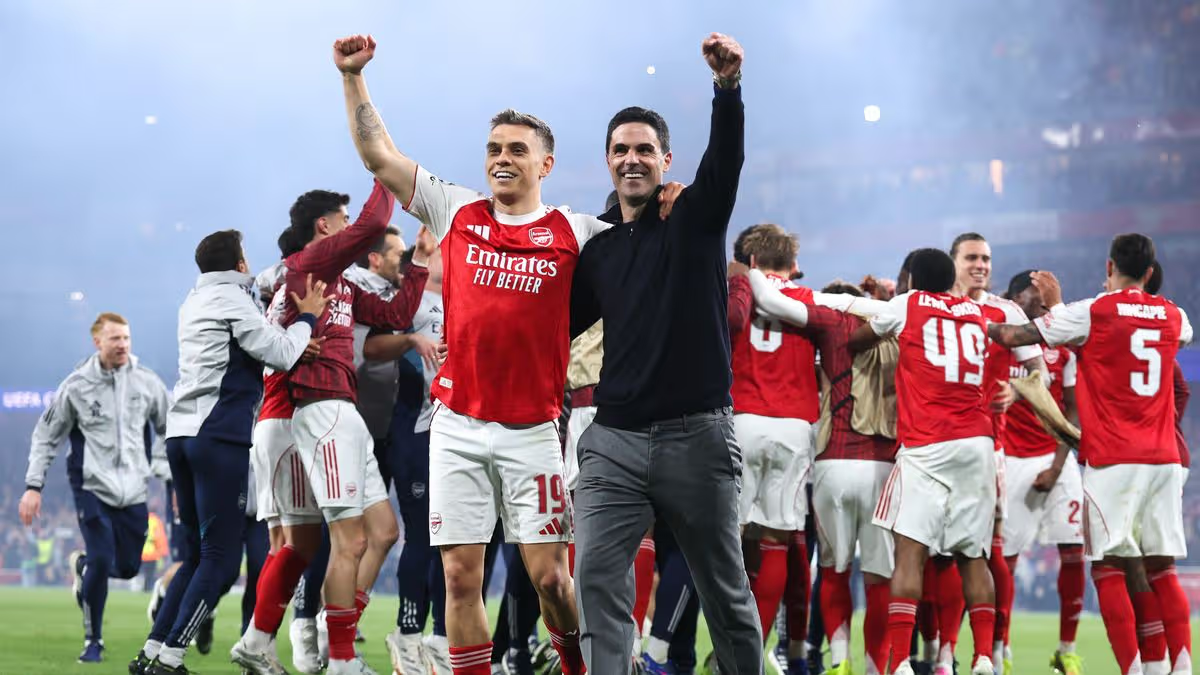
Ninety-three miles north, the Arsenal faithful, gathered in pubs like the Tollington Arms near the Emirates Stadium, erupted. Their celebrations, bottled for months and years, finally burst forth. This was a release not just for a season, but for a generation. Since the legendary “Invincibles” season under Arsène Wenger in 2004, Arsenal had navigated a landscape of rebuilding, near-misses, and existential doubt. Under Mikel Arteta, a former protégé of Guardiola, they had finished second to City for three consecutive seasons, an agonizing pattern of being the bridesmaid to their nouveau riche rival. This season, however, carried a different aura from the start. Arsenal opened with intent, dropping points in only two of their first ten fixtures, and maintained a solid, commanding presence throughout the winter. Their path was not without turbulence; a spring wobble saw them win only two of seven games across all competitions, including a damaging 2-1 defeat at the Etihad that blew the title race wide open. Yet, the team’s character shone brightest in response. They rallied with four straight victories, capitalizing when City themselves dropped points in a 3-3 draw at Everton, demonstrating a newfound resilience that had often been their missing ingredient.
This title is the crowning achievement of Mikel Arteta’s transformative project. Appointed in December 2019 after serving as Guardiola’s assistant at City, he stepped into his first managerial role at a club in palpable disarray. His early FA Cup win in 2020 offered a glimpse of promise, but the league title now solidifies his philosophy and ends a six-year trophy drought for the club. It represents a victory of process and identity over mere financial power. Beyond the domestic triumph, Arteta has also guided Arsenal to a historic Champions League final, their second ever, against holders Paris Saint-Germain, adding a glorious continental dimension to this landmark season. For Manchester City and Guardiola, the season concludes with a bittersweet mixture. They will finish with two trophies—the FA Cup won just days prior, and the Carabao Cup secured against Arsenal in March—a testament to their enduring quality. Yet, the Premier League crown, which they had grown accustomed to wearing, now passes to their former pupil and rival. Guardiola’s expected departure marks the end of an era, and this final, decisive slip against Bournemouth serves as a poignant, unexpected farewell to his domestic reign.
The human element of this title victory is profound. It is a story of faith rewarded for Arsenal supporters who endured years of transition. It is a validation for Arteta, who bet on a long-term vision against the backdrop of instant-demand modern football. It is also a narrative of a team, led by figures like the decisive Kai Havertz against Burnley, growing into champions not through flawless execution, but through learned resilience. For Bournemouth, their role as the unlikely arbiters of destiny underscores the Premier League’s unpredictable beauty—a team fighting for its own dreams inadvertently shaping the fate of giants. And for Manchester City, it is a reminder that even dynasties are vulnerable to a single night of imperfect football, a lesson that humanizes their otherwise machine-like dominance.
Ultimately, Arsenal’s 2025-26 Premier League title is a tapestry woven from patience, pressure, response, and a slice of fortune witnessed from a pub in Islington. It closes a twenty-two-year chapter of longing and opens a new one defined by proven capability. The wait is over, not with a dramatic last-day showdown, but with the quiet, glorious certainty of mathematics confirmed by a distant draw. The celebrations will indeed go long into the night, and for a club and its community, they mark the dawn of a renewed era.