


A Strategic Handshake in a Changing World: Putin’s Beijing Visit Amidst Global Realignment
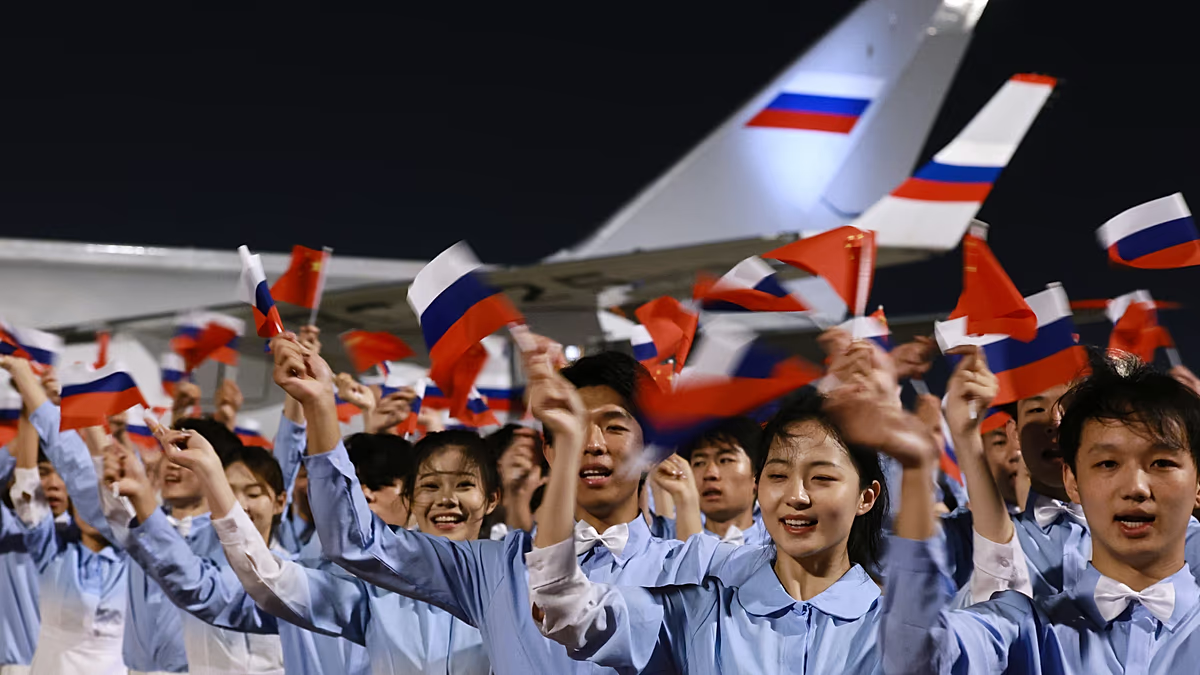
The arrival of Russian President Vladimir Putin in Beijing this week was a meticulously choreographed display of political theater, rich with symbolism and strategic intent. Stepping onto the tarmac to be greeted not by his counterpart, President Xi Jinping, but by China’s senior diplomat, Wang Yi, the scene immediately communicated a message of high-level, fraternal partnership. This was no ordinary state visit; it was a powerful visual affirmation of a deepening alignment between two giants who increasingly see themselves as architects of a new world order, distinct from the one led by the West. The red carpet, the military honor guard, and the small group of young Chinese supporters waving the flags of both nations were all elements in a carefully constructed narrative of mutual respect and shared destiny, set against the backdrop of a rapidly evolving global landscape.
This visit, strategically timed just days after US President Donald Trump’s own trip to China and coinciding with the 25th anniversary of the Sino-Russian Treaty of Good-Neighborliness and Friendly Cooperation, was laden with historical and contemporary echoes. The proximity to Trump’s visit allowed both Moscow and Beijing to subtly emphasize the consistency and depth of their own partnership, contrasting it with the more transactional and unpredictable nature of current US foreign policy. By marking the treaty’s anniversary, the leaders invoked a quarter-century of formalized cooperation, framing their current rapport not as a marriage of convenience forged by recent pressures, but as the mature evolution of a long-standing strategic understanding. This historical framing serves to legitimize and solidify a relationship that has grown increasingly consequential.
At its core, the burgeoning partnership between Russia and China is fundamentally driven by a confluence of economic necessity and geopolitical ambition. For Russia, isolated by Western sanctions and seeking pathways to sustain its economy, China represents an indispensable market for its energy exports, a source of critical technological imports, and a financial lifeline. For China, Russia is a colossal and reliable supplier of oil and natural gas, enhancing its energy security, and a diplomatic ally who provides crucial political cover on the world stage. Their collaboration extends to ambitious infrastructure projects like the Power of Siberia gas pipeline and enhanced coordination in forums like the Shanghai Cooperation Organization and BRICS, creating an alternative network of influence and trade. This is a pragmatic alliance where mutual need fuels strategic coordination, allowing both nations to mitigate vulnerabilities and project strength.
Beyond the economics, the partnership is cemented by a powerful, shared worldview that sees the US-led international system as inherently hostile to their interests and rightful spheres of influence. Both Moscow and Beijing champion a vision of “sovereign democracy” and a multipolar world order where their authoritarian models of governance face less criticism and their regional dominance goes unchallenged. They provide each other with diplomatic support on contentious issues—whether it’s Russia’s actions in Ukraine or China’s policies in the South China Sea and toward Taiwan—acting as a mutual buffer against Western condemnation. In this sense, the handshake in Beijing is a handshake against a common perceived adversary, a unified front aimed at diluting American hegemony and reshaping global norms to better suit their autocratic frameworks.
However, to view this partnership as an unbreakable monolithic bloc would be a profound oversimplification. Underneath the surface harmony lie deep-seated asymmetries and historical suspicions. China’s economy now dwarfs Russia’s, creating a relationship that is increasingly tilted in Beijing’s favor—a dynamic that can breed long-term resentment in Moscow. Historical territorial disputes and rivalry for influence in Central Asia linger in the background. Furthermore, while united in opposition to US dominance, their ultimate visions for Eurasia may not fully align. Russia’s conception of its “Greater Eurasia” partnership idea sometimes struggles with China’s overwhelmingly dominant Belt and Road Initiative. The alliance, therefore, is one of calculated limits, a flexible partnership of convenience rather than a rigid ideological union, where cooperation is deep but not unconditional.
Ultimately, Vladimir Putin’s motorcade leaving the Beijing airport signifies more than just the conclusion of a state visit. It represents the ongoing consolidation of a pivotal axis in 21st-century geopolitics. This relationship does not necessarily presage a formal military alliance akin to the Cold War blocs, but it does create a durable strategic coalition that complicates Western foreign policy at every turn. It ensures that both nations are less isolated, more economically resilient, and more diplomatically defiant. As the world continues its fitful transition toward a more multipolar structure, the Moscow-Beijing nexus will remain a central factor, a powerful testament to how shared grievances and complementary needs can forge partnerships that reshape the global balance of power for decades to come. Their handshake is a handshake shaping the contours of our collective future.