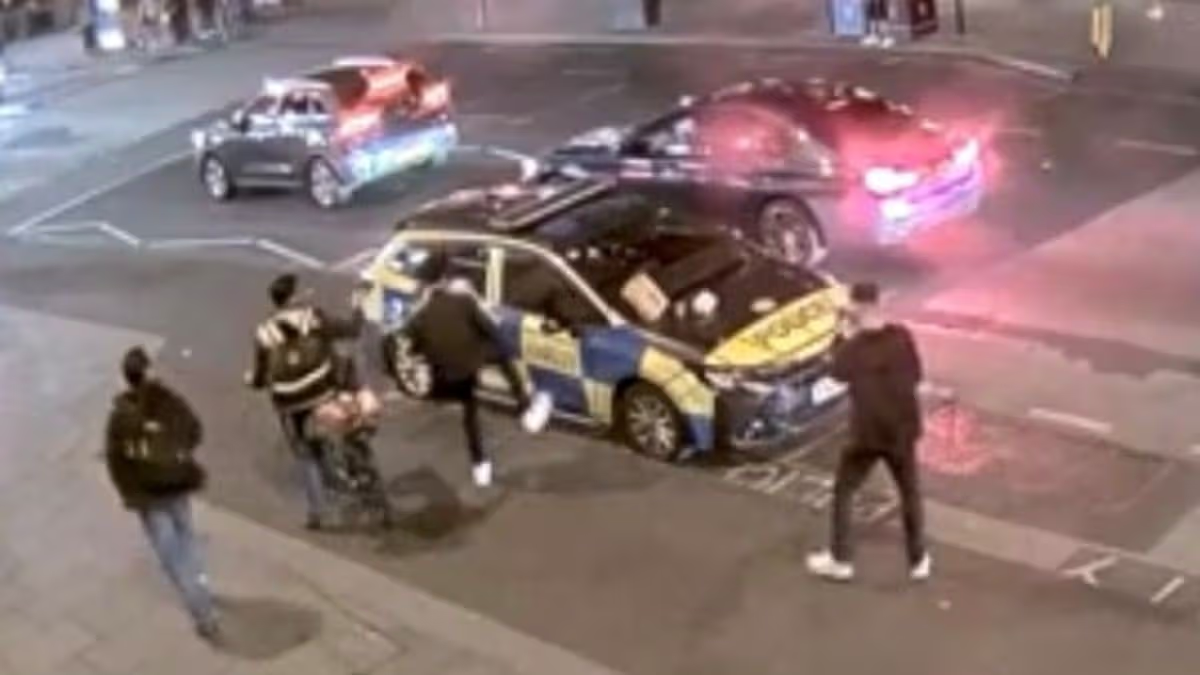




Of all the late-night takeaways in London, it was the bonnet of a marked police car parked outside Bishopsgate Police Station that Adam Bachir-Belmehdi chose as his dining table. In the early hours of May 3rd, the 21-year-old from Stratford, captured in crystal clarity by the City of London’s sophisticated CCTV network, approached the vehicle. In an act of baffling performance, he first lay across its bonnet and windscreen while a friend documented the moment. Then, shifting from spectacle to sustenance, he proceeded to unpack his takeaway meal and begin eating it directly off the car’s painted surface. This peculiar scene, however, was merely the prelude to a more destructive sequence, as he then kicked the side of the vehicle and its wing mirror before forcefully ripping the mirror from its housing entirely.
What Bachir-Belmehdi perhaps failed to grasp in that moment was the immediacy of modern urban surveillance. The very CCTV footage that recorded his actions was being monitored in real-time within the City of London Police control room. Officers were dispatched within seconds of the damage beginning and arrived on the scene swiftly. This rapid response underscores a critical point made by the force: their network is not merely a passive recording device but an active policing asset designed to protect the Square Mile, London’s historic financial district. The technology allowed them to track the incident live, direct resources instantly, and intervene before the situation could escalate further.
The consequences of this “incredibly childish behaviour,” as described by attending officer Police Constable Oliver Gage, extended beyond the immediate arrest. Bachir-Belmehdi’s actions rendered a marked police vehicle unusable, taking it off the road for five full days for repairs. In a compact, busy jurisdiction like the City of London, each patrol car is a vital tool for response and visibility. This meant that for nearly a week, officers were without that resource, potentially stretching their capacity to respond to other incidents and patrol the densely populated business district effectively. The damage was not just to property, but to a piece of operational infrastructure.
Justice followed at Westminster Magistrates’ Court, where the financial implications of a fleeting, foolish act became starkly real. Bachir-Belmehdi was convicted of criminal damage and ordered to pay a total of £957. This sum comprised £200 in direct compensation, a £480 fine, £85 in costs to the Crown Prosecution Service, and a £192 victim surcharge. It is a substantial penalty for a young man, serving as a tangible reminder that such antics, which might be brushed off as a prank in the moment, carry serious legal and financial repercussions in the eyes of the law.
The incident stands as a stark, almost absurd case study in poor decision-making. It blends a desire for social media notoriety—suggested by the friend taking photos—with a blatant disregard for public property and the rule of law. Choosing a police car, an explicit symbol of authority, as the stage for this display added a layer of deliberate provocation. It speaks to a mindset that either did not consider or did not care about the real-world functions the vehicle served, viewing it instead as merely a backdrop for a stunt.
Ultimately, the City of London Police used this case to send a clear, public message. As PC Gage stated, “We do not tolerate this sort of behaviour in the City of London and we want to make it clear that anyone who behaves in this manner will face justice.” The statement reinforces that the district’s security is taken seriously, underpinned by both advanced technology and a commitment to prosecute such offences. For Adam Bachir-Belmehdi, a costly takeaway meal and a criminal record are the enduring souvenirs of a night where a search for laughs or likes collided head-on with the realities of consequence and a very watchful city.