


Paragraph 1:
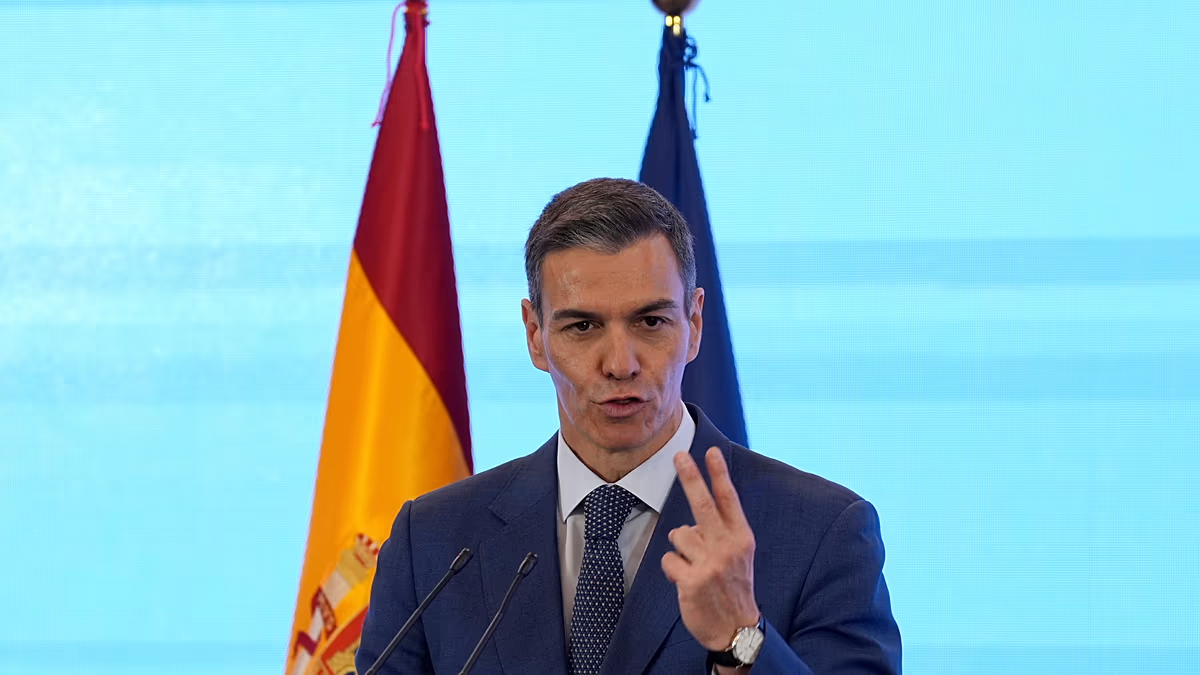
The European Commission has formally cleared the Spanish government of allegations that it misused post-pandemic European Union recovery funds to pay for national pension obligations. This decisive statement comes in response to a brewing controversy, initially sparked by reports from Spain’s own national auditor and amplified by segments of the European press, particularly in Germany. In a letter addressed to the European Parliament, senior Commissioners explicitly stated that their thorough review found “no evidence of misuse of EU public funds.” They underscored a fundamental rule: Spain’s approved recovery plan never included milestones or targets that would allow EU funds to be used for pension expenditures, as such spending is categorically ineligible. Madrid had consistently denied any wrongdoing, framing the issue as a minor accounting technicality related to the management of state liquidity, rather than a diversion of dedicated EU grants.
Paragraph 2:
However, the Commission’s closure of the matter has failed to satisfy all critics, particularly among budget hawks in the European Parliament. Johan Van Overtveldt, a prominent member of the Parliament’s budget committee, has publicly dismissed the Commission’s explanations as “vague and obtuse.” His central concern lies in the complexities of financial control within the vast recovery fund system. While the Commission and Spain speak of permissible management of “excess liquidity,” Van Overtveldt questions the transparency and practical oversight of such practices. “How do we control this? And what is the money being used for?” he asked, arguing that without crystal-clear accounting and specific numbers, a “cloud of doubt” would persist. This highlights a tension between the Commission’s view of resolved technicalities and lawmakers’ demand for granular financial transparency to ensure every euro is traceable to its intended purpose.
Paragraph 3:
The timing of this controversy and the Commission’s response is politically charged, extending far beyond a simple audit inquiry. It erupts on the eve of negotiations for the EU’s next long-term budget, a traditionally bruising process that pits member states with different fiscal philosophies against one another. On one side are nations, often in southern Europe, advocating for a more robust communal budget and even permanent joint borrowing instruments to fund collective ambitions. On the other are more fiscally conservative, predominantly northern states, emphasizing restraint, stricter controls, and national responsibility. Spain, currently the fastest-growing major economy in the eurozone, finds itself in a strengthened but sensitive position, seeking to influence these talks from a posture of economic success rather than perceived dependency.
Paragraph 4:
Within this context, Spanish officials perceive the pension fund allegations not as a genuine audit issue, but as a political weapon. They suspect the narrative—framed in some German tabloids as another case of the frugal north subsidizing the profligate south—was leveraged to undermine Madrid’s credibility and negotiating strength ahead of the difficult budget discussions. This sentiment reflects a deeper, evolving dynamic in European politics: the traditional economic divide between a struggling south and a prosperous north is shifting, with southern economies like Spain’s now outperforming some of their northern counterparts. The controversy, therefore, touches a raw nerve, reviving old stereotypes even as current economic realities tell a different story.
Paragraph 5:
Van Overtveldt insists his critique is not about political point-scoring but about institutional accountability. He redirects scrutiny toward the European Commission itself, arguing that the problem is a systemic lack of clarity in how it supervises the massive Recovery and Resilience Facility (RRF). “They have to explain to us how they supervise the system of funding allocation and how the RRF is controlled. That’s what we need,” he stated. He contends that it is precisely this opacity, not legitimate parliamentary questioning, that risks poisoning the well for the upcoming budget talks. His message is that public trust in the EU’s financial machinery, easily shaken by headlines about misspending, depends on the Commission providing unequivocal, detailed assurances that prevent such doubts from arising in the first place.
Paragraph 6:
The European Commission, for its part, considers the case resolved and has used its letter to reaffirm its commitment to transparency broadly, even as it rejects the specific allegations against Spain. This episode lays bare a classic EU dilemma: balancing the necessary flexibility for member states to manage complex national finances with the imperative for ironclad, communicable oversight that maintains public confidence. While the immediate accusation against Spain has been officially dismissed, the underlying debate it ignited remains fully alive. It is a debate about financial controls, political narratives, and trust—a prelude to the much larger and more contentious battle over the European Union’s financial future that is just beginning. The cloud over Spain may have lifted, but the fog over the intricacies of EU fund management and the political fight over the bloc’s fiscal soul is yet to clear.