


The true substance of a high-level diplomatic visit often lies not in the official press statements, but in the composition of the delegation itself. This was made starkly clear during a recent visit by Russian President Vladimir Putin to China. While a visiting U.S. president might be accompanied by a coterie of technology and finance executives, signaling a focus on commercial ties, Putin arrived with a formidable governmental battalion. His delegation included five deputy prime ministers, eight federal ministers, several regional governors, and the head of Russia’s central bank. This was not merely a ceremonial trip between friends; it was a full-spectrum strategic council, bringing the very architects of Russia’s economic, industrial, and financial policy. The message was unambiguous: for Russia, the relationship with China is an all-encompassing national priority, demanding coordination across every sector of the state apparatus.
The reason for this intensity is a profound and structural dependency that has solidified since the outbreak of the war in Ukraine. China has become Russia’s indispensable economic lifeline. With bilateral trade surpassing $200 billion for three consecutive years, Moscow now relies on Beijing for the fundamental building blocks of its economy: industrial machinery, electronics, and vehicles. Perhaps even more critical is the financial umbilical cord. Locked out of Western financial systems like SWIFT, major Russian banks have turned overwhelmingly to the Chinese yuan for trade settlements. Where the yuan accounted for less than 2% of Russia’s international trade before 2022, it now facilitates between 30% and 40% of it. This shift is not just convenient; it is a revolutionary re-wiring of Russia’s financial connections, tethering its economic survival directly to Beijing’s systems and policies.
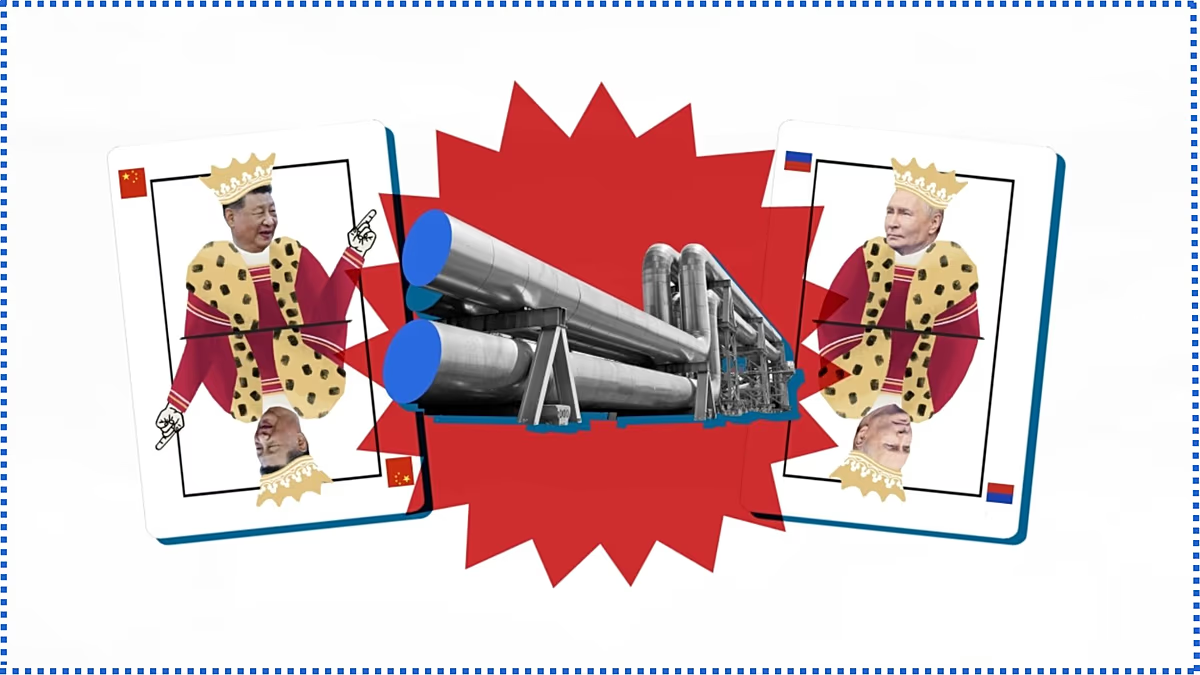
For China’s leader, Xi Jinping, this relationship is a masterclass in calculated, opportunistic pragmatism. Beijing is securing immense strategic benefits, chiefly a massive influx of discounted raw materials. It is buying over 100 million tonnes of Russian oil annually at favorable prices and is actively pushing for the “Power of Siberia 2,” a monumental new gas pipeline project that would further deepen its energy security. The calculus is straightforward: Xi desires the cheap resources and strategic alignment with a major power, but he is meticulously cautious not to jeopardize China’s own critical economic interests. He cannot risk secondary sanctions from the West that could cripple Chinese exports to the lucrative European market. Thus, China walks a tightrope, providing Russia with a crucial economic cushion while officially maintaining a facade of neutrality, all to avoid triggering the very Western penalties it relies on for its own prosperity.
Beyond the ministers and trade figures, however, the guest list revealed another, more subtle layer of Kremlin strategy. Notably present was Kirill Dmitriev, the head of Russia’s sovereign wealth fund and a key historical negotiator with the West. His inclusion suggests a hope in Moscow to leverage China’s diplomatic heft not just for economic support, but as a potential mediator or conduit to wind down the conflict in Ukraine on terms favorable to Russia. From Beijing’s perspective, this geopolitical alliance serves a parallel, high-stakes purpose: the “Taiwan Card.” By demonstrating an increasingly “no limits” partnership with Moscow, Xi signals to Washington, and particularly to a new Trump administration, the potential global consequences of continued U.S. support for Taiwan. The implicit threat is that challenging China’s core interests could push Beijing and Moscow into an even more unified and disruptive front, forcing the U.S. to recalibrate its commitments, including multi-billion-dollar arms sales to Taipei.
The personal bond between the two autocrats is the glue that makes this formidable partnership possible. Putin and Xi have met over forty times and publicly refer to each other as “old friends,” a relationship built on a shared vision of a world order free from Western democratic dominance. For European leaders who might hope that changing leadership could reset these fraught relationships, there is sobering news. The two men appear entrenched for the long term, with no clear political successors in waiting. In a moment of darkly symbolic humor caught on a hot microphone last year, they were even overheard discussing the potential to live to 150—a jocular comment that underscores their perceived permanence on the world stage. This prospect presents a chilling scenario for a Europe often seen as vacillating and divided in its response to their authoritarian challenge.
Ultimately, the summit between Putin and Xi presents a stark, long-term challenge to the Western-led international system. It illustrates a world increasingly bifurcated into competing spheres of influence, where economic networks, financial systems, and security alliances are being deliberately decoupled. The meeting was a powerful display of an alternative axis of power, one built on transactional support, strategic resource flows, and a united disdain for external criticism. The concluding, sardonic suggestion that Europe has perhaps just enough time to finally decide on a coherent stance—or, failing that, to learn Mandarin—cuts to the heart of the matter. It highlights a perceived European indecision in the face of a determined and patient alliance that is diligently reshaping the geopolitical landscape, with or without the West’s consent. The delegation list was more than a roster of names; it was a blueprint for a new, illiberal world order in the making.