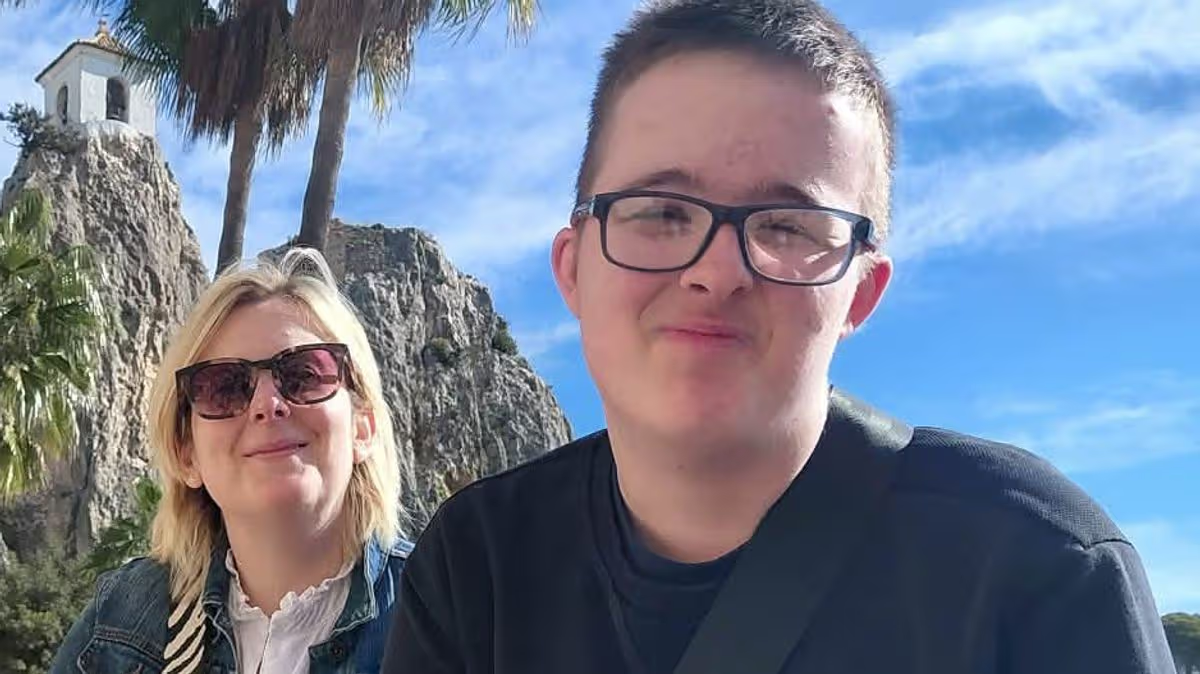



The harrowing experience of Harry Burden, a 15-year-old boy living with epilepsy, and his mother Judith, stands as a stark indictment of how traditional educational environments can fail our most vulnerable children. What began as the universal anxiety of a new school term rapidly spiraled into a health crisis, triggered not by academic challenges but by relentless social cruelty. Mere hours into his first day, the overwhelming stress of the environment induced a seizure in Harry, whose condition had previously been well-managed. This initial incident was a grim portent of the year to come, where the constant barrage of bullying—including name-calling, theft of his belongings, and physical assaults—systematically eroded his well-being. Despite Judith’s repeated warnings to the school about the severe medical implications, she found the response to be inconsistent and ultimately ineffective, leaving her son in a daily state of dread. The very institution tasked with his care and development had become, through its inability to guarantee his safety, a direct threat to his health, necessitating a dangerous doubling of his medication.
As the school year progressed, the toxic combination of bullying and an overwhelmingly busy secondary school environment took a devastating toll on Harry’s physical and mental state. The anxiety became all-consuming, leading to sleepless nights and a loss of appetite, both of which are known triggers for his seizures. Judith watched in horror as her son deteriorated, her prophetic fear that “this is going to end badly” culminating in another major seizure during the school holidays. The promised safeguards, like a pastoral safe room, proved unreliable, sometimes closed on the days he needed them most. The final breaking point arrived when Harry, in a state of complete distress, refused to attend school altogether. Faced with the unbearable choice between compulsory attendance and her son’s literal survival, Judith realized she could no longer gamble with his safety. The decision, though difficult, became clear: mainstream education was an unsustainable risk.
Choosing to homeschool was a leap of faith for Judith, fraught with worries about academic rigour and the logistics of balancing work and her son’s education. She enrolled Harry with Wolsey Hall Oxford, a provider of distance learning, and the transformation that followed was nothing short of remarkable. Liberated from the chaos and fear of his previous environment, Harry began to heal. The constant background hum of anxiety lifted, his sleep improved, and, most significantly, doctors were able to reduce his medication. As Judith poignantly states, “the old Harry is back.” He discovered a genuine love for learning, now possible in a quiet, safe space where he could progress at his own pace. The family established a structured routine, with Harry demonstrating newfound independence by diligently starting his studies each morning, supported by his parents and tutors. This personalized approach did not isolate him but instead rebuilt the confidence that school had stripped away.
Academically, Harry is not just recovering but thriving, uncovering passions that were suppressed in his previous setting. He has excelled in environmental management, a subject unavailable at his old school, and now nurtures a clear ambition to study animal management and become a zookeeper—a future he feels was unimaginable before. “I wouldn’t have done that before,” Harry admits. “I’d have just done something boring in an office.” His story illustrates how a supportive, tailored learning environment can unlock potential that a rigid, one-size-fits-all system often stifles. For Judith, the contrast is both a relief and a source of anguish. She carries the regret of the years spent forcing her son into a situation that caused him such profound harm, a period defined by daily fear for both of them.
Judith’s experience has led her to a broader, critical perspective on the systemic flaws within mainstream education. She emphasizes that she does not blame the individual teachers, acknowledging the immense challenge of supporting countless children with diverse needs in overcrowded schools. However, she firmly believes that “so many kids out there just don’t thrive in huge, chaotic learning environments.” This sentiment is echoed by Gavin McLean, Principal at Wolsey Hall Oxford, who argues that forcing children to conform to an “outdated system” constitutes a national crisis. He advocates for an education that adapts to the child, nurturing individuality through flexibility and hands-on learning. Harry’s case powerfully supports the idea that alternative educational paths are not a mere concession but a vital necessity for many students whose needs extend beyond the conventional classroom.
Ultimately, Harry Burden’s journey from trauma to triumph is a testament to parental advocacy and the transformative power of an education built around the child, rather than forcing the child to fit the system. Judith’s courageous decision to step away from traditional schooling was driven by a fundamental desire to protect her son’s life and well-being. The result has been the restoration of his health, his happiness, and his future prospects. Her concluding reflection resonates with profound simplicity and truth: “Homeschooling has given me my son back.” This story is a powerful call to re-examine our educational priorities, urging a system where safety, well-being, and individual growth are not incidental but foundational, ensuring no child has to live in fear to receive an education.