


The Imperative of a Truly Unified Europe: Revitalizing the Single Market for a New Era
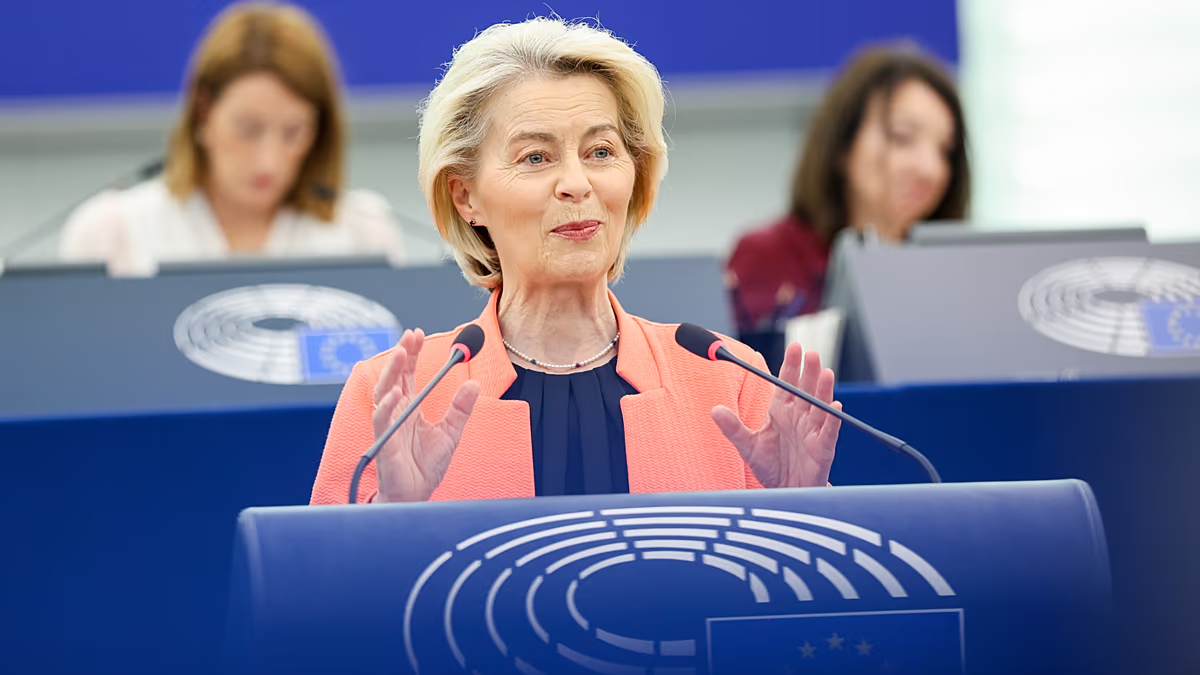
In a pivotal address to the European Parliament, European Commission President Ursula von der Leyen issued a powerful and urgent call to action. Speaking on May 20, 2026, she framed the completion of the European Union’s internal market not merely as an economic project, but as a fundamental geopolitical necessity. In a world marked by intense global competition and strategic realignments, von der Leyen argued that Europe’s strength and sovereignty depend on its ability to harness the full potential of its single market. She presented a vision where tearing down the final, persistent barriers between member states is critical for European businesses to innovate, scale up, and thrive on the world stage. This speech was less a retrospective celebration of past achievements and more a forward-looking blueprint for ensuring Europe’s relevance and resilience in the coming decades.
Finishing the Job: Confronting the Remaining Barriers
At the heart of von der Leyen’s message was a challenge to the EU’s political leaders: to “finish what we started.” She lamented that despite decades of integration, the foundational promise of the single market—to allow businesses to operate seamlessly across 27 countries as if within one—remains unfulfilled. A primary culprit she identified is the practice of “gold plating,” where individual member states add their own layers of bureaucratic complexity and stricter national rules atop agreed EU regulations. While sometimes well-intentioned, this creates a fragmented legal landscape where a company selling in multiple EU nations faces not one set of rules, but 27 subtly different ones. This administrative maze stifles growth, particularly for smaller businesses and startups that lack the resources to navigate it, preventing them from scaling up to become European champions capable of competing with global giants.
A Digital and Green Engine for the Future
Looking ahead, von der Leyen outlined a dual transformation for the single market, built on the pillars of digitalization and sustainability. She pledged to make the market “digital by design,” ensuring that its very architecture supports and accelerates the digital economy. This involves building on key EU initiatives in strategic sectors like semiconductor production, shared cloud infrastructure, and artificial intelligence development. Simultaneously, she directly linked the success of the European Green Deal to a fully functional single market. Achieving ambitious climate and circular economy goals, she argued, requires a market that actively rewards clean innovation. This means systematically removing trade barriers for low-carbon goods, services, and technologies, allowing sustainable solutions to spread faster and cheaper across the continent, thereby turning environmental ambition into economic opportunity.
Building Resilience through Openness and Internal Strength
Acknowledging the lessons learned from recent global crises, the Commission President connected internal market reforms to external economic resilience. She stressed that a stronger, more integrated home market is the best foundation for confident and strategic engagement with the world. By reducing internal friction, European supply chains become more robust and less vulnerable to external shocks. This internal fortitude, in turn, empowers the EU to pursue ambitious new trade agreements, such as the one with Mexico she noted was imminent, from a position of collective strength rather than fragmentation. The strategy is clear: solidify the Union’s internal foundations to better navigate and shape the volatile global trading system, ensuring access to critical materials and markets while upholding European standards.
Ensuring the Promise is Felt by All
Crucially, von der Leyen grounded her economic arguments in a social imperative. She emphasized that the benefits of the single market must tangibly reach “every region and every citizen.” This means ensuring that economic integration does not leave certain areas or communities behind, but instead creates opportunities everywhere—from major capitals to rural regions. A truly successful single market should mean greater consumer choice, lower prices, higher standards, and more local jobs fueled by cross-border investment and trade. It is about making the abstract concept of the “four freedoms” (of movement for goods, capital, services, and people) a lived reality that improves daily life and fosters a shared sense of European prosperity and belonging.
A Call for Sustained Political Will
In her concluding remarks, von der Leyen offered both a tribute and a warning. While rightly celebrating the single market as “one of Europe’s great success stories,” she starkly reminded her audience that “success is not something we inherit.” It is a dynamic achievement that demands constant renewal. The vision of a seamless, digital, and green European economy will not materialize through complacency. It requires persistent political will, cooperation, and courage from national governments to prioritize the collective European good over narrow, short-term national administrative preferences. Her speech was ultimately a rallying cry, urging European institutions and member states to muster the vision and determination needed to complete this generations-long project, ensuring that the EU remains a confident and influential actor in an uncertain world.