


Paragraph 1: A Welcome Amid Global Tension
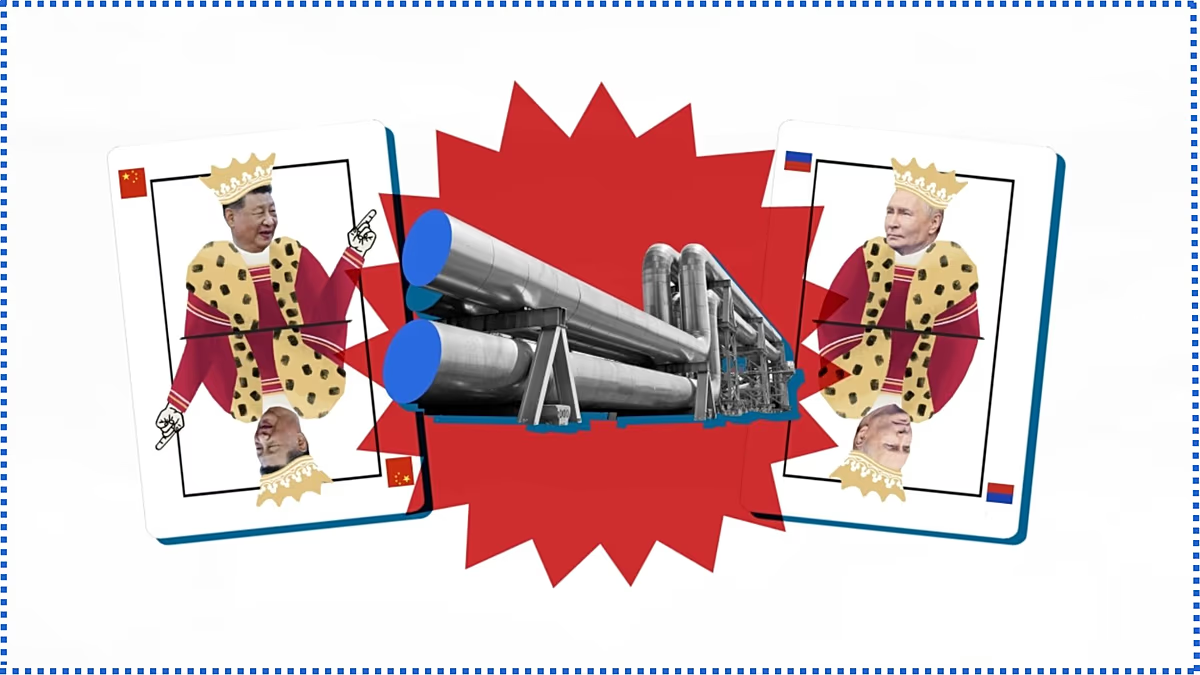
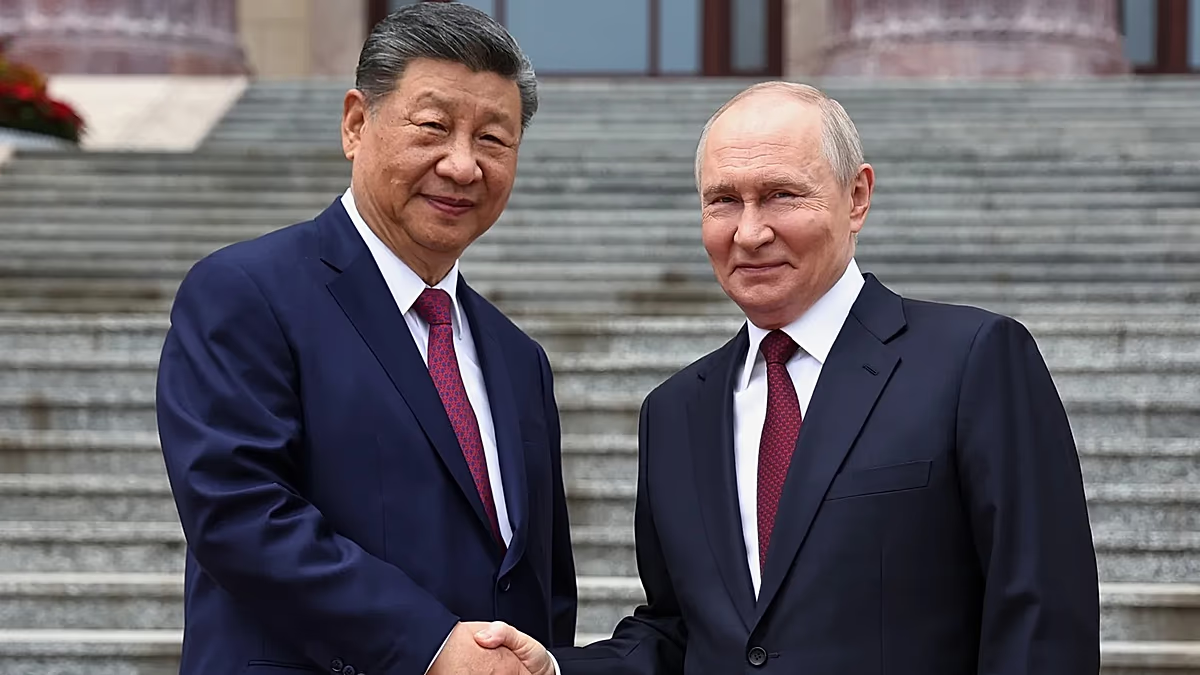
In the early hours of a Wednesday morning in Beijing, Chinese President Xi Jinping welcomed Russian President Vladimir Putin, framing their meeting against a backdrop of worldwide instability. Putin, addressing Xi as a “dear friend,” emphasized that their close partnership was “particularly needed” in the current tense international climate. Xi’s response, as reported by Chinese state media, cast their alliance as a necessary counterweight to what he described as “unilateral hegemony running rampant.” He positioned China and Russia, as permanent UN Security Council members and major world powers, not merely as bilateral partners but as architects of a future global order. Their duty, he stated, was to adopt a “long-term strategic view” and cooperate to build “a more just and equitable global governance system.” This rhetoric set the tone for the visit, elevating it from a routine diplomatic exchange to a statement of shared intent to reshape international norms.
Paragraph 2: Navigating Regional Crises and a Shared Diplomatic Role
The discussions naturally extended to specific global hotspots, particularly the Middle East. Xi noted that the conflict there was at a “critical juncture,” transitioning from war to peace, and stressed it was “imperative” to stop the fighting. He referenced his own four-point proposal for the region—promoting peaceful coexistence, sovereignty, international law, and a balance of development and security—as a framework to build consensus and ease tensions. This focus on the Middle East coincided with proactive statements from Moscow. Ahead of the talks, Russia’s Deputy Foreign Minister Sergei Ryabkov declared that Moscow was ready to provide “all possible assistance” in facilitating dialogue, notably between the US and Iran. These parallel comments from Beijing and Moscow illustrated a coordinated effort to present themselves as indispensable, responsible mediators in complex international crises, a role traditionally occupied by Western powers.
Paragraph 3: Western Scrutiny and the Unspoken Question of Ukraine
The visit occurred under intense Western scrutiny, with the unspoken central question being whether Xi would leverage China’s influence to pressure Putin over Ukraine. German Chancellor Friedrich Merz explicitly voiced this hope, stating he wished Xi would persuade Putin “to end this war in Ukraine which he cannot win.” Western capitals view the Sino-Russian relationship with deepening concern, noting that China has become Russia’s most vital international partner since the invasion. While Beijing has not explicitly endorsed the war, its sustained economic and diplomatic backing has crucially helped sustain Russia’s war effort. Analysts point out that China has not used its considerable leverage to compel Moscow to cease hostilities. Thus, the meeting in Beijing was watched not for declarations on Ukraine, but for any subtle shift in posture or for reaffirmation of the supportive dynamic that has become a cornerstone of Russia’s ability to withstand international isolation.
Paragraph 4: Cementing the Partnership: Documents and Treaties
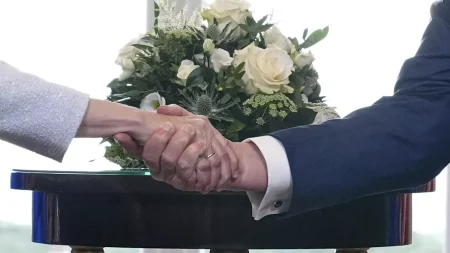
The substance of the partnership was formalized through a series of agreements signed during the visit. Approximately 40 documents were set for signing, with Putin and Xi personally overseeing 21 of them. Key among these, according to Russian state media, were a joint statement on strengthening comprehensive partnership and strategic interaction, and a “declaration on the emergence of a multipolar world and a new type of international relations.” These titles directly echoed Xi’s earlier rhetoric about challenging hegemony and building a new order. Furthermore, Chinese media reported the extension of the foundational “Treaty of Good-Neighbourliness and Friendly Cooperation between China and Russia.” Originally signed in 2001 and extended in 2022, this treaty outlines peaceful relations, economic collaboration, and includes stipulations on military cooperation and defense. Its renewed extension symbolically and legally anchors the long-term strategic commitment both leaders professed.
Paragraph 5: The Strategic Calculus of a “No-Limits” Friendship
The summit reinforced the strategic calculus behind what was once dubbed a “no-limits” friendship. For Russia, embattled and sanctioned, China represents an irreplaceable economic lifeline, a diplomatic shield, and a source of geopolitical legitimacy. For China, Russia serves as a powerful strategic ally in its vision to dilute US-led global dominance, a stable partner in securing its northern frontiers, and a source of energy and military technology. Their coordinated stance on issues like the Middle East allows both to project influence beyond their immediate regions. While the partnership is not without its asymmetries and historical complexities, the current convergence of interests—opposition to a Western-centric order, mutual economic benefits, and shared security perspectives—has forged a bond that appears resilient and deepening, despite external pressures.
Paragraph 6: Implications for a World in Transition
The Beijing summit between Xi and Putin is more than a bilateral event; it is a significant marker in a transitioning global landscape. It showcased a concerted effort by two major powers to present themselves as the stewards of a alternative international system, one they deem more “just and equitable.” Their actions—from extending foundational treaties to aligning on crisis diplomacy—signal a durable alliance intent on weathering contemporary conflicts and shaping future norms. While Western hopes that China might moderate Russia’s actions in Ukraine remain unfulfilled, the meeting instead highlighted the priority both nations place on their strategic synergy. As the world grapples with multiple crises, the solidified Sino-Russian partnership emerges as a defining feature of 21st-century geopolitics, challenging established power structures and introducing a more complex, multipolar dynamic into every major international forum.