

The United States is preparing to announce a significant reduction in the number of troops it would make available to defend Europe in the event of a major invasion or war. This planned shift, expected to be formalized on Friday, reflects a long-anticipated recalibration of American military priorities. While the announcement will not immediately alter the current presence of approximately 76,000 U.S. soldiers stationed across NATO territory—a number that remains at its highest since the Cold War due to Russia’s ongoing war in Ukraine—it signals a future change in the level of American commitment. The decision is rooted in the “America First” doctrine established during the Trump administration and represents a strategic pivot, with the U.S. aiming to focus more resources on other global theatres, such as the Western Hemisphere.
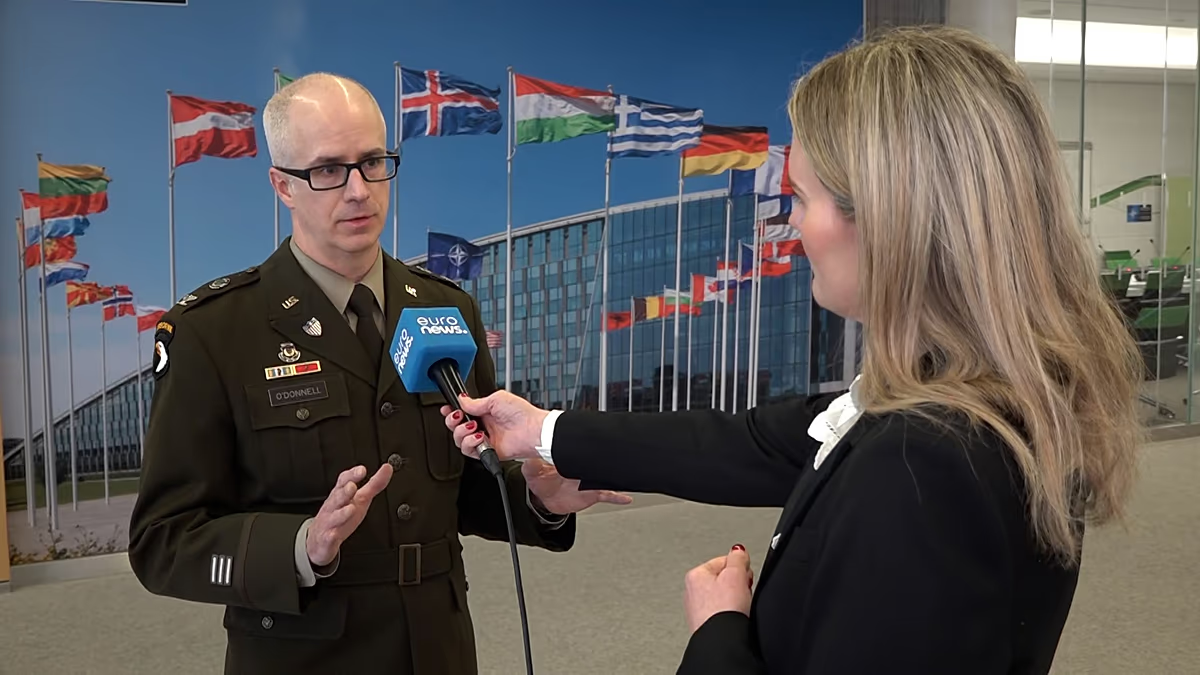
According to NATO senior military advisor Colonel Martin O’Donnell, these adjustments are the result of months of discussion between U.S. military planners and NATO strategists. He emphasized that the changes are targeted specifically at areas where European NATO members have demonstrably increased their own defense capabilities and investments. “There should be no surprises on this,” O’Donnell stated, “and it will focus on areas where we see Europeans very, very capable of stepping up.” The rationale, therefore, is not simply a withdrawal, but a rebalancing: the U.S. intends to pull back its promised support in sectors where European allies are now better equipped to shoulder the burden themselves, fostering a more self-reliant European defense architecture.
However, the practical implications are substantial. A NATO military source confirmed that, while troop numbers on the ground today may not change, the announcement will reduce the level of U.S. material support pledged for Europe during a future crisis or conflict. Pentagon spokesman Sean Parnell clarified that the process involves cutting the number of troops available to NATO as part of a comprehensive review of the U.S. posture in Europe. This follows recent concrete steps, such as the abrupt cancellation of the deployment of a 4,000-strong U.S. armored brigade to Poland. These actions underscore that the policy shift is moving from theory into practice, affecting real-world readiness and contingency planning.
The political context surrounding this shift is complex and charged. The recent brigade cancellation was linked to an earlier decision by former President Trump, who publicly announced a withdrawal of 5,000 soldiers amid a diplomatic feud with German Chancellor Friedrich Merz. Trump took offense at Merz’s criticism of U.S. negotiations with Iran and the broader Middle East strategy, illustrating how these strategic military decisions can be influenced by, and exacerbate, transatlantic political tensions. European allies have been nervously anticipating such changes, aware that the American security umbrella, long a foundational element of post-war Europe, is being folded to a new shape.
Despite this rebalancing, U.S. and NATO officials stress that American commitment to the alliance remains. Colonel O’Donnell urged observers not to overlook the “formidable strength” the U.S. continues to provide: tens of thousands of land, air, maritime, and special forces personnel actively participating in NATO exercises and daily operations across the continent. The message is one of evolution, not abandonment. The U.S. footprint will remain significant, but its future promises and crisis-response capabilities are being scaled down to match a new strategic reality where Europe is expected to do more.
Ultimately, this announcement marks a pivotal moment in transatlantic defense relations. It is a deliberate move away from the post-Cold War model of predominant U.S. guardianship toward a more balanced partnership. The success of this transition hinges on the continued and accelerated strengthening of European militaries. For NATO, the challenge will be to maintain a cohesive and credible deterrence against threats like Russia, even as the cornerstone ally recalibrates its contribution. The coming years will test whether a more self-sufficient Europe can seamlessly fill the gaps left by a more continentally restrained America.