
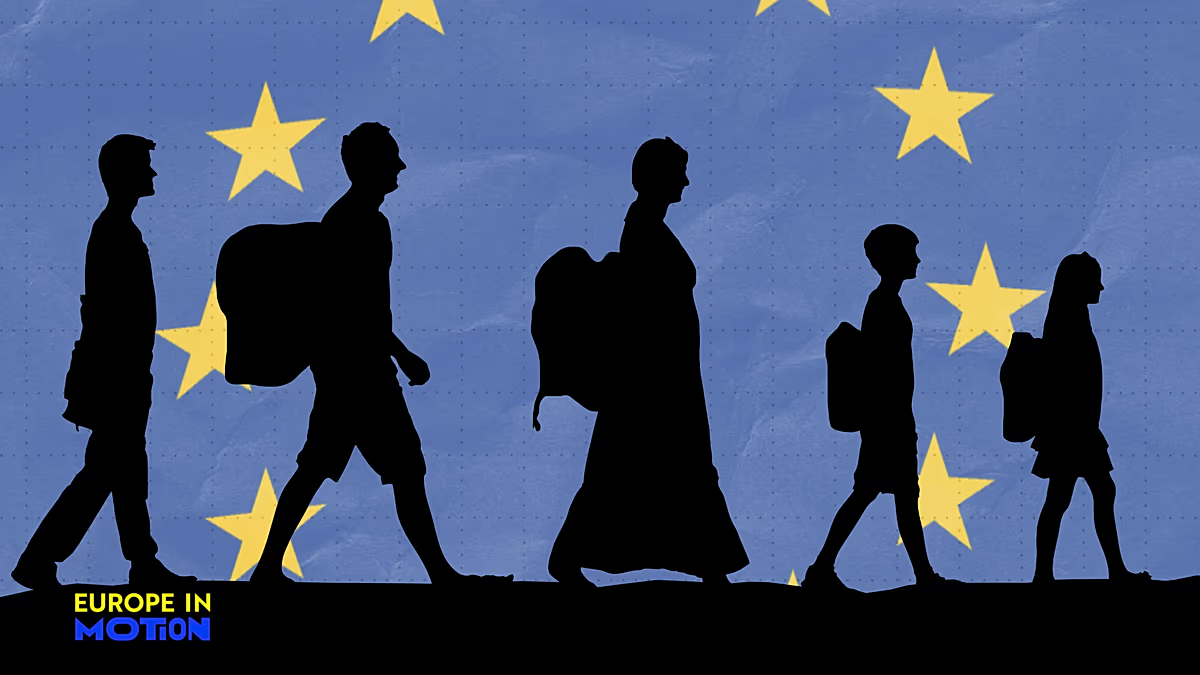


The European Union is entering a new era of border management, marked by a significant and sustained shift in migration patterns. According to recent Eurostat data, the flow of new migrants into the bloc has been steadily declining since 2022, dropping from 5.4 million to 4.5 million in 2024—a reduction of nearly one-quarter. This trend appears to be more than a temporary fluctuation; it reflects a concerted, medium-term policy effort. In parallel, the number of asylum seekers granted protection status has fallen to 361,000 in 2025, the lowest figure since 2019. The narrative is not solely about reduced arrivals; it is equally about increased departures. The EU is actively seeking to balance its humanitarian obligations with stricter enforcement, signaling a move toward a system that prioritizes controlled and regulated migration.
This shift is underscored by a sharp rise in enforcement actions. Repatriation orders issued by EU member states reached almost half a million in 2025, the highest level since 2019. While the gap between orders issued and actual returns remains wide, the number of people physically expelled from the continent—155,000 last year—was the largest since 2020. European Commissioner for Internal Affairs and Migration, Magnus Brunner, frames this within a historic reform. He stated that the EU is on the “final stretch of the largest reform of the European asylum and migration system to date,” aiming to create “the most modern border management system in the world.” This includes the upcoming Entry/Exit system and strengthened cooperation with non-EU countries to combat illegal crossings and smuggling, though Brunner acknowledges that “a lot of work” remains.
A closer look at the data reveals which nations and groups are most affected by this enforcement push. In 2025, Turkish nationals were the most repatriated group, with over 13,000 returns, followed by Georgians, Syrians, and Albanians. In terms of national efforts, Germany carried out the highest number of actual expulsions (nearly 30,000), followed by France and Sweden. However, when examining repatriation orders—the legal directives to leave—France emerges as the most active issuer, with 138,000 orders compared to Germany’s 55,000. This stark disparity in France, and across the bloc, highlights a persistent challenge: translating legal orders into physical returns. Spain and the Netherlands also issued tens of thousands of orders. The execution gap is attributed to practical obstacles like difficulties in establishing a migrant’s origin, health complications, or protections for unaccompanied minors.
Border enforcement is also intensifying at the point of entry. In 2025, more individuals were refused entry at EU borders than in the previous two years, totaling 133,000 rejections. The primary reason, accounting for 30% of cases, was failing to provide a valid purpose and conditions for their stay. Another 17% were turned back because they had already exceeded the 90-day limit for short stays within a six-month period. Issues like lacking a valid visa (15%) or being flagged on a security alert (13%) also contributed. Geographically, Poland reported the highest number of border rejections, at nearly 30,000, reflecting its pivotal role as an eastern frontier, followed by France with just over 12,000. This data illustrates a multi-faceted approach to control, combining visa checks, duration limits, and security screenings.
The driving force behind these statistical trends is a comprehensive political and legal overhaul. Two weeks ago, the European Commission published a report detailing the implementation of the Pact on Migration and Asylum, a sweeping legislative package adopted in 2024. The report asserts that member states have “significantly advanced” in putting the Pact into practice. Its core objectives are to establish a common EU framework featuring stronger external border protections, while maintaining what it describes as “fair and firm asylum rules, and a balance between solidarity and responsibility.” This Pact represents the institutional backbone of the current strategy, aiming to replace ad-hoc crises management with a predictable, unified system that manages migration proactively rather than reactively.
In summary, the EU is methodically enacting a tougher stance on border control and migration management. The numbers tell a clear story: fewer arrivals, more orders to leave, and increased rejections at the frontier. This is supported by a major legal reform—the Pact on Migration and Asylum—and ambitious technological projects like the Entry/Exit system. Yet, the human and administrative complexities persist. The large gap between repatriation orders and actual expulsions, and the varied reasons for border rejections, show that policy ambitions must contend with real-world hurdles. The bloc is striving to build a system that is both modern and rigorous, but its ultimate effectiveness will depend on consistent implementation across all member states and sustainable cooperation beyond its borders.