
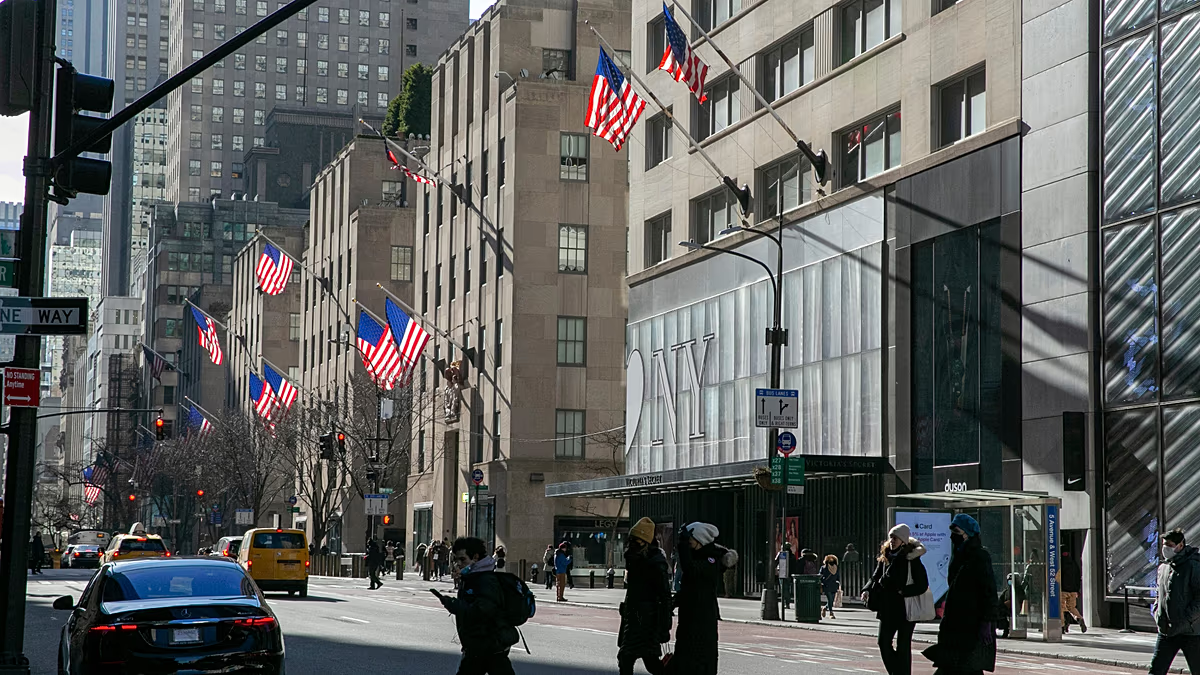


On a busy Monday night in Midtown Manhattan, a vibrant and affluent neighborhood just blocks from Trump Tower, a routine errand ended in a tragic and shocking fatality. Donike Gocaj, a 56-year-old woman from the suburban community of Briarcliff Manor, parked her SUV near the corner of Fifth Avenue and East 52nd Street shortly before 11:30 p.m. Moments after exiting her vehicle, she fell into an open maintenance hole on the street. Emergency responders, including firefighters, worked to extract her from the shaft, but despite their efforts, she was pronounced dead after being transported to a local hospital. This incident transformed a familiar, glittering cityscape into a scene of profound personal loss and public hazard, highlighting how everyday infrastructure can, under rare circumstances, become a fatal threat.
The utility company responsible for the maintenance hole, Con Edison, later provided a crucial detail from surveillance footage. Their investigation revealed that a multi-axle truck had driven over the heavy metal cover approximately twelve minutes before Ms. Gocaj’s arrival, dislodging it from its proper position. In a statement, a Con Edison spokesperson expressed condolences, noting, “Our thoughts remain with her family, and safety remains our top priority.” The spokesperson also acknowledged that while such events are rare, the immense weight of certain heavy vehicles can indeed displace these covers. This explanation points to a complex interplay of urban mechanics—the constant, grinding pressure of city traffic against the static fixtures designed to protect the public.
The location of this accident underscores its jarring nature. Fifth Avenue and East 52nd Street sit in the heart of a high-end shopping district, an area synonymous with luxury, security, and order. That a gaping, unprotected hole could appear suddenly on such a prestigious and well-maintained street forces a reckoning with the invisible vulnerabilities woven into even the most polished urban environments. It challenges the assumption that safety is guaranteed in conspicuous zones of wealth and power, reminding us that the underlying networks of utilities and transportation—the city’s unseen circulatory system—are subject to stresses that can manifest danger anywhere, without warning.
As the city’s chief medical examiner’s office conducts its investigation to determine the precise cause of death, the human story at the center of this event deserves reflection. Donike Gocaj was not merely a statistic or a victim in a news brief; she was a resident of a nearby suburb, likely in Manhattan for reasons commonplace to many—perhaps a late meeting, a visit with family, or simply navigating the city’s endless rhythms. Her death is a devastating loss to her community, family, and friends, a life ended not by malice or overt negligence, but by a freakish and instantaneous structural failure. It is a reminder that public safety infrastructure, from manhole covers to guardrails, exists to protect millions of individual stories and journeys; its integrity is a silent covenant between the city and its inhabitants.
This tragic event also prompts broader considerations about urban responsibility and engineering. While Con Edison rightly notes the rarity of such occurrences, the fact that a single vehicle’s passage can dislodge a cover suggests a need for ongoing review of materials, design, and traffic management in areas with heavy commercial flow. It raises questions about whether periodic inspections or technological monitoring could detect displaced covers more rapidly, or if different securing mechanisms could better withstand the forces of modern truck traffic. The balance between cost, practicality, and absolute safety is a perennial challenge for municipalities, but each incident like this one renews the urgency of that conversation.
Ultimately, the death of Donike Gocaj is a somber narrative of intersection—where private life meets public space, where routine infrastructure meets catastrophic failure, and where a vibrant city’s dynamism meets its latent peril. As official investigations continue to seek clarity, the core truth remains a profound human loss arising from a mundane urban object. It underscores that our shared spaces require vigilant stewardship, and that behind every public safety protocol is a singular human life worth protecting. Her story is a call to honor those lives through relentless attention to the details that, while usually invisible, form the very foundation of our collective security and trust in the city around us.