


Paragraph 1: A Strategic Shift in Budapest
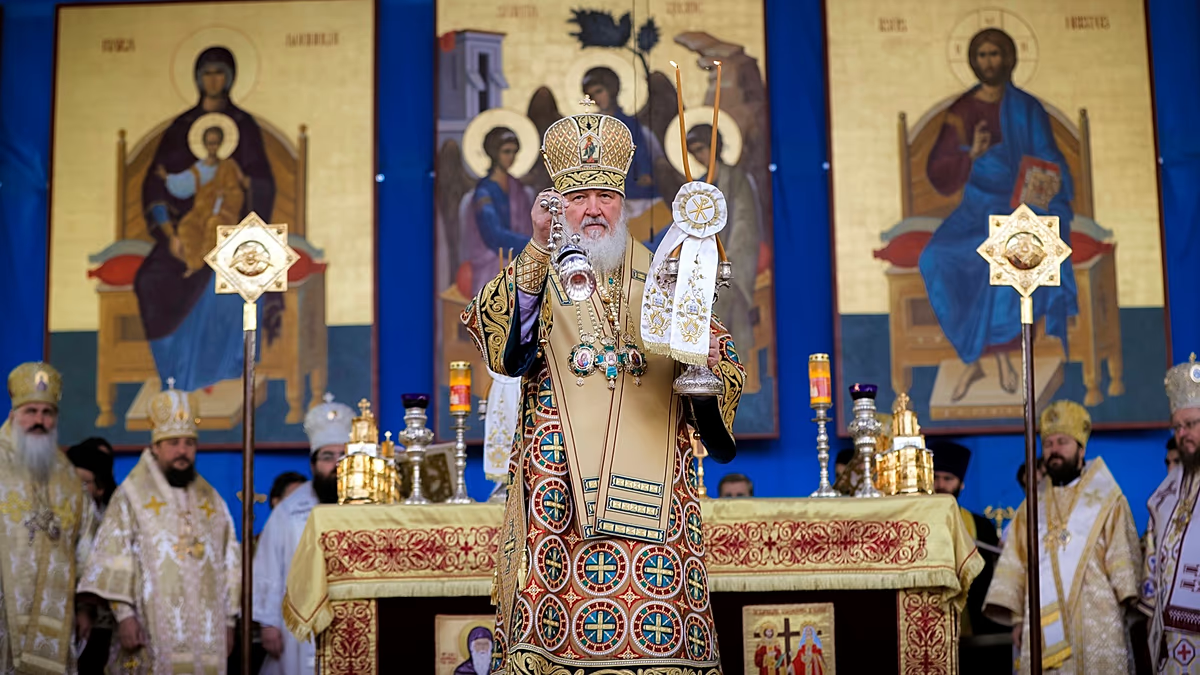
In a significant policy shift, Hungary’s new government has indicated it will no longer shield certain high-profile Russian figures from European Union sanctions—a move that directly reverses the protective stance of former Prime Minister Viktor Orbán. Euronews reports that Péter Magyar’s administration is prepared to allow Patriarch Kirill, the influential head of Russia’s Orthodox Church, to be added to the EU’s sanctions list. This decision could pave the way for one of Russia’s most prominent religious and political voices to face concrete penalties from the bloc. The change signals Magyar’s desire to distance his government from Orbán’s frequent use of veto power and recalibrate Hungary’s role within the EU, particularly regarding collective measures against Russia.
Paragraph 2: The Long-Stalled Effort to Sanction Patriarch Kirill
The EU first sought to sanction Patriarch Kirill in 2022, accusing him of publicly endorsing Russia’s full-scale invasion of Ukraine and disseminating propaganda that justified the war. At the time, Hungary blocked the measure, framing its opposition as a defense of religious freedom—a position critics viewed as politically motivated. Now, with Orbán out of office, Brussels hopes the path is finally clear. As one EU diplomat noted, revising names on sanctions proposals is a normal part of negotiations, but this particular case carries symbolic weight. It represents not just the potential isolation of a key Kremlin ally, but also a test of European unity in the face of Russian aggression.
Paragraph 3: Beyond Kirill—Revisiting Shelved Sanctions
The shift in Budapest could also lead the EU to revisit other Russian individuals previously spared from sanctions at Orbán’s insistence. Notable examples include Sports Minister Mikhail Degtyaryov and oligarch Viatcheslav Kantor, whose names were removed from earlier sanctions lists following Hungarian objections. According to Márton Hajdu, a senior lawmaker and ally of Prime Minister Magyar, the new government will not use state power to “cut private deals” that undermine common EU efforts. However, Budapest remains firm on one point: sanctions perceived as threatening Hungary’s economic stability remain off the table. This nuanced position highlights the balancing act facing the new administration as it seeks to align more closely with European partners while safeguarding national interests.
Paragraph 4: Cracking Down on Russia’s “Shadow Fleet”
Alongside targeting individuals, the EU is preparing a smaller, more agile sanctions package aimed at disrupting Russia’s so-called “shadow fleet”—a network of vessels used to circumvent Western restrictions on oil exports. These ships, often operating under false flags and with inadequate insurance, have raised environmental and security concerns across European waters. In recent months, countries including France, Sweden, and Poland have boarded suspected vessels, reflecting growing determination to tackle sanctions evasion. EU foreign policy chief Kaja Kallas has advocated for a “rolling” sanctions approach, whereby ships and entities involved in illicit oil trade can be blacklisted as soon as evidence is gathered, rather than waiting for larger, slower-moving sanction packages.
Paragraph 5: A New Approach to Sanctions Enforcement
This “rolling” method represents a notable evolution in the EU’s sanctions strategy, enabling more rapid responses to emerging evasion tactics. Ambassadors are set to discuss the proposed measures, with the aim of formal adoption by mid-June. Looking ahead, a broader 21st package of economic sanctions is expected by mid-July. The EU is also considering extending the standard sanctions renewal period from six months to one year—a change Orbán long opposed because it reduced his government’s leverage to veto extensions. With Hungary now potentially supportive, the bloc could strengthen the durability and impact of its restrictive measures, closing loopholes that have allowed Russian oil and revenue to continue flowing.
Paragraph 6: Implications for European Unity and the War in Ukraine
Hungary’s newfound willingness to cooperate marks a meaningful step toward greater EU consensus on pressuring Russia. For years, Orbán’s vetoes created friction and slowed collective action, often casting Hungary as Moscow’s tacit ally within the bloc. Under Magyar, the emphasis appears to be on pragmatic alignment, provided Hungary’s core economic interests are preserved. If the EU succeeds in sanctioning Patriarch Kirill and tightening the noose on Russia’s shadow fleet, it would send a clear message: European resolve remains firm, and adapts as the conflict persists. Ultimately, this shift is about more than adding names to a list—it is about reinvigorating a unified European front dedicated to ending the war in Ukraine.