

A New Chapter in Swiss Security: Balancing Tradition with Modern Threats
Swiss Defence Minister Martin Pfister struck a resonant chord in Berlin, declaring Switzerland’s readiness to shoulder greater responsibility for both its own security and that of Europe. Speaking at a meeting of the DACH countries—Germany, Austria, and Switzerland—Pfister positioned Switzerland as a nation eager to evolve from a passive neutral state into an active, reliable partner. This statement marks a subtle but significant shift for a country historically defined by its non-alignment. While Switzerland remains outside the European Union and NATO, the geopolitical shockwaves from Russia’s invasion of Ukraine have compelled a continental reassessment. Nations once content with minimal defence budgets are now rearming, and Switzerland, though moving cautiously, is part of this trend. Pfister’s words signal an acknowledgment that in today’s interconnected world, national security cannot be entirely divorced from regional stability.
Investing in a Modern Defence: Closing the Spending and Capability Gap
This philosophical shift is underpinned by concrete, if gradual, financial commitments. Switzerland currently allocates approximately 0.7% of its GDP to defence, a figure notably lower than the 2% NATO benchmark and Germany’s 2.4%. Bern’s plan to increase this to 1% by 2032 is a step forward, yet it highlights the measured pace of change. Pfister pointed to strengths in the existing structure, notably a “well-functioning militia army” of about 140,000 personnel. However, he openly admitted that modernisation is urgently needed, particularly in procuring new equipment and, most critically, in closing glaring gaps in air defence. This acknowledgment sets the stage for Switzerland’s most significant defence transformation in decades, moving beyond the symbolic presence of its militia toward a technologically capable force prepared for 21st-century threats.
The Layered Challenge of Air Defence: High-End Systems and Low-Cost Drones
The centrepiece of Switzerland’s modernisation is its participation in the European Sky Shield Initiative (ESSI), a German-led project for joint air defence procurement. Through this, Switzerland is acquiring high-end systems like the IRIS-T SLM and the Patriot missile system, alongside committing to the F-35 fighter jet. Yet, as Marcel Berni, a strategic studies lecturer at ETH Zurich, cautions, these prestigious platforms address only part of the problem. While essential for countering aircraft and cruise missiles, they are an inefficient and costly solution against cheap, mass-produced drones. The war in Ukraine has starkly illustrated this new reality: a multi-million-dollar missile cannot sustainably defend against a drone costing a few thousand francs. Berni argues that a truly effective air defence must be layered, incorporating electronic warfare, secure communications, and rapid adaptation. For Switzerland, this means complementing high-tech purchases with investments in resilience and recognising that neutral isolation may be a strategic liability in the face of complex, hybrid threats.
The Drone Revolution: A Direct Threat to the Swiss Heartland
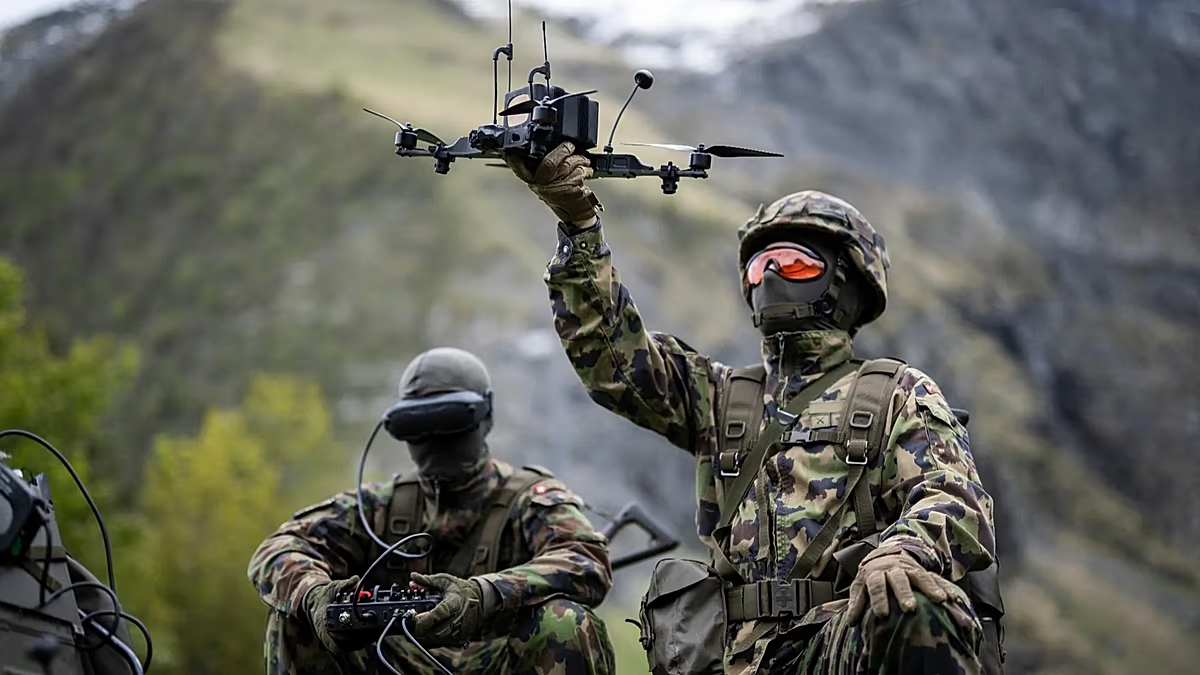
The drone threat is not a distant concern for this landlocked nation. Despite being surrounded by neighbours, including NATO members, Switzerland is proactively preparing for aerial vulnerabilities. The army is massively expanding its drone capabilities, integrating a “drone flying school” into basic training with the goal of having multiple trained pilots in every platoon. While initially focused on reconnaissance, the program is testing attack drones, including FPV (First-Person-View) “kamikaze” drones similar to those used devastatingly in Ukraine. Funding for drones and counter-drone systems has doubled in the latest armaments plan. Berni notes the threat is less about swarms attacking cities and more about targeted strikes on critical infrastructure—of which Switzerland hosts a significant amount for European logistics. This new battlefield calculus, where cheap offensive weapons force disproportionately expensive defences, is reshaping Swiss military priorities in real-time.
The Limits of Military Response: Civil Resilience and Shared Responsibility
A crucial complexity in Switzerland’s security equation is the division of responsibility. The protection of critical infrastructure—energy grids, transport hubs, communication networks—officially falls to private operators and civil authorities, not the army. The military can only provide subsidiary support in exceptional crises. This creates a potential vulnerability gap; while the army modernises to counter drone threats, the day-to-day physical security of key sites rests elsewhere. This structure underscores a broader point: national defence in the modern era cannot be the military’s task alone. It requires a whole-of-society approach, integrating civil resilience, private-sector preparedness, and seamless public-private cooperation. The Swiss model, which traditionally separates civil and military domains, is being tested by threats that blur these very lines.
Neutrality Under Pressure: An Enduring Ideal in a Changing World
All these developments unfold under the long shadow of Swiss neutrality, a centuries-old principle enshrined in international law and popular identity. Berni observes that Switzerland’s current legal framework treats “perpetrator and victim in the same way,” a stance starkly visible in its initial reluctance to allow the re-export of Swiss-made arms to Ukraine. However, the practical demands of continental security are pulling the country toward deeper cooperation with European partners on defence projects, joint exercises, and industrial policy. This tension has sparked a political movement seeking to constitutionally cement a stricter form of neutrality. Thus, Switzerland finds itself at a crossroads, navigating between a cherished, historically successful tradition of non-alignment and the pressing, practical imperative to collaborate closely with its allies in an increasingly dangerous world. The path it chooses will define its role in Europe for generations to come.