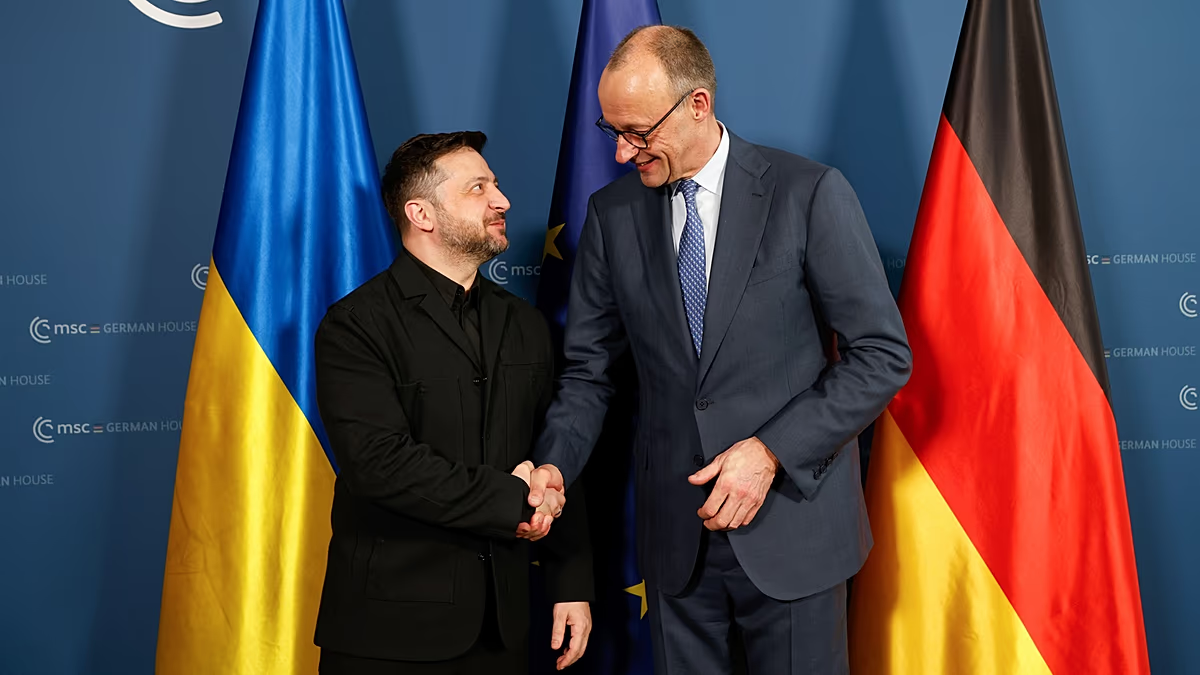



Amid the prolonged and often stalled negotiations surrounding Ukraine’s bid to join the European Union, German Chancellor Friedrich Merz has put forward a novel and ambitious proposal. With the full accession process likely to take many years due to complex political and legal hurdles, Merz suggests creating a new category of “associate membership” for Ukraine as an immediate and substantial step forward. This status, detailed in a letter to EU leaders, is designed to break the current deadlock, offering Kyiv tangible benefits and a deeper political bond with the bloc while the longer, formal accession talks continue. The core idea is to offer Ukraine more than symbolic gestures but something less than full voting membership, specifically tailored to the extraordinary circumstance of a nation defending itself from a brutal war.
Under Chancellor Merz’s proposal, associate membership would grant Ukraine unprecedented access to the EU’s core decision-making bodies—the European Council, Commission, and Parliament—allowing it to participate in discussions and shape agendas, albeit without formal voting rights. Perhaps more concretely, it would enable Ukraine to gradually integrate into certain EU-funded programs and, most crucially, provide a structured security guarantee. This guarantee would be activated under Article 42.7 of the EU treaties in the event of a new Russian attack, compelling member states to provide aid and assistance. While different from NATO’s Article 5, this mechanism offers a significant EU-backed pledge of support, ranging from military to economic and diplomatic aid. To ensure compliance, a “snap-back mechanism” would be included to freeze associate status if Ukraine backtracks on essential reforms in democracy or the rule of law.
This proposal arrives at a critical juncture in the dialogue between Ukraine and the EU. Ukrainian President Volodymyr Zelenskyy has consistently and forcefully rejected any “symbolic” forms of membership, arguing that his citizens are paying for their European future with their lives and deserve a clear path to full integration. Just last month, he urged EU leaders to provide a definitive start date for membership. Merz’s plan attempts to bridge the gap between Ukraine’s urgent demand for recognition and the cautious, merit-based approach of many member states. He acknowledges that the unprecedented “associate” concept will raise legal and political questions but urges leaders to adopt a constructive approach, framing it as the strong political signal of solidarity that Ukraine desperately needs to sustain its fight and strengthen its hand in future peace negotiations.
Importantly, Chancellor Merz is keen to position this as a solution for Ukraine that does not come at the expense of other EU hopefuls. He explicitly states that the proposal must not derail the accession processes of Moldova—whose path is informally linked to Ukraine’s—or the countries of the Western Balkans. For these candidates, he suggests exploring “privileged access” to the single market and closer institutional ties. This balancing act reflects the EU’s broader challenge of managing multiple enlargement processes simultaneously. Furthermore, the political landscape is shifting, most notably with the departure of Hungary’s Viktor Orbán, Ukraine’s most vocal opponent within the EU. His successor, Péter Magyar, has shown a willingness to lift Hungary’s veto, provided bilateral issues concerning the Hungarian minority in Ukraine are addressed, opening a window of opportunity for progress.
The path forward, however, remains complex and requires consensus. Other member states, including Austria, the Czech Republic, Italy, Slovakia, and Slovenia, have circulated an alternative plan focusing on the sectoral integration of all candidate countries into specific EU policies and markets. Merz concludes his letter by calling for a dedicated task force to work out the details of his associate membership model, aiming for a political agreement soon. The immediate, more traditional next step in Ukraine’s journey could be the opening of the first formal cluster of accession negotiations—the “fundamentals”—potentially as early as the EU summit in June, provided progress is made with Hungary.
In essence, Chancellor Merz’s proposal represents a bold attempt to inject political creativity and urgency into a process often mired in bureaucracy. It seeks to offer Ukraine a real seat at the table and a concrete security pledge now, without pre-empting the rigorous and necessary reforms for full membership later. It is a recognition that while the technical process of alignment may be long, the political and moral imperative to anchor Ukraine firmly within the European family is immediate. The proposal tests the EU’s capacity for institutional innovation in the face of geopolitical necessity, aiming to provide hope and practical support to a nation at war while preserving the integrity and future stability of the Union itself.