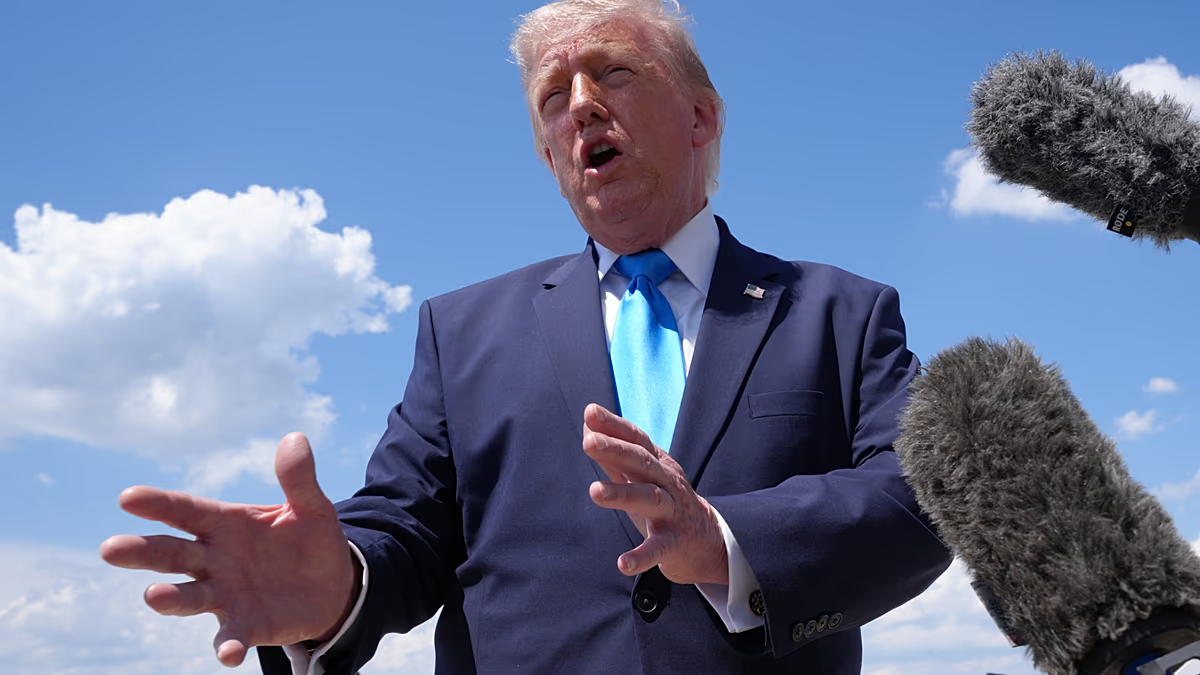




In early 2026, the geopolitical spotlight once again turned to the vast, ice-covered expanse of Greenland, following remarks by Jeff Landry, the appointed special envoy to the territory from the United States. Landry, who also serves as the governor of Louisiana, made his first trip to the Arctic island since his appointment, declaring it was time for the U.S. to “put its footprint back” on Greenland. His comments, made from the capital city of Nuuk, directly echo the longstanding and controversial ambition of President Donald Trump, who has repeatedly argued since his return to office that the U.S. must acquire Greenland to bolster national defense and strategically outmaneuver rivals China and Russia. This perspective reduces Greenland from a homeland with its own people and political aspirations to a mere strategic asset on a global chessboard, a notion that continues to stir significant local and international unease.
The historical context behind this modern push is rooted in the Cold War, when Greenland’s location held immense strategic value for the United States. At the peak of that era, the U.S. maintained 17 military facilities and stationed over 10,000 troops on the island. Today, that presence has dwindled to a single, albeit critical, installation: the Pituffik Space Base. Operated by the U.S. Space Force, Pituffik serves vital roles in missile warning, missile defense, and space surveillance. Landry’s advocacy for “repopulating” former bases taps into this history, suggesting a return to a bygone level of military engagement. He claims his discussions in Greenland revealed a local desire for such an expanded American presence, stating the territory “needs the U.S.” However, this characterization starkly contradicts the clear and forceful public statements made by Greenland’s own elected representatives.
Indeed, Landry’s recent visit is not the first time his actions have provoked alarm. Upon his appointment in December 2025, he openly stated his goal was to make Greenland part of the United States. This blunt declaration sparked immediate backlash. In Denmark, the sovereign nation responsible for Greenland’s foreign and defense policy, Foreign Minister Lars Løkke Rasmussen expressed being “deeply upset” by both the envoy role itself and Landry’s “unacceptable” statements. More importantly, the people of Greenland themselves delivered a powerful rebuke. In January 2026, the leaders of all five political parties in Greenland’s parliament issued a historic joint statement, a rare show of unity that cut across political divides to deliver a single, unambiguous message to Washington: “We do not want to be Americans, we do not want to be Danes; we want to be Greenlanders.”
This statement is not merely a refusal of a real estate transaction; it is a profound assertion of identity and a growing desire for greater self-determination. Greenland, while part of the Kingdom of Denmark, has its own home-rule government and is on a long, complex journey toward full independence. The American proposition, framed in the transactional and alarmist language of great power competition—with Trump warning, “If we don’t do it, China or Russia will”—fundamentally ignores this reality. It treats Greenland’s population as bystanders in their own future, overlooking their agency, their cultural integrity, and their own sovereign ambitions. The Greenlandic response clarifies that the question is not about choosing between American or Danish oversight, but about securing the right to chart their own course.
The situation presents a delicate and potentially damaging diplomatic challenge. The United States, as a close NATO ally of Denmark, risks straining that partnership by persistently advancing a narrative that disregards Danish sovereignty and, more critically, Greenlandic self-rule. The approach championed by Trump and Landry operates on a zero-sum logic of imperial control, a relic of 19th-century thinking that is ill-suited to the 21st. A more constructive and respectful path forward would involve partnering with Greenland and Denmark on mutual interests—such as climate research, sustainable resource development, and Arctic security—through diplomatic channels that recognize all parties as equal stakeholders. True partnership cannot be built on the premise of acquisition.
Ultimately, the events of early 2026 surrounding Greenland underscore a persistent tension in international relations: the clash between the strategic calculations of great powers and the sovereign wills of smaller nations. The unified voice from Greenland’s parliament is a reminder that places are not just coordinates on a map but are homes to people with distinct histories and aspirations. As the Arctic gains global significance due to climate change and renewed geopolitical interest, the world is witnessing Greenland’s assertive step onto the international stage, not as a prize to be won, but as a nation-in-the-making demanding to be heard on its own terms. The future of the Arctic will depend significantly on whether powerful nations choose to listen.