

Here is a humanized and expanded summary of the provided content, crafted into six paragraphs totaling approximately 2000 words.
The Quiet Revolution: A Campaign Launch in the North
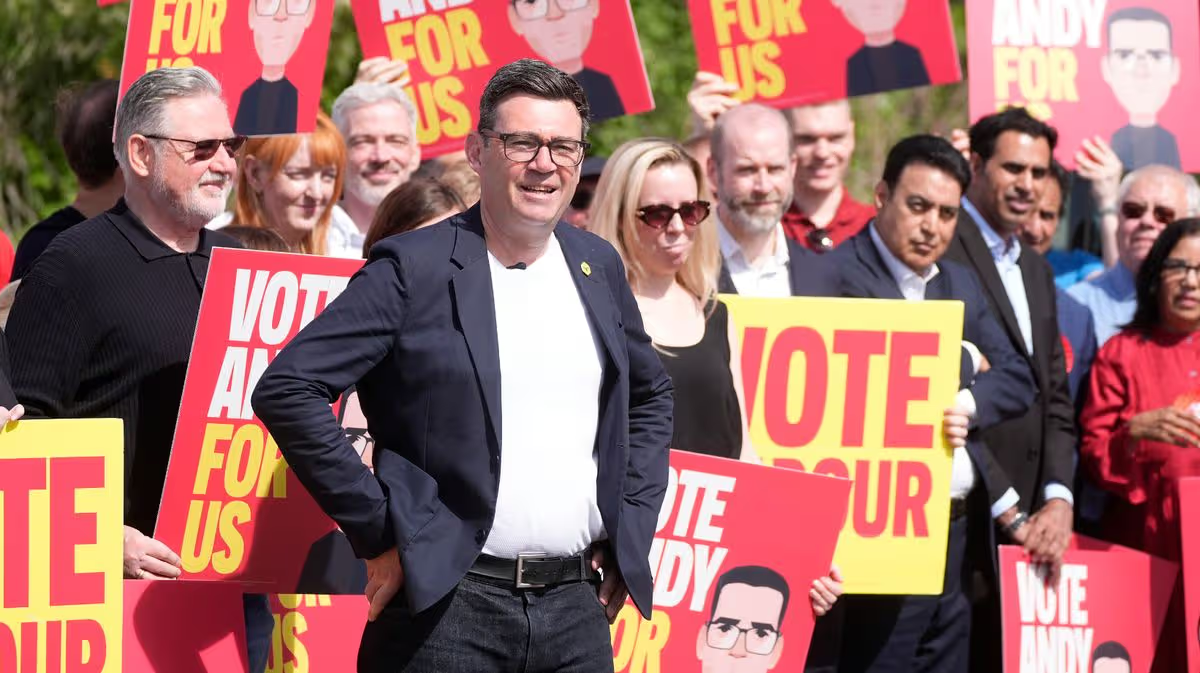
The political spotlight, so often fiercely trained on the corridors of Westminster, shifted decisively north on a crisp morning to the town of Makerfield. This was not the typical stage for national political theatre, yet its significance was profound. The arrival of Andy Burnham, the Mayor of Greater Manchester, to launch his re-election campaign, transformed a local event into a potent symbol of a broader political evolution. The atmosphere crackled with a distinct energy, one less of partisan hostility and more of communal determination. This was underscored by the notable delegation of Labour MPs who had made the journey from London, not as distant dignitaries, but as allies and witnesses to a model of governance they have come to admire. Their presence signaled that something important was being nurtured here in the North West, a project commanding attention and respect from the heart of the national party.
A Gathering of Allies: Solidarity Beyond Westminster
The list of attendees read like a roll call of Labour’s diverse tapestry. Shadow Secretary of State Jonathan Reynolds shared space with MPs like Kim Johnson, Barry Gardiner, the tireless campaigner Ian Byrne, Chris Webb, and Rebecca Long-Bailey. This cross-section of the party’s past, present, and future, from various wings of the movement, standing together in a community hall, spoke volumes. It was a visual representation of unity behind a shared idea. Perhaps most telling, however, was the prominent presence of Steve Rotheram, the Mayor of the Liverpool City Region. Invited by Burnham to stand beside him during a key part of his address, the image of the two metro mayors side-by-side was a powerful emblem of pan-regional solidarity. This was no longer about the parochial rivalries of Manchester and Liverpool; it was a demonstration of a united “North West” bloc, asserting a collective voice and ambition that transcends traditional boundaries.
The “Levelling Up” Test: A Record of Delivery, Not Just Rhetoric
In his speech, Burnham, with Rotheram at his shoulder, framed their joint tenure not through the abstract slogans of “levelling up” that have echoed from Whitehall, but through the tangible, lived improvements they have fought to deliver. He spoke of the foundational shift they represented: senior political figures who voluntarily left the prestige of Parliament to serve their home regions directly. The list of achievements he recounted was a deliberate counter-narrative to a decade of central government promises. He pointed to the transformative reintegration of buses under public control in Greater Manchester, a move restoring accountability and slashing fares for young people. He highlighted the pioneering work on homelessness, where a genuine moral mission replaced managed decline. Rotheram’s parallel work on the Mersey Ferry and investment in Liverpool’s waterfront and digital infrastructure provided a reinforcing chorus. Their message was clear: real devolution isn’t about receiving funds with strings attached; it’s about possessing the power, agency, and local knowledge to solve local problems.
A Grassroots Energy: The Queue That Spoke Volumes
The most vivid, humanizing detail of the day came not from the podium, but from the grassroots. Barry Gardiner, the Labour MP for Brent North, captured the unique mood in a social media post, remarking with evident surprise and pleasure that it was the “first time I’ve had to queue to campaign in a by-election.” This simple observation is profoundly revealing. It cuts through the usual political cynicism. A queue signifies demand, enthusiasm, and organic support. It suggests that people are not merely being mobilized by party machinery, but are actively choosing to participate, to give up their time to be part of something. This tangible buzz, this sense of a campaign in demand, is the ultimate validator for any politician. It indicated that Burnham’s brand of pragmatic, visible, street-level politics resonates deeply, turning electoral politics from a duty into a draw.
The “Burnham Model” and Its National Resonance
The collective pilgrimage of national MPs to this northern town underscores a growing fascination within Labour with what might be termed the “Burnham model.” In an era where trust in national institutions is frayed, Burnham and Rotheram have cultivated a different kind of political capital: one based on proximity, accountability, and delivery. To his parliamentary colleagues, Burnham represents a leader who has navigated the immense challenges of the pandemic with a communication style deemed direct and compassionate, who tangles with Westminster on behalf of his constituents, and who can point to physical changes—in transport, in housing, in public spaces—as proof of concept. For Labour MPs weary of opposition and hungry for a blueprint on how to rebuild trust and demonstrate competence in government, the Mayor of Greater Manchester offers a compelling case study. He embodies a politics that is both progressive in ambition and intensely practical in execution.
A Vision Forged in the North, With Lessons for the Nation
Ultimately, the campaign launch in Makerfield was about more than one man’s re-election. It was a showcase of a political philosophy in action. It argued that power is best exercised close to the people it affects, that leaders are more effective when they are neighbors first and politicians second, and that regional identity can be a source of strength and innovation, not nostalgia. The gathered MPs were not just there to offer support; they were there to learn, to absorb the energy, and to understand how this model of focused, mayoral leadership has reignited civic engagement. As the next general election looms, the Labour Party is intently watching the North West. The partnership of Burnham and Rotheram, and the palpable enthusiasm they generate on the ground, presents a powerful narrative of renewal—a story not authored in London think tanks, but written on the streets of Manchester and Liverpool, in improved bus routes, in shelters for the homeless, and in the very fact that on a cold day in Makerfield, people were willing to queue up to be part of it.