



Paragraph 1: The Claim and the Immediate Reaction
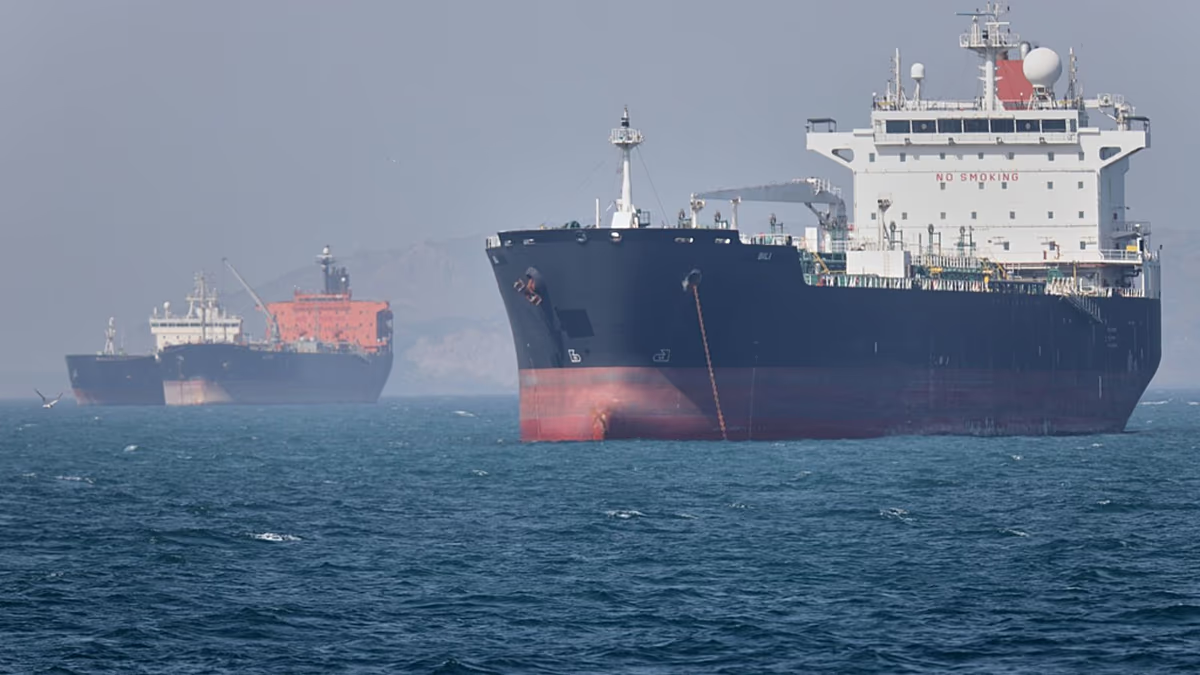
In a move that has escalated tensions in a region already fragile from recent conflict, Iran has unilaterally declared regulatory control over a significant portion of the Strait of Hormuz, one of the world’s most critical oil transport corridors. Through its Persian Gulf Strait Authority (PGSA), Iran published a new map and announced a mandatory authorization process for all vessels transiting a zone that extends deep into waters internationally recognized as belonging to the United Arab Emirates and Oman. This claim effectively places Iranian authority over the territorial seas of its neighbors. The reaction from other Gulf states was swift and unified. Bahrain, Kuwait, Qatar, Saudi Arabia, and the UAE issued a formal joint warning through the International Maritime Organisation (IMO), urging all commercial shipping companies to ignore Iran’s demands and not to comply with the PGSA’s procedures, framing the move as an illegitimate encroachment on sovereign territory.
Paragraph 2: The Strategic and Economic Implications
The stakes of this declaration are extraordinarily high. The Strait of Hormuz is a lifeline for global energy supplies, with about one-fifth of the world’s oil consumption passing through its narrow channels. Iran’s action comes after a period of disruption following the outbreak of the Iran war in February, which saw the strait first blocked by Tehran and then by a U.S.-led blockade. By establishing a toll and authorization system, Iran is attempting to formalize a position of dominance over this chokepoint. This directly threatens the economic and security strategies of neighboring states. Notably, the UAE port of Fujairah, which falls within Iran’s newly claimed zone, is the terminus of a major pipeline built explicitly to allow Emirati oil exports to bypass the strait entirely. Iran’s move challenges the very premise of such alternative infrastructure.
Paragraph 3: A Pattern of Expansion and a Divided International Response
Analysts observe that this is not a static claim but an expanding one. The Washington-based Institute for the Study of War (ISW) noted that the map published in late May appears to extend Iran’s claimed zone beyond the boundaries it initially outlined just weeks earlier, suggesting a deliberate, incremental strategy to push territorial boundaries. The international response to the PGSA’s toll system has been divided, reflecting broader geopolitical alliances. So far, compliance has come primarily from vessels linked to China’s so-called “shadow fleet,” while Western-flagged operators have avoided engagement, partly due to fears of triggering U.S. sanctions. This split underscores how the issue is entangled in larger global rivalries.
Paragraph 4: Post-War Confidence and Reconstruction Efforts
The ISW assessment suggests that this bold territorial claim stems from a perception within Tehran that it emerged victorious from the recent war, granting it the confidence to make demands over sovereign territory of other nations. Furthermore, Iran is utilizing the current ceasefire period not just for geopolitical maneuvering but for rapid military reconstruction. U.S. intelligence reports indicate Iran has resumed its drone production ahead of schedule. This program is particularly resilient as it relies on simpler, widely available components. Reports also suggest, though without public confirmation, that China and Russia may be providing assistance in these rebuilding efforts, indicating broader strategic partnerships are actively supporting Iran’s post-war recovery.
Paragraph 5: The Broader Standoff: Nuclear Issues and Strait Control
The strait claim is inextricably linked to the unresolved, broader standoff between Iran and the United States, particularly concerning Iran’s nuclear program. According to analysts, Iranian officials have found unity in pursuing control over the Strait of Hormuz even while internal debates over nuclear concessions continue. The two sides remain deadlocked on key issues: the removal of Iran’s stockpiles of enriched uranium and, crucially, the long-term status of the strait itself. Iran has not yet responded to Washington’s latest proposals, making the strait not just a local shipping issue but a central bargaining chip in high-stakes international diplomacy.
Paragraph 6: A Precarious Future for Global Trade and Security
The situation presents a grave challenge to international law, maritime security, and global economic stability. By claiming authority over the territorial waters of other nations, Iran is testing the limits of postwar norms and provoking a direct confrontation with its regional neighbors. The unified Gulf state warning through the IMO is a first line of diplomatic defense, aiming to preserve established maritime boundaries. However, the divided compliance from the global shipping industry, coupled with Iran’s ongoing military rebuild and its entanglement in the nuclear dispute, creates a highly volatile scenario. The future of free navigation through the Strait of Hormuz—and thus the stability of global energy markets—now hangs in the balance, dependent on whether Iran’s unilateral claim becomes an enforced reality or is resisted by international consensus and action.