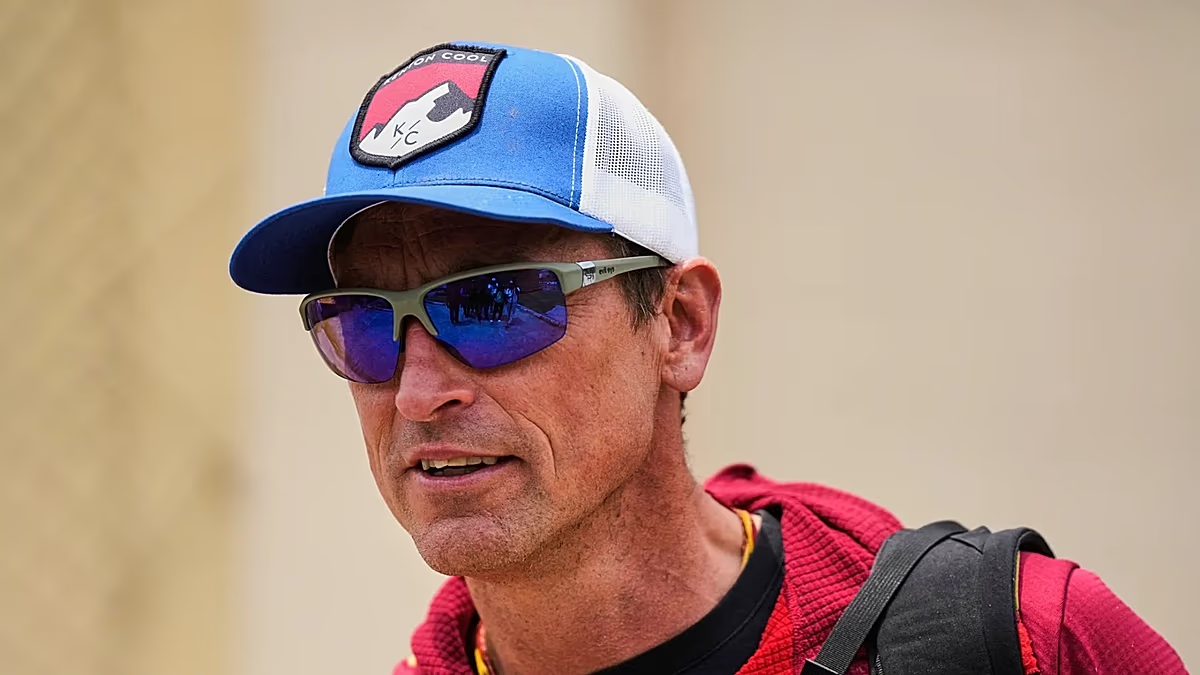


The thin air of the Himalayas is, once again, thick with historic achievement and sobering reality. In the predawn darkness of a late May morning, British mountaineer Kenton Cool, accompanied by his trusted Sherpa guide Dorjee Gyelzen, stood atop the world for a record-breaking twentieth time. This ascent, confirmed by hiking officials, solidifies Cool’s standing as the non-Sherpa with the most climbs of Mount Everest, extending a record he already held. Reaching the 8,849-meter summit around 4 a.m. local time, Cool embodies a rare and relentless dedication to the mountain. His peer, four-time Everest climber Lukas Furtenbach, captured the seeming ease of such a feat, remarking from base camp that Cool makes this extraordinary achievement look like “just another walk in the hills,” and hailing him as an “absolute legend.”
Cool’s monumental success is set against the backdrop of an extraordinarily busy season on the mountain’s Nepali side. Just days before his climb, officials reported a single-day record of 270 climbers and guides successfully reaching the summit, capitalizing on a narrow window of clear, stable weather that is critical during the short spring climbing window. This surge of activity highlights the enduring, almost magnetic draw of Everest, a peak that continues to represent the ultimate physical and symbolic conquest for adventurers from across the globe. Yet, this very congestion underscores the modern challenges of climbing Everest, where logistical coordination and managing “traffic jams” at high altitude become matters of life and death.
Tragically, the same week that celebrated record-breaking numbers also underscored the mountain’s unforgiving nature. As news of Cool’s triumph spread, reports confirmed that two Indian climbers had perished while descending from the summit after a successful climb just a day prior. These losses serve as a stark and solemn reminder that the journey is not over upon reaching the top. The descent, often undertaken on exhausted legs with depleted oxygen supplies, is where many dangers crystallize. Everest’s extreme altitude, capricious weather, and inherent hazards claim lives nearly every season, ensuring that no statistic of success is ever untempered by grief and respect for those who do not return.
The narrative of records on Everest is profoundly intertwined with the Sherpa community, without whom most climbs would be impossible. Just this week, the legendary Kami Rita Sherpa extended his own unparalleled record, summiting for the thirty-second time. With over four decades of high-altitude experience and more than 40 ascents of peaks over 8,000 meters, Kami Rita represents the backbone of the Everest guiding industry. His achievements and those of guides like Dorjee Gyelzen highlight a profound expertise and resilience that often operates behind the scenes. While international climbers like Cool achieve celebrated milestones, they stand literally and figuratively on the shoulders of Sherpa climbers whose deep cultural and physical connection to the Himalayas makes these expeditions feasible.
This enduring human drama unfolds on a stage first conquered seventy-one years ago. In May 1953, the world cheered as New Zealander Edmund Hillary and Nepalese-Indian Sherpa Tenzing Norgay became the first confirmed climbers to stand on Everest’s summit. Their partnership forged the template for all future expeditions: a blend of external ambition and indigenous skill. The mountain they conquered—the crown jewel of the Himalayas, straddling the border of Nepal and Tibet—has not changed, but the world surrounding it has. What was once a near-mythical quest for a few has become a highly organized, though still perilous, endeavor for hundreds each year.
Thus, the story of this season on Everest is one of poignant contrasts: between individual legend and collective endeavor, between historic achievement and immediate tragedy, and between the celebrating climber and the indispensable guide. Kenton Cool’s twentieth summit is a testament to human endurance and passion, a personal milestone in a lifelong conversation with the mountain. Yet, viewed in full context, it is a single thread in a richer tapestry—one woven with the unparalleled legacy of climbers like Kami Rita Sherpa, the sobering memory of those lost, and the ever-present shadow of the original pioneers, Hillary and Tenzing. Together, these elements remind us that Everest remains not just a physical peak to be counted, but a profound and complex human story, written one arduous step at a time.