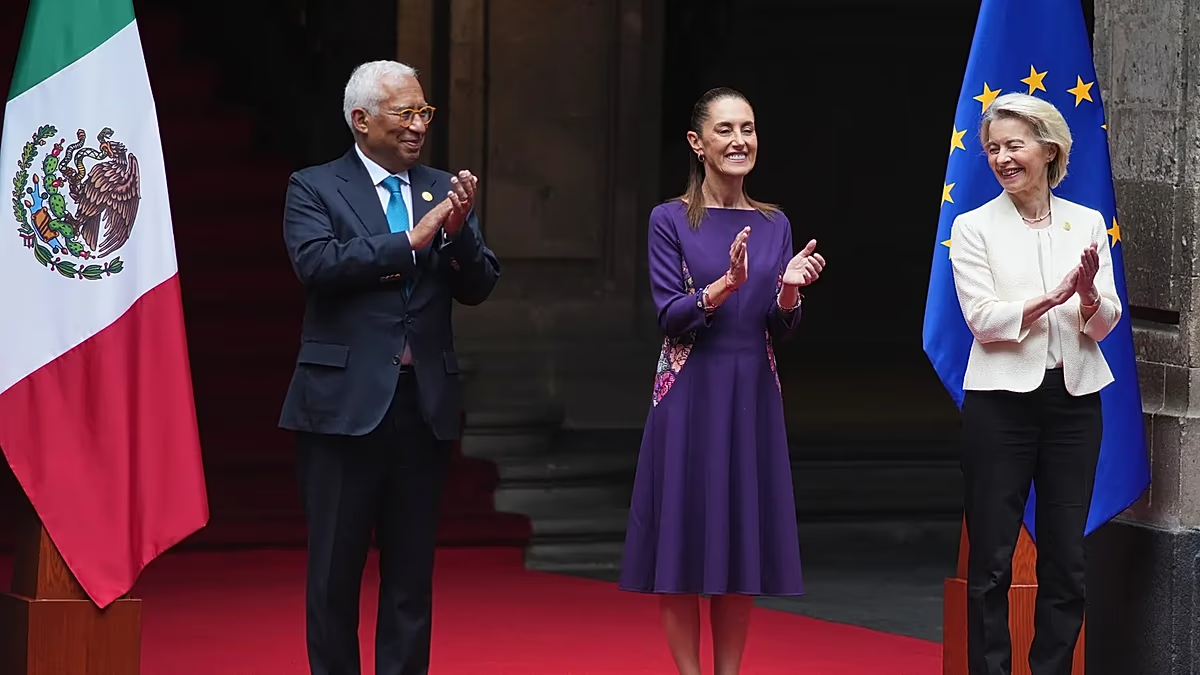



In a significant move to solidify its economic and strategic ties beyond its traditional partners, the European Union has formally strengthened its relationship with Mexico. At a summit in Mexico City, European Commission President Ursula von der Leyen and European Council President António Costa joined Mexican President Claudia Sheinbaum to sign a modernized trade agreement. This event, occurring shortly after the provisional activation of the EU’s pact with the Mercosur bloc, underscores a deliberate European push to expand its influence across Latin America. The timing is notably strategic, set against a backdrop of rising geopolitical tensions and a shifting global order, particularly with the return of a more protectionist U.S. administration to the White House, which has prompted both sides to reassess their dependencies.
The core of this renewed partnership is an economic one, driven by a mutual desire for diversification. Both the EU and Mexico are medium-sized powers seeking to reduce their over-reliance on their largest trading partner, the United States, and on China, for which Mexico has become a crucial manufacturing hub, especially for electric vehicles. President von der Leyen emphasized this “close strategic partnership,” framing the updated agreements as a shared vision for the future that promises tangible benefits. The deal effectively revitalizes a 20-year-old pact that had already removed most tariffs, now extending into new sectors. For European businesses, this opens doors to Mexican markets for agri-food products like pork, dairy, and pasta, as well as pharmaceuticals and machinery, creating fresh opportunities for growth and exchange.
The economic figures highlight both the potential and the current limits of this relationship. Mexico stands as the EU’s second-largest trade partner in Latin America, with bilateral trade in goods reaching €86.8 billion in 2025 and services adding €29.7 billion in 2024. However, these numbers pale beside the colossal $900 billion in goods and services traded between Mexico and its neighbor, the United States. The new EU-Mexico deal, therefore, is also a defensive maneuver for Mexico, offering a counterbalance against mounting pressure from a protectionist U.S. trade policy. Similarly, the EU itself faces repeated tariff threats from the U.S., making stable, rules-based partnerships like this one increasingly valuable. EU Trade Commissioner Maroš Šefčovič noted that over 43,000 European companies already export to Mexico, with more than 11,000 operating there, underscoring the deep, existing commercial ties that this agreement aims to protect and expand.
Beyond tariffs and goods, the agreement is designed to foster a deeper, more integrated economic relationship. It promises to open new avenues for Mexican agricultural exports such as coffee, fruit, chocolate, and agave syrup to European consumers. Importantly, it includes the protection of 568 European and 26 Mexican geographical indications—safeguarding the names and reputations of unique regional products like Champagne or Tequila. Furthermore, it opens public procurement markets, allowing businesses to compete for government contracts on both sides. This comprehensive approach reflects a modern trade philosophy that goes beyond mere commodity exchange to protect intellectual property and create fair competition in state-led projects.
The signing carries a pronounced geopolitical signal. The EU is consciously reinforcing its presence in a region where China has rapidly expanded its influence through investment and trade. A senior EU official proudly stated that, with this and the Mercosur deal, sophisticated EU agreements now cover 97% of the GDP of Latin America and the Caribbean, creating a “dense and connected network” unmatched by any other global region. This represents a deliberate EU strategy to be a cornerstone of Latin America’s economic landscape, offering an alternative model of partnership based on established rules and reciprocity. However, this ambition faces internal EU challenges, most notably from the agricultural sector. The Mercosur deal’s ratification was suspended after strong opposition from European farmers fearing unfair competition and a legal challenge in the EU Court of Justice. Brussels hopes the Mexico agreement will avoid similar backlash by capping sensitive agricultural imports through tariff quotas, a calibrated approach meant to balance market openness with the protection of domestic interests.
In conclusion, the modernized EU-Mexico trade deal is a multifaceted instrument. It is an economic catalyst for both parties, a strategic hedge against global uncertainty, and a statement of European commitment to Latin America. While it cannot instantly rival the sheer volume of Mexico’s trade with the United States, it builds a crucial, reliable alternative pathway for commerce and investment. It also represents a cautious lesson learned from the contentious Mercosur process, attempting to preempt domestic political friction by incorporating safeguards. Ultimately, in a world where alliances are shifting and protectionism is rising, this agreement embodies a conscious choice by both Mexico and the European Union to prioritize openness, partnership, and long-term ambition over isolation and uncertainty.