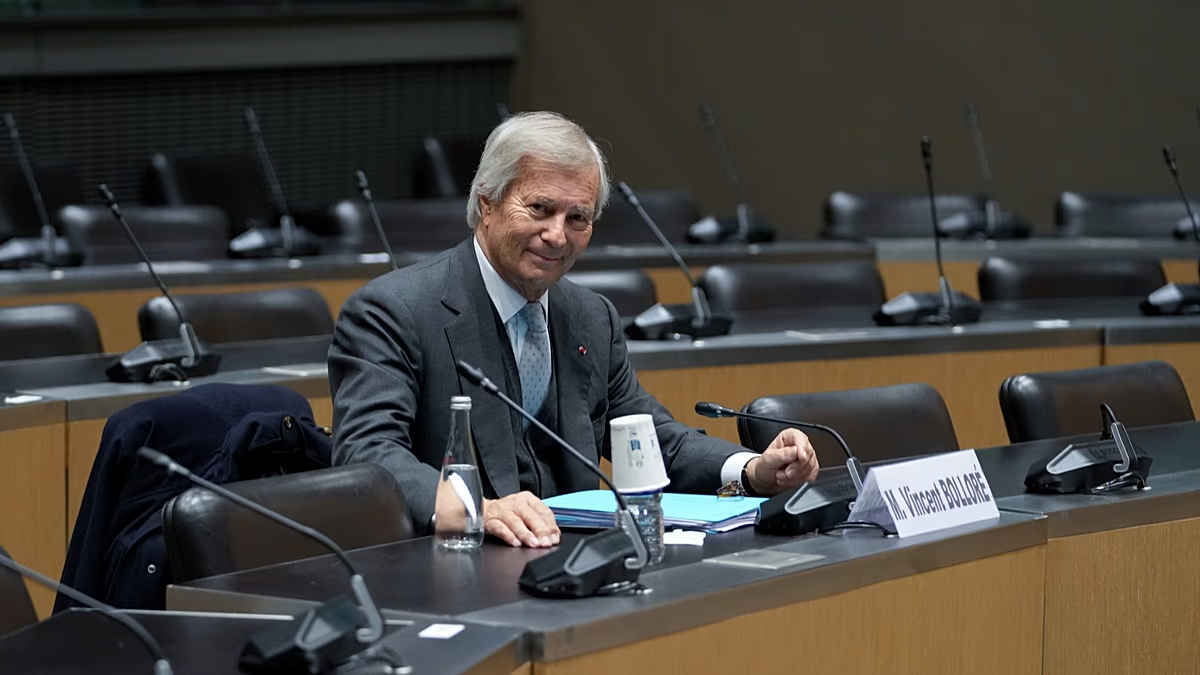



A profound and unsettling tremor reverberated through the French film industry just before the celebrated Cannes Film Festival in May. The source of this disturbance was an open petition, signed initially by over 600 film professionals and later supported by international figures like Javier Bardem and Ken Loach, alongside French luminaries such as Juliette Binoche and Adèle Haenel. The petition, organized by the collective “Zapper Bolloré,” took direct aim at media mogul Vincent Bolloré, the largest stakeholder in France’s dominant film producer and broadcaster, Canal+. The signatories voiced a grave and collective fear: that Bolloré, whom they accuse of using his vast empire to promote reactionary and far-right ideas, was establishing a “fascist grip on the collective imagination.” This alarm grew louder with Canal+’s strategic move to acquire a major stake in the UGC cinema chain, suggesting a vertical integration of production, distribution, and exhibition under a single, politically charged vision.
The corporate response to this public dissent was immediate and stark, escalating the conflict from a war of words to a potential professional boycott. During a Cannes event, Canal+ CEO Maxime Saada declared he would no longer work with, nor allow Canal+ to collaborate with, any professional who had signed the petition, framing their action as an “injustice” against his teams. For many in the artistic community, this was not merely a strong opinion but a direct threat to their livelihoods, intended to punish and silence dissent. Actress Adèle Exarchopoulos crystallized the fear, stating, “you cannot be afraid of losing your job simply for expressing a collective concern.” This perceived attempt to blacklist artists sparked outrage among politicians and commentators, with accusations that Bolloré’s empire was actively “quashing freedom of speech and of creativity,” transforming a business dispute into a fundamental battle for the soul of French cultural expression.
From a legal standpoint, the situation enters a complex grey area. As lawyer Yann Personnic explained, while Saada’s verbal statements themselves are protected as free speech, acting upon them by systematically refusing contracts with signatories could violate French principles of non-discrimination in the workplace and in commercial relations. It is illegal to discriminate based on political opinions. However, the practical challenge is immense. Proving such discrimination in court is exceedingly difficult, as Canal+ could cite subjective artistic or financial reasons for rejecting a project. The chilling effect, therefore, is very real: the mere threat creates an atmosphere of self-censorship where professionals might hesitate to speak out, fearing their career could be quietly derailed under the guise of commercial decision-making, without a clear legal path to recourse.
Crucially, this debate unfolds within a unique French legal framework designed explicitly to prevent such concentrations of ideological power. France’s foundational broadcasting laws obligate channels like Canal+ to ensure “the pluralistic expression of different schools of thought” and to promote diversity. Beyond this mandate for content, Canal+ is legally bound by stringent investment quotas, requiring it to finance a significant portion of French and European cinema, particularly independent productions. Therefore, while the leadership may wish to shape the ideological landscape, their hands are partly tied by a regulatory system built to safeguard cultural diversity. This creates a tense dichotomy: a corporate entity with apparent political motivations is simultaneously a central, legally-mandated patron of the very industry that opposes it.
In an attempt to calm the crisis, key institutions have stepped in to call for de-escalation. France’s audiovisual regulator, Arcom, urged all sides to “lower the temperature” and engage in dialogue. Meanwhile, the French Society of Film Directors proposed a formal mediation process between the petition’s signatories and Canal+’s film teams, hoping to rebuild broken trust. These interventions highlight the high stakes; the health of France’s entire cinematic ecosystem is in jeopardy. The outcome will test whether dialogue and regulatory oversight can temper the clash between corporate power and artistic independence, or whether the industry will fracture further.
Ultimately, this controversy transcends a simple business dispute. It is a defining moment for French culture, probing the resilience of its protections for artistic freedom and pluralism against the influence of concentrated media power. The petition and the aggressive response to it have forced a public reckoning: can a cinematic culture renowned for its intellectual rigor, social critique, and diverse voices continue to thrive if a single gatekeeper, accused of a specific political agenda, controls so much of its funding and distribution? The future of French cinema now hinges on the answer, awaiting the results of proposed mediation and the willingness of all parties to uphold the principles of diversity and free expression that have long been its bedrock.