


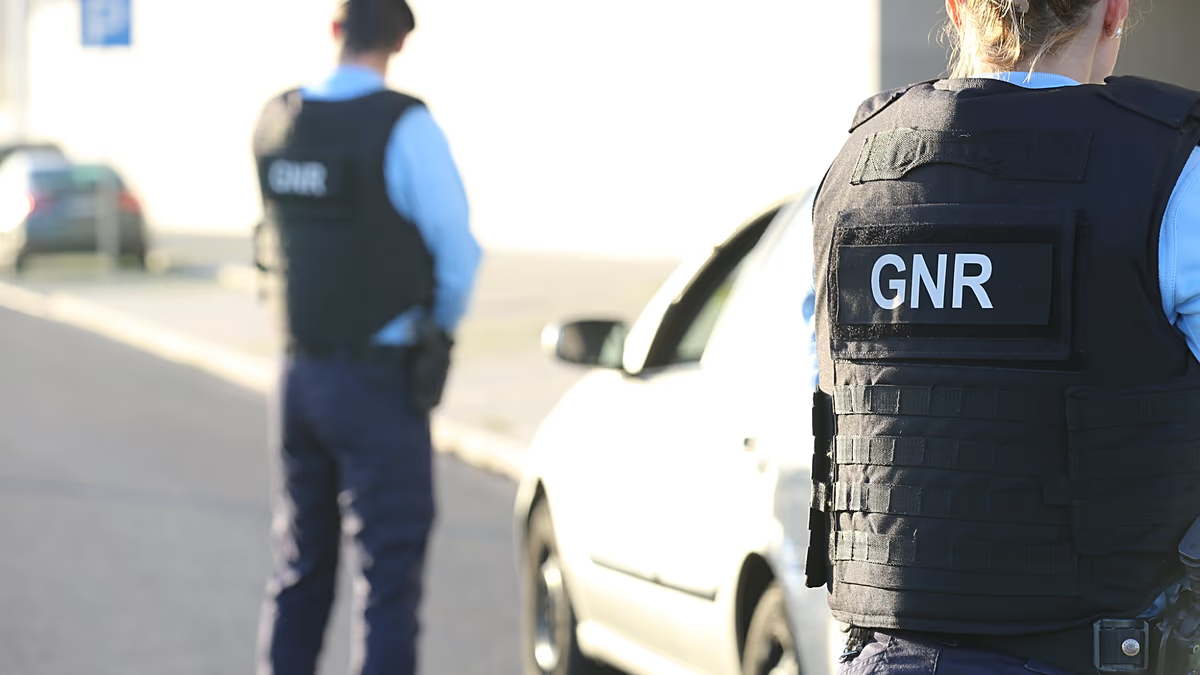
In a disturbing incident that has sparked a complex international investigation, Portuguese authorities arrested a French national, Marine Rousseau, and her companion, Marc Ballabriga, earlier this week. The arrests followed the discovery of Rousseau’s two young sons, abandoned and alone by the side of a main road in Alcácer do Sal, a municipality south of Lisbon. According to Portugal’s National Republican Guard (GNR), the pair are suspected of the crimes of domestic violence and the exposure and abandonment of minors. The arrest location, approximately 170 kilometres from where the children were found, underscores the chaotic and itinerant nature of the situation that unfolded across European borders, drawing immediate cooperation between Portuguese and French judicial systems.
The background of the individuals involved adds layers of complexity to this troubling case. Marine Rousseau, 41, presented herself on social media as a “sexologist” specializing in trauma recovery, body practices, and psychomotricity—a field she reportedly studied at Pierre and Marie Curie University in Paris. Her online professional persona stands in stark contrast to the allegations now facing her. Her companion, 55-year-old Marc Ballabriga, is identified in French media as a former police officer with a prior conviction in 2010 for harassment and domestic violence against the mother of his own daughter, for which he received a prison sentence. His social media activity reportedly includes conspiracy theories and references to his past work for the French Ministry of Defence. This combination of professional backgrounds related to care and authority, juxtaposed with serious past and present allegations, paints a confusing and alarming picture.
The event was the culmination of a frantic cross-border search. Prior to the children’s discovery in Portugal, Rousseau’s family in France had reported her missing to the Colmar police station on May 11th, expressing deep concern as she had vanished without explanation, leaving behind a 16-year-old child. The Colmar public prosecutor’s office noted the disappearance was especially worrying and revealed that the father of the two young boys, from whom Rousseau was separated, had also filed a complaint for child abduction. French police managed to track her movements through the south of France, into Spain, and finally to Portugal, but were unable to make direct contact. The discovery of the children alone by the roadside immediately triggered a judicial inquiry in France for “child neglect,” while Portuguese authorities launched their own criminal investigation.
The discovery itself was a moment of chance intervention and immediate compassion. A couple driving along the road noticed the disoriented children in a scrubland area. The boys told the couple they had been taken to the forest “to play,” hinting at a bewildering and frightening ordeal. The passers-by alerted the GNR, whose officers swiftly secured the scene. The children were brought to a local territorial post where soldiers focused on providing immediate care—food, comfort, and a tranquil atmosphere—sensitive to their young age and evident emotional fragility. After a medical examination confirmed the boys were in apparent good physical health, they were discharged into the protective care of a temporary foster family in Portugal, where they await resolution of their future.
The legal and diplomatic process to determine that future is now underway. The Setúbal District Court has stated clearly that the children can only be returned to France following a formal request from French judicial authorities, who hold international competence in matters of parental responsibility for the children, as France is their habitual residence. The boys’ father is reportedly en route to Portugal, but reunification is subject to complex legal cooperation. Meanwhile, Rousseau and Ballabriga have been brought before a judge for initial questioning. The case presents a tangled web of allegations spanning two countries, involving charges of abandonment, domestic violence, and the prior criminal history of one suspect, all centered on the welfare of two vulnerable children.
This distressing episode serves as a stark reminder of the silent crises that can traverse national borders and the vital role of civilian vigilance and coordinated international law enforcement. The compassionate actions of the passing drivers and the protective response of the GNR soldiers provided a critical safety net for the children at their most vulnerable moment. As the Portuguese and French judicial systems now work in tandem to untangle the circumstances of the abandonment and investigate the suspects’ actions, the primary focus remains unequivocally on securing a stable, safe, and permanent solution for the two young boys, whose lives have been violently uprooted. Their immediate physical safety has been assured, but the longer journey toward emotional recovery and legal stability is just beginning.