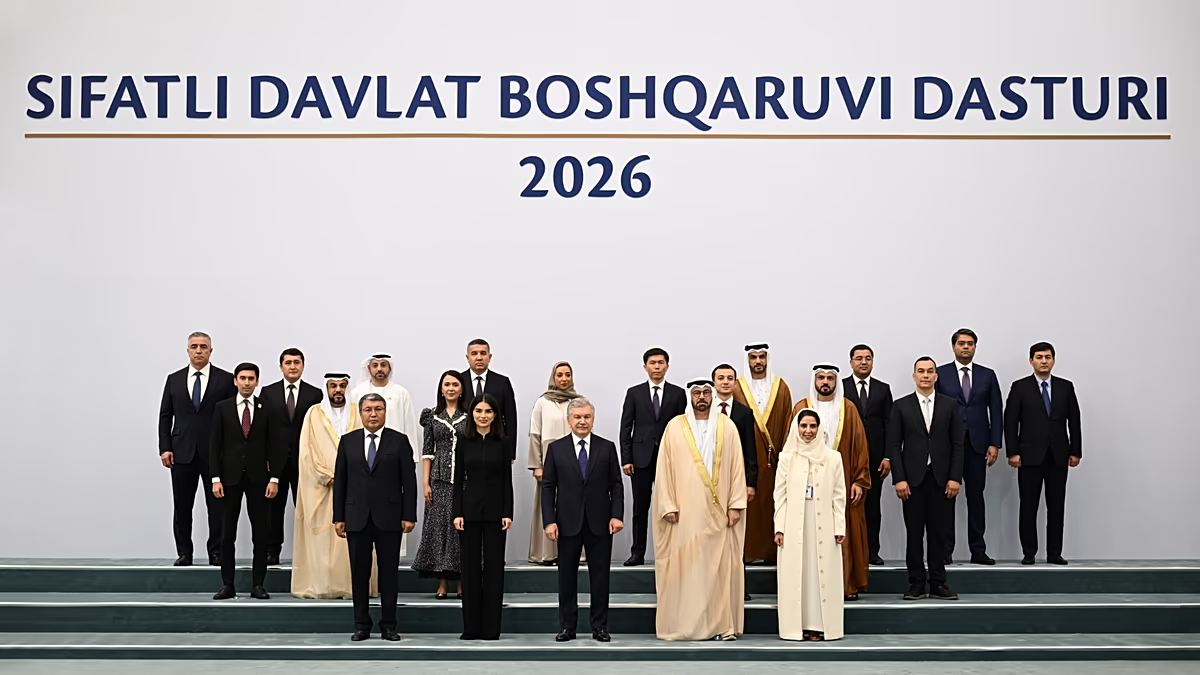



In a significant expansion of its public administration reforms, Uzbekistan has more than doubled the scope of a key performance evaluation programme, supported by the United Arab Emirates. This year, 41 ministries, state agencies, and committees underwent rigorous independent assessment, a notable increase from the 17 institutions reviewed in the previous cycle. The programme, which culminated in an awards ceremony in Tashkattended by President Shavkat Mirziyoyev and UAE Minister of Cabinet Affairs Mohammed Bin Abdullah Al Gergawi, represents a deepening of bilateral cooperation on modernising governance. As governments worldwide increasingly turn to data and metrics to gauge efficiency, Uzbekistan is leveraging this partnership to systematically evaluate its civil service against contemporary benchmarks like digitalisation, transparency, and service delivery, moving beyond traditional, often opaque, bureaucratic measures.
The initiative is fundamentally designed to shift the culture of government from one focused on internal processes to one dedicated to tangible results for citizens. Based on the well-established UAE Government Excellence Programme, it has been operational in Uzbekistan since 2019. As Abdulla Abdukadirov, Director of Uzbekistan’s Agency for Strategic Development and Reforms, explained, the expansion aims to cover not just major ministries but also various committees and agencies. The evaluation methodology, conducted by joint Uzbek-Emirati teams, consciously looks past formal reports to examine how institutions actually function on a daily basis. The core questions, as Abdukadirov outlined, revolve around systematisation and digitalisation: “Are they systematic? Are they digitalised? And is there any gap between the understanding of tasks at different levels?” This practical focus seeks to bridge the gap between policy and implementation.
Concrete examples from the awards ceremony illustrate the tangible impacts sought by the programme. The Ministry of Internal Affairs was highlighted for its achievements in public service delivery, having transitioned 55 of its 62 services to fully electronic platforms, a dramatic increase from around 20 services in 2020. Deputy Interior Minister Zafar Kurbanov emphasized that this allows citizens to complete procedures in minutes through a government portal, saving time and reducing opportunities for bureaucratic delay. Furthermore, the programme has introduced individual award categories to recognise civil servants—including young professionals, HR specialists, and women in leadership—aiming to motivate and validate excellence at a personal level. This human-centric approach underscores the understanding that institutional change is driven by empowered and recognised individuals within the system.
Central to this entire effort is a direct drive to reduce bureaucratic burdens and rebuild public trust. President Mirziyoyev explicitly linked effective problem-solving by state institutions to increased citizen confidence in government. He declared that the principle of “working for results” must become the main criterion for all state bodies, warning that underperforming ministries would face greater public scrutiny in future assessment cycles. This sentiment was echoed by UAE officials, with Assistant Minister Mohammed Bin Taliah pointing to Uzbekistan’s parallel “Zero Bureaucracy” initiative as a complementary and crucial endeavour. The ultimate goal, as articulated by Minister Al Gergawi, is to cultivate “a culture of excellence and innovation in the government sector,” transforming political will into a sustainable, positive work culture that prioritises the citizen experience.
For the civil servants involved, the assessment process carries profound professional and personal significance. Akbarkhon Sobirkhonov, Director of the Innovation Office at the Ministry of Higher Education, Science and Innovation, described the competition as an opportunity for meaningful reflection on nearly a decade of public service and a chance to strategically plan for the future. This introspection is a vital component of the programme’s human impact, fostering a sense of ownership and continuous improvement among officials. The recognition serves not just as a reward, but as a catalyst for further innovation and dedication, embedding the new values of efficiency and transparency within the heart of the administrative corps.
Looking ahead, the next phases of the programme are set to intensify the focus on measurable outcomes, particularly at regional and local levels where citizens most directly interact with the state. The expansion of the assessment framework signifies a commitment to ensuring that reforms penetrate every layer of governance, from central ministries in Tashkent to local service centres across the country. By systematically evaluating performance, celebrating success, and demanding accountability, Uzbekistan aims to solidify a lasting transformation of its public administration—one that consistently prioritises effective service, reduced red tape, and, ultimately, the needs and trust of its people. This partnership with the UAE provides both a tested model and external impetus for a journey of modernisation that is increasingly defined by its results.